
Tony Spiro
February 25, 2026
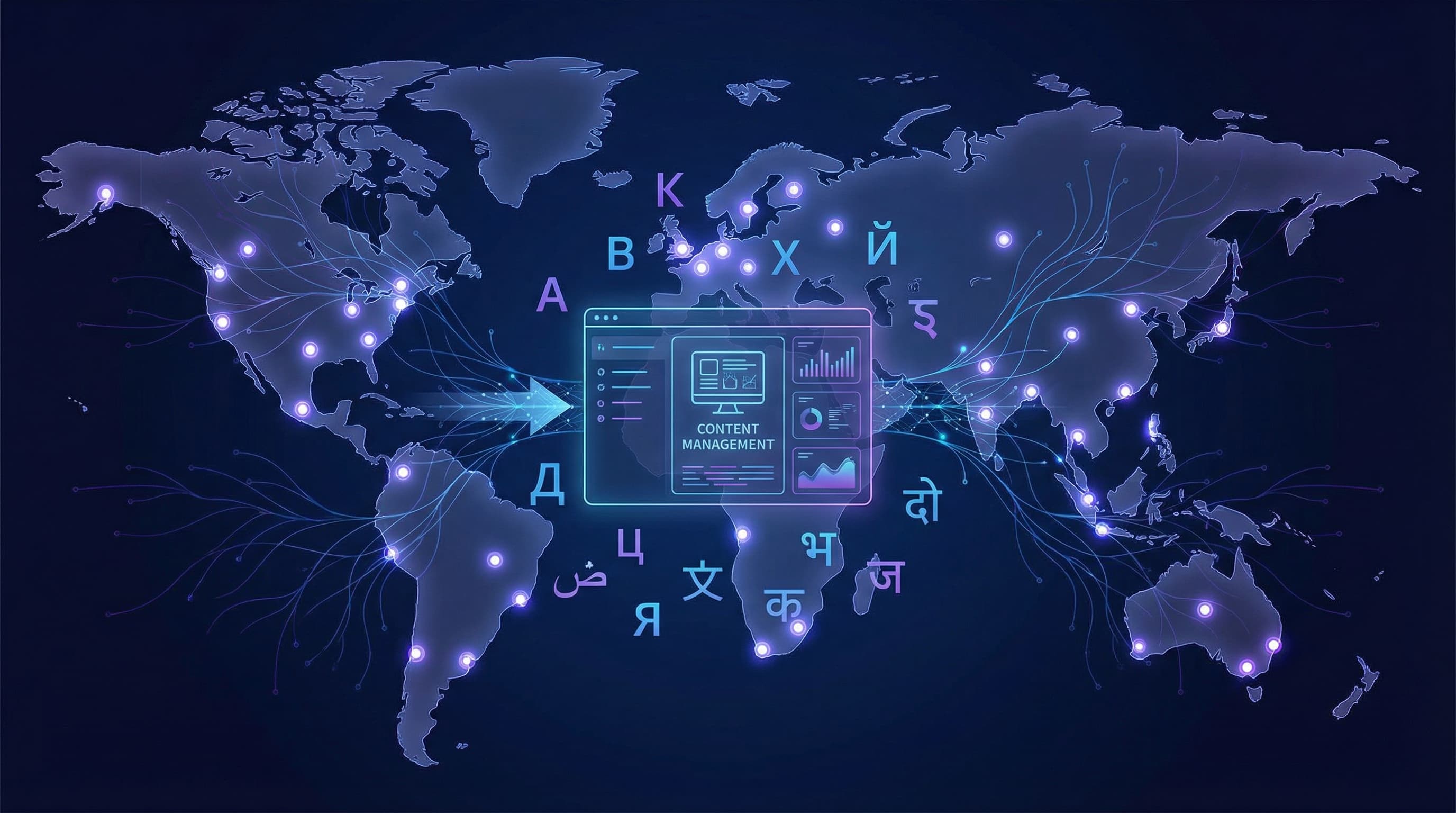
The global content landscape has fundamentally shifted. What once required armies of translators, months of coordination, and budgets that made international expansion prohibitive for most companies has transformed into a streamlined, AI-powered workflow that delivers localized content at unprecedented speed and scale.
For content teams managing international audiences, the combination of modern AI translation capabilities and headless CMS architecture represents a paradigm shift in how global content strategies are executed. This guide explores how to leverage these technologies effectively.
The Evolution of AI Translation Quality
AI translation has matured dramatically. The current generation of language models delivers near-human quality for major languages while continuously improving support for lower-resource languages.
Current AI Translation Capabilities
Large Language Models (GPT-4o, Claude, Gemini)
Modern LLMs excel at contextual translation that preserves meaning, tone, and nuance. Unlike earlier statistical machine translation, these models understand context across paragraphs and can maintain consistent terminology throughout long documents.
Claude demonstrates particularly strong cross-lingual performance, maintaining consistent quality across both widely-spoken and lower-resource languages. This makes it reliable for enterprises targeting diverse global markets.
GPT-4o offers significant multilingual capabilities with the added benefit of handling audio inputs, enabling real-time translation workflows that span text and speech.
Google Gemini provides multi-language support for 17+ languages with integrated text-to-speech functionality, making it valuable for content that needs audio localization.
Specialized Translation APIs
DeepL supports over 80 languages with specialized optimization for translation tasks. Its API integrates cleanly with content workflows and offers consistent quality across European languages in particular.
These tools aren't competing, they're complementary. Smart localization strategies often combine specialized translation APIs for bulk content with LLMs for nuanced marketing copy that requires brand voice preservation.
Headless CMS Architecture for Multi-Language Content
Traditional CMS platforms struggle with localization. Content is often locked into page structures that don't translate well across languages with different text lengths, reading directions, or cultural conventions.
Headless architecture solves this by separating content from presentation entirely.
How Cosmic Handles Localization
Cosmic's approach to localization treats each language as a first-class citizen in your content model. Content is stored with locale identifiers, and the API supports locale-based queries that return the appropriate version automatically.
// Fetching Spanish content
const spanishPosts = await cosmic.objects
  .find({ type: 'posts', locale: 'es' })
  .props('title,slug,metadata.content')
This architecture enables several powerful patterns:
Parallel Content Development: Teams can work on English and localized versions simultaneously without blocking each other.
Selective Localization: Not every piece of content needs translation. Product documentation might need full localization while internal announcements stay in the original language.
Regional Variations: Support for locale variants (en-US, en-GB, en-AU) allows subtle regional differences without duplicating entire content libraries.
The Hybrid Workflow: AI Translation with Human Review
The most effective localization strategies don't choose between AI and human translators, they combine both strategically.
The Recommended Workflow
Stage 1: AI First Pass
Content enters the localization pipeline and receives AI translation across all target languages simultaneously. This stage handles 80-90% of the work in minutes rather than days.
Stage 2: Human Review
Native speakers review AI output, focusing on:
- Brand voice consistency
- Cultural appropriateness
- Industry-specific terminology
- Marketing messages that require localization rather than translation
Stage 3: Quality Assurance
Automated checks verify completeness, link validity, and format consistency before publishing.
This hybrid approach typically reduces localization costs by 60-80% compared to traditional human-only workflows while maintaining quality standards that pure AI translation cannot yet guarantee.
Cost Analysis: Making the Business Case
The economics of AI-assisted localization are compelling.
Traditional Human Translation
- Cost: $0.10-0.30 per word
- Timeline: Days to weeks per language
- Scalability: Linear cost increase with content volume
AI Translation APIs
- Cost: $0.00002-0.02 per word (depending on model)
- Timeline: Minutes for any volume
- Scalability: Near-zero marginal cost increase
Hybrid Approach (Recommended)
- AI translation: ~$0.001 per word
- Human review: ~$0.03-0.05 per word
- Total: ~$0.04-0.06 per word
- Quality: Comparable to human-only translation
For a 10,000-word website:
- Human-only: $1,000-3,000 per language
- Hybrid: $400-600 per language
- Savings: 60-80%
International SEO Considerations
Localized content only delivers value if search engines can properly index and serve it to the right audiences.
Essential Technical Requirements
hreflang Implementation
Google uses hreflang tags to understand which language version to show users. Proper implementation prevents duplicate content issues and ensures users see content in their preferred language.
<link rel="alternate" hreflang="en" href="https://example.com/page" />
<link rel="alternate" hreflang="es" href="https://example.com/es/page" />
<link rel="alternate" hreflang="de" href="https://example.com/de/page" />
<link rel="alternate" hreflang="x-default" href="https://example.com/page" />
URL Structure Options
Three primary approaches exist:
- Subdirectories (example.com/es/): Easiest to implement, shares domain authority
- Subdomains (es.example.com): More separation, slightly more complex
- Country-code TLDs (example.es): Strongest geographic signal, highest overhead
For most businesses, subdirectories offer the best balance of SEO benefit and operational simplicity.
Content Parity
Search engines expect localized versions to contain equivalent content. Partial translations or placeholder content can harm rankings across all language versions.
Implementation Patterns with Cosmic
Pattern 1: Full Automation for High-Volume Content
For content types that need rapid localization without significant brand voice concerns (support documentation, product specifications, FAQs), full automation works well.
Cosmic's webhook system can trigger translation workflows automatically when content is published:
- English content publishes
- Webhook triggers translation function
- AI translates to all target languages
- Translated versions save as drafts or publish directly
Pattern 2: AI-First with Review Queue
For marketing content, blog posts, and customer-facing materials:
- Content publishes in primary language
- AI generates translations
- Translations enter review queue with native speaker assignments
- Reviewers approve, edit, or flag for revision
- Approved content publishes
Pattern 3: Template Translation
For applications where the UI chrome needs localization but content remains in the original language:
- Identify all UI strings (buttons, labels, navigation)
- Translate UI elements once
- Main content serves in original language
- Users see localized interface around original content
This pattern reduces localization load significantly for content-heavy applications where full translation isn't feasible.
Automating Localization Updates with Cosmic AI Workflows
One of the most powerful localization patterns in Cosmic is using AI Workflows to automatically update all localized versions when your primary language content changes. Instead of manually re-translating and updating each locale, you can configure an event-triggered workflow that handles the entire process autonomously.
Example: Auto-Update Localized Content on Edit
This workflow listens for edits to your primary language content and automatically propagates changes to every target locale.
Trigger: Object Edited (articles, filtered to en-US locale)
Step 1 (Content Agent): Detect what changed and translate
When the triggered object is edited and its locale is "en-US":
1. Compare the updated fields with the previous version.
2. Translate only the changed fields into Spanish (es), French (fr), and German (de).
3. Preserve any human-reviewed translations for unchanged fields.
4. Save each localized version as a draft for review.
5. Send an email notification summarizing the updates and languages affected.
Step 2 (Content Agent): Validate and publish
For each localized draft created in Step 1:
1. Verify that all required fields are populated.
2. Check that metadata (SEO title, description, Open Graph tags) is present in the target language.
3. If validation passes and the source object is published, publish the localized versions.
4. If validation fails, flag the object for human review and send a notification with the specific issues.
This two-step workflow ensures that localized content stays in sync with your source material without requiring manual intervention. The first step handles intelligent, context-aware translation of only the fields that changed, while the second step acts as a quality gate before anything goes live.
Why This Pattern Works
Cosmic AI Workflows support event triggers that fire automatically when objects are created, edited, published, or deleted. When an event triggers your workflow, context data including the object type, ID, title, slug, status, locale, and all metadata fields is passed into every step. This means each Content Agent step can make smart decisions based on exactly what changed and in which locale, without any manual configuration per content update.
You can also add approval gates between steps for high-stakes content like legal pages or regulated product descriptions, pausing the workflow until a human reviewer approves the translations before they publish.
Extending the Pattern
This same workflow structure scales to more complex scenarios:
- Add a Computer Use Agent step to capture screenshots of each localized page after publishing, verifying that layouts render correctly with translated text lengths.
- Chain a Code Agent step to automatically update hreflang sitemaps or regenerate static pages in your frontend framework after new localized content publishes.
- Schedule a recurring workflow that runs weekly to audit all localized content for drift, flagging any source-language updates that were not yet propagated to all target locales.
For teams managing content across multiple markets, this event-driven approach eliminates the most common localization bottleneck: the delay between updating source content and having those changes reflected across every language version.
Preserving Brand Voice Across Languages
The biggest challenge in AI translation isn't accuracy, it's consistency. A brand that sounds confident and direct in English might come across as aggressive in Japanese or overly casual in German.
Strategies for Brand Consistency
Create Language-Specific Style Guides
Document how your brand voice should manifest in each target language. Include:
- Preferred terminology
- Tone adjustments for cultural context
- Examples of good and bad translations
Use Translation Memory
Build a database of approved translations for key terms and phrases. Feed this context to AI models and human reviewers to ensure consistency.
Establish Review Criteria
Give reviewers specific checkpoints:
- Does this sound like our brand?
- Would a native speaker find this natural?
- Are calls-to-action culturally appropriate?
Getting Started
Implementing AI-powered localization doesn't require a massive upfront investment. Start with these steps:
1. Audit Your Content
Identify which content types would benefit most from localization. Prioritize high-traffic pages and conversion-focused content.
2. Choose Your Languages
Start with 2-3 languages where you have existing demand or market opportunity. Expand as you validate the workflow.
3. Set Up Your Pipeline
Configure your Cosmic bucket for localization, integrate your chosen translation APIs, and establish the review workflow. Cosmic supports auto-translating content with AI directly from the dashboard, giving you an immediate starting point before building out more advanced automation.
4. Train Your Reviewers
Even AI-assisted workflows need human judgment. Invest in training native speakers on your brand voice and quality standards.
5. Measure and Iterate
Track metrics that matter: translation quality scores, time-to-publish, cost per word, and most importantly, business outcomes in localized markets.
The Future of Content Localization
AI translation quality continues to improve rapidly. Models are getting better at preserving nuance, understanding context, and maintaining consistency across long documents.
But the fundamental architecture decision, using a headless CMS that treats localization as a first-class feature, will remain valuable regardless of how AI evolves. The flexibility to swap translation providers, adjust workflows, and scale to new languages without restructuring your entire content infrastructure is the real competitive advantage.
For teams managing global content operations, the question isn't whether to adopt AI-assisted localization, but how quickly you can implement it effectively. The cost savings, speed improvements, and scalability benefits are too significant to ignore.
The combination of modern AI translation capabilities with a headless CMS architecture like Cosmic provides the foundation for global content strategies that would have been impossible, or prohibitively expensive, just a few years ago. The technology is ready. The question is whether your content operations are ready to take advantage of it.