ContentOps Explained: Building a Modern Content Operations Framework for Your Team

Cosmic AI
March 5, 2026
Content teams are producing more than ever. Blog posts, social campaigns, product documentation, email sequences, video scripts: the demand is relentless. Yet most organizations still manage content the same way they did a decade ago: scattered tools, tribal knowledge, and workflows held together by Slack threads and spreadsheets.
This is where ContentOps comes in.
What Is ContentOps?
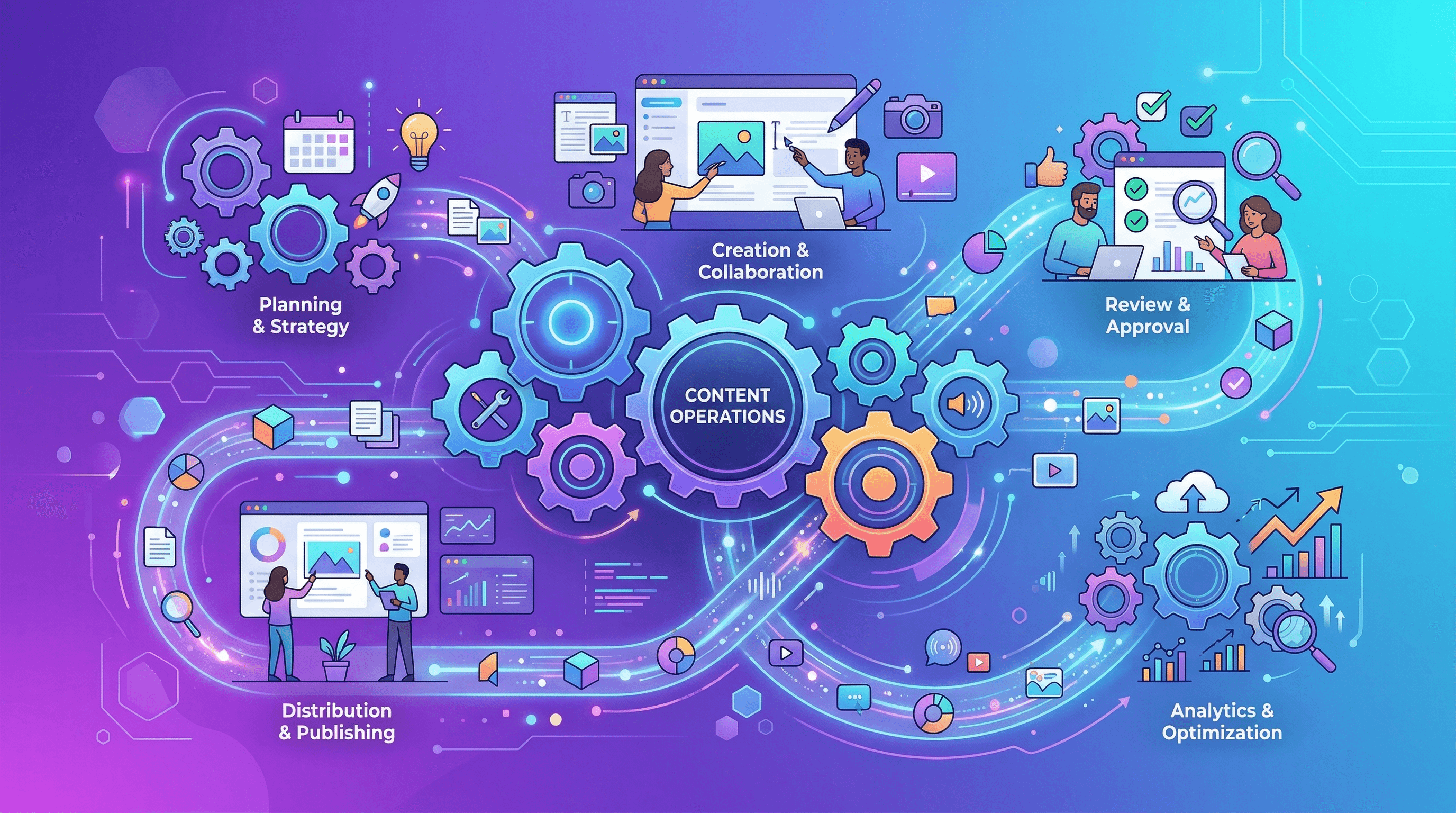
ContentOps, short for Content Operations, is the discipline of systematizing how content gets created, managed, and distributed across an organization. Think of it as the operational backbone that transforms chaotic content production into a repeatable, scalable system.
The Content Marketing Institute defines ContentOps as "the set of processes, people, and tools required to support the strategic, efficient, and consistent production and distribution of content."
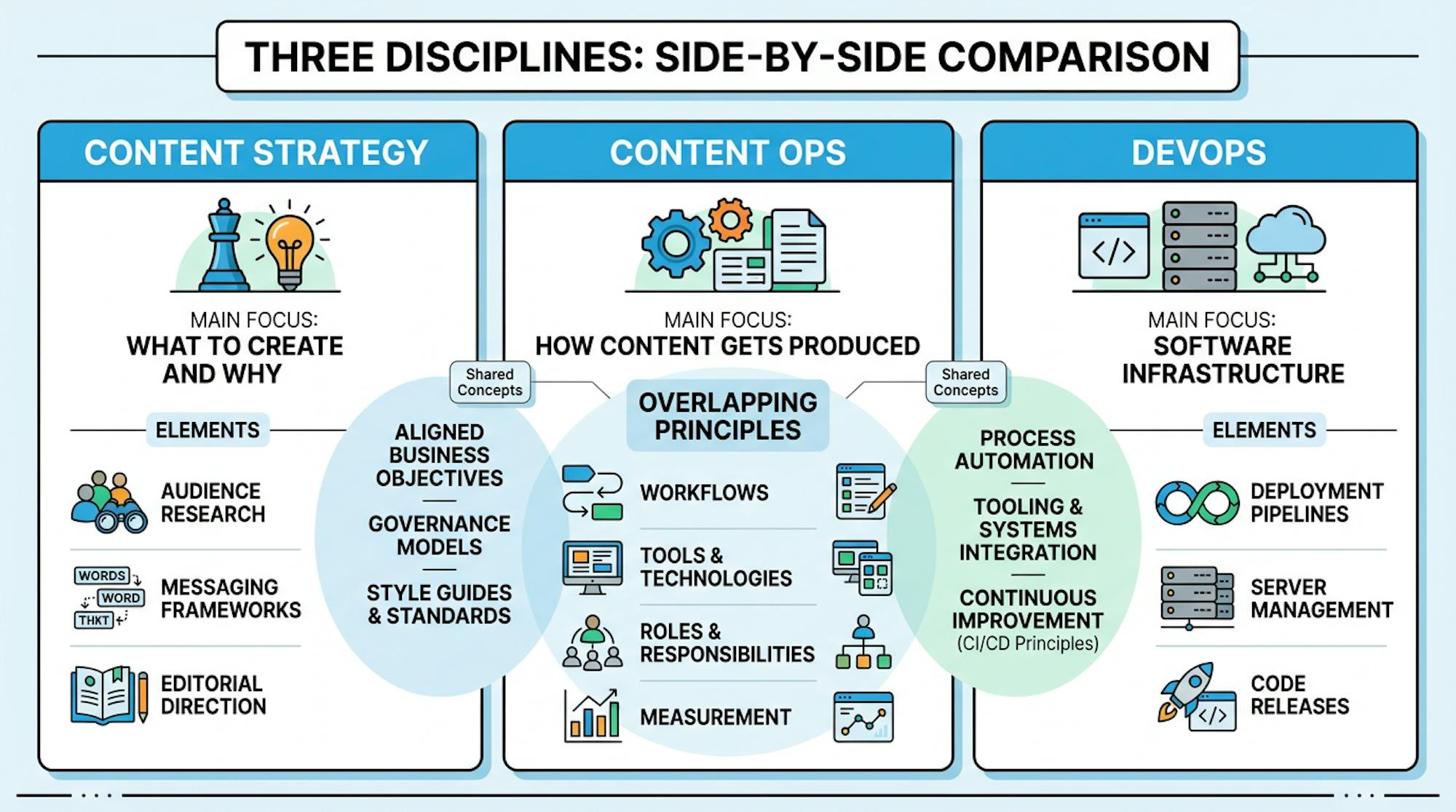
ContentOps is distinct from related disciplines:
- Content Strategy focuses on what to create and why: audience research, messaging frameworks, editorial direction
- DevOps focuses on software infrastructure: deployment pipelines, server management, code releases
- ContentOps focuses on how: the workflows, tools, roles, and measurements that enable content production at scale
ContentOps sits at the intersection of content marketing, operations management, technology, and organizational design. It's less about creative decisions and more about removing friction so creative work can happen faster.
Why ContentOps Matters Now
The pressure on content teams has intensified. Organizations that implement structured ContentOps practices report significant improvements:
- 40-60% reduction in time-to-publish
- 35% increase in content output without adding headcount
- 50% decrease in content errors and compliance issues
- 25% improvement in content performance metrics
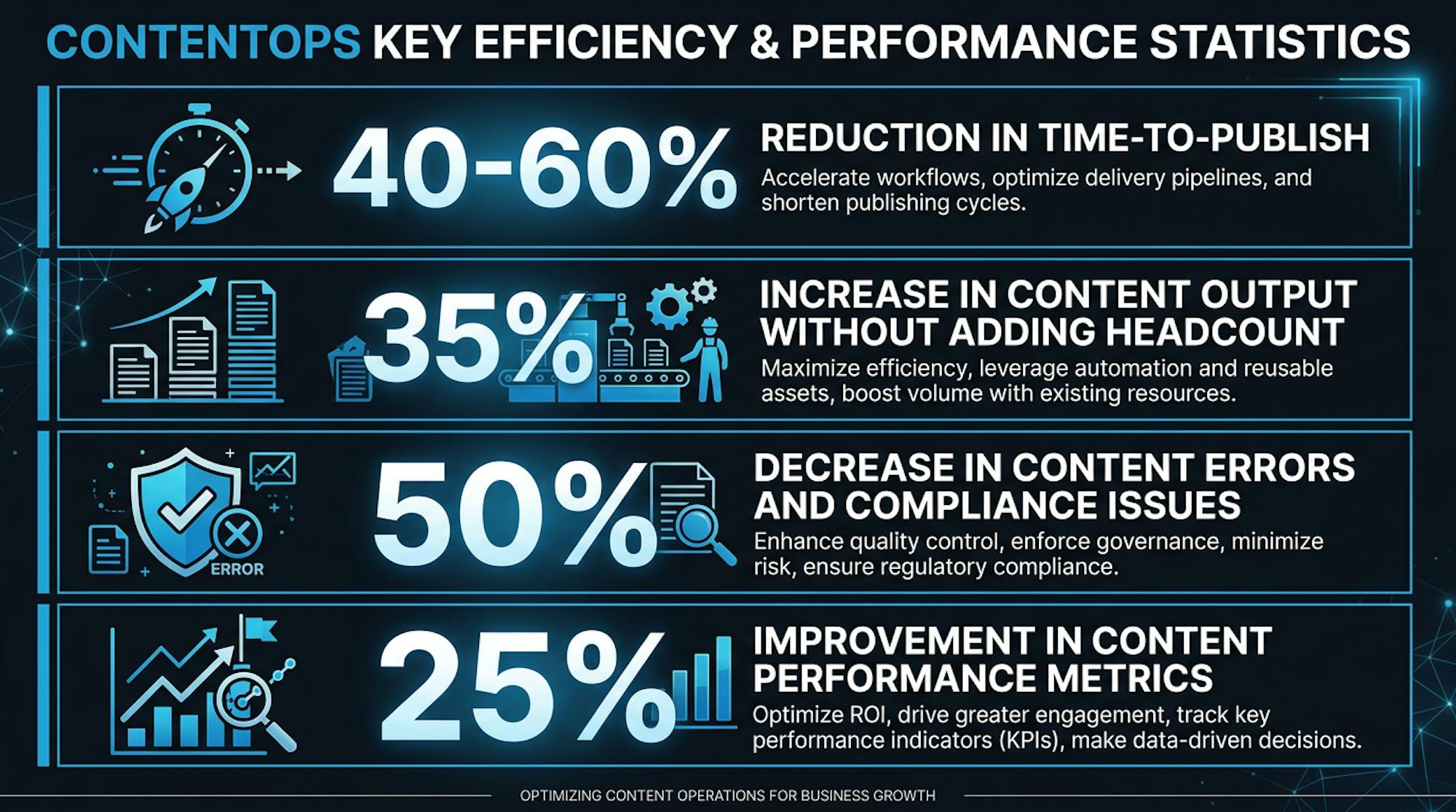
These aren't theoretical gains. They come from replacing ad-hoc processes with documented workflows, eliminating approval bottlenecks, and using automation for repetitive tasks.
The rise of AI-assisted content creation has only accelerated this need. AI can generate drafts in seconds, but without operational infrastructure, those drafts become another pile of unreviewed content sitting in a queue.
The Seven Pillars of ContentOps
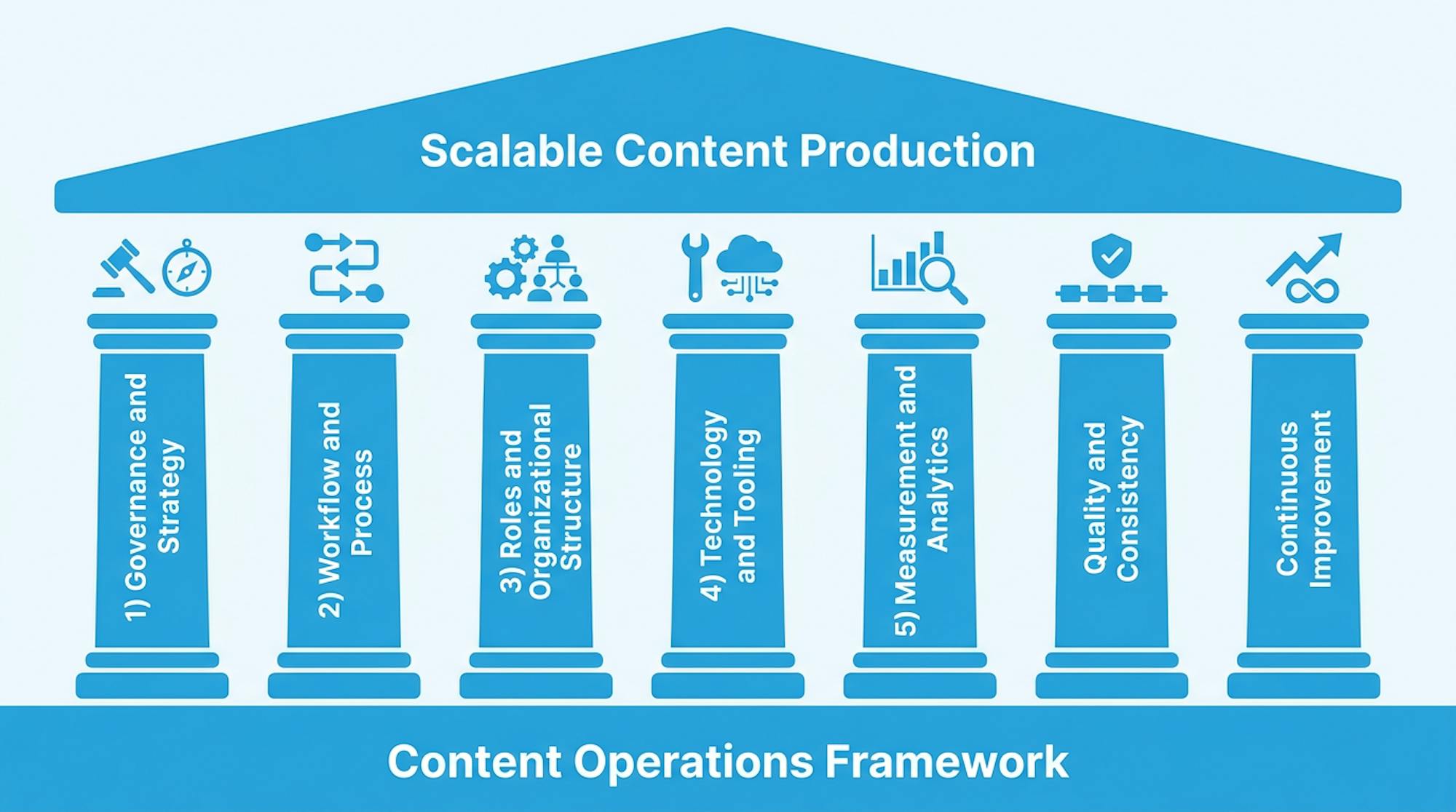
A mature ContentOps framework rests on seven interconnected pillars. Each pillar addresses a specific operational challenge.
Pillar 1: Governance and Strategy
Governance establishes the rules of engagement. Without it, every piece of content becomes a negotiation.
Key components:
- Content standards and style guides
- Brand voice documentation with examples
- Approval workflows with clear decision-making authority
- Compliance requirements and risk management protocols
- Editorial calendar ownership and planning processes
Governance answers questions before they arise: Who can publish? What requires legal review? How do we handle controversial topics?
Pillar 2: Workflow and Process
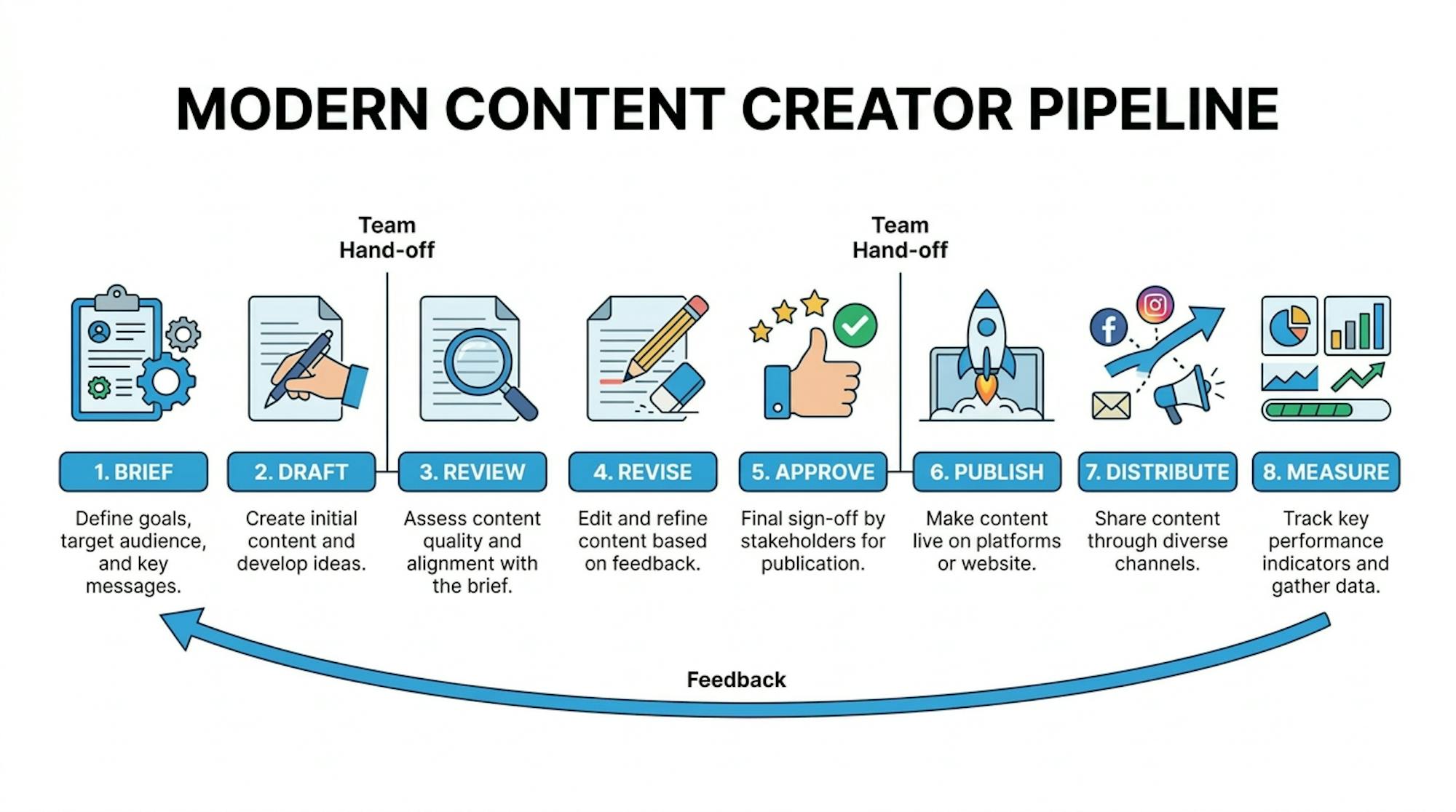
Workflow design determines how content moves from idea to publication. Poor workflows create bottlenecks; good workflows create momentum.
Key components:
- Standardized creation workflows (brief → draft → review → publish)
- Hand-off procedures between teams (design to development, marketing to sales)
- Template libraries for repeatable content types
- Integration points with other business processes
- Change management procedures when workflows evolve
The goal is predictability. When a new blog post enters the pipeline, everyone knows exactly what happens next.
Pillar 3: Roles and Organizational Structure
ContentOps requires clear role definition. Ambiguity leads to dropped balls and duplicated effort.
Common ContentOps roles:
- Content Strategist/Planner: Owns the editorial calendar and content direction
- Content Creators: Writers, designers, videographers producing assets
- Content Editor/QA: Reviews for quality, accuracy, and brand consistency
- Publishing Specialist: Manages distribution across channels
- Analytics Lead: Tracks performance and reports insights
- ContentOps Manager: Coordinates the entire system
Smaller teams combine these roles; larger organizations may have entire departments for each function.
Pillar 4: Technology and Tooling
The right tools amplify human effort. The wrong tools create friction and technical debt.
Essential ContentOps stack:
- Headless CMS: Central content repository with API-driven delivery
- Workflow Automation: Tools like Make, Zapier, or n8n to connect systems
- Collaboration Platform: Where teams coordinate work in real-time
- Analytics Platform: For measuring content performance
- AI Assistants: For drafting, optimization, and research acceleration
A headless CMS like Cosmic becomes the operational hub. Content stored once can be distributed everywhere (web, mobile, email, social) through APIs. Features like AI Agents automate routine tasks, webhooks trigger downstream workflows, and built-in collaboration tools keep teams aligned.
Pillar 5: Measurement and Analytics
What gets measured gets managed. ContentOps requires clear metrics tied to business outcomes.
Key metrics:
- Time-to-publish: How long from brief to live content?
- Content velocity: How many pieces published per period?
- Cost-per-content: Total investment divided by output
- Performance metrics: Engagement, conversions, SEO rankings
- ROI tracking: Revenue attributed to content efforts
The best ContentOps teams create dashboards that surface these metrics automatically, eliminating manual reporting.
Pillar 6: Quality and Consistency
Scale without quality is just noise. ContentOps must enforce standards at every stage.
Quality mechanisms:
- Content templates with required fields
- Automated quality checks (spelling, links, SEO elements)
- Peer review processes with clear criteria
- Brand consistency enforcement through design systems
- Accessibility compliance verification
Pillar 7: Continuous Improvement
ContentOps is never finished. The best teams build feedback loops into their operations.
Improvement practices:
- Regular process audits (quarterly reviews of what's working)
- Team retrospectives after major campaigns
- Competitive content analysis
- Tool effectiveness reviews
- Capacity planning based on historical data
Common ContentOps Challenges (and Solutions)
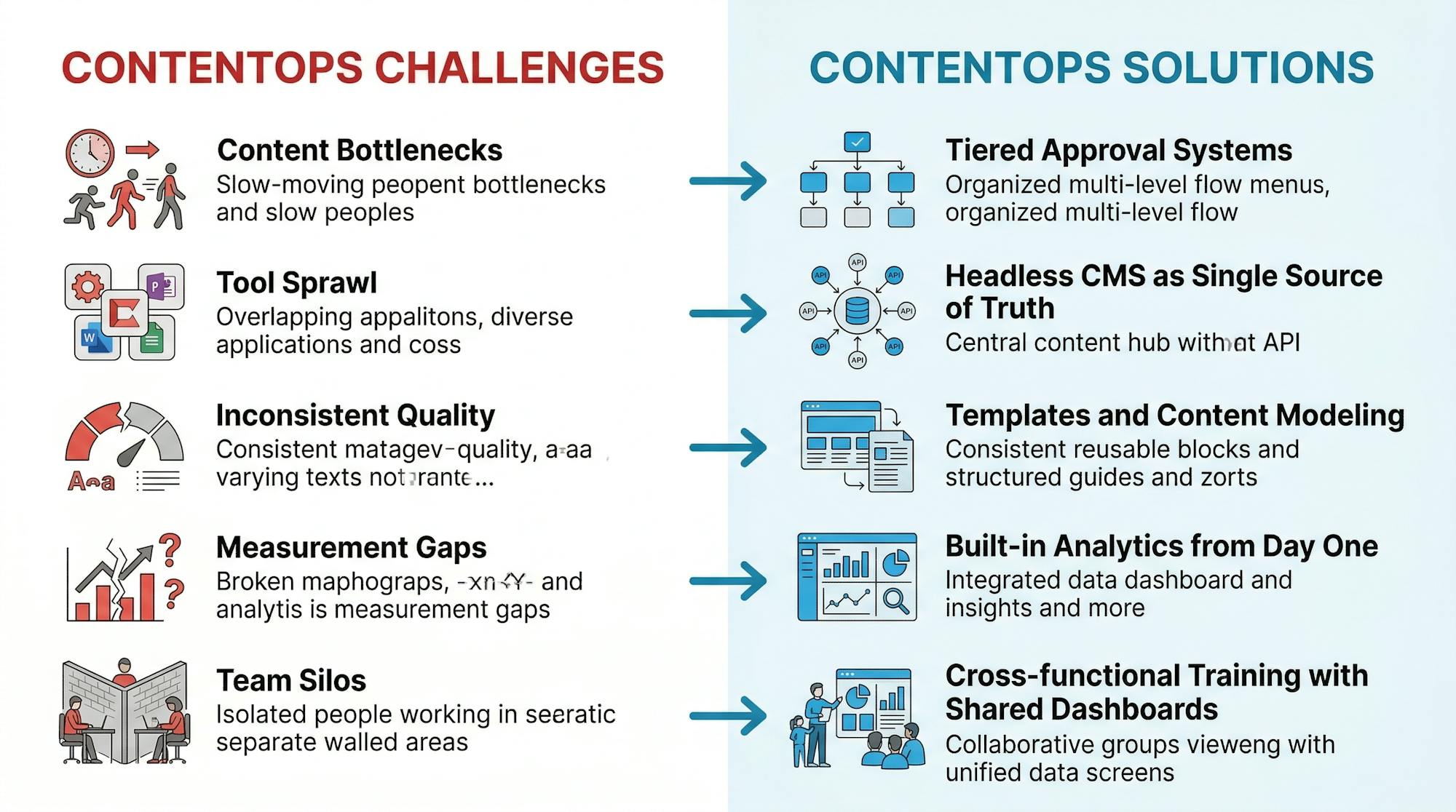
Challenge: Content Bottlenecks
Problem: Everything stalls waiting for approval from the same person.
Solution: Tiered approval systems. Routine content follows a fast track; only high-risk content requires senior review.
Challenge: Tool Sprawl
Problem: Teams use 15 different tools that don't talk to each other.
Solution: Consolidate around a headless CMS as the single source of truth, with webhooks connecting to specialized tools only where necessary.
Challenge: Inconsistent Quality
Problem: Different creators produce wildly different outputs.
Solution: Templates and style guides enforced through content modeling. When your CMS requires specific fields and formats, consistency becomes automatic.
Challenge: Measurement Gaps
Problem: Leadership asks for ROI numbers; the team has no data.
Solution: Build analytics into the workflow from day one. Tag content with campaigns, track UTM parameters, and connect content to conversion data.
Challenge: Team Silos
Problem: Creators don't understand operations; operations don't understand creative constraints.
Solution: Cross-functional training and shared metrics. When everyone sees the same dashboards, alignment follows.
Implementing ContentOps: A Practical Approach
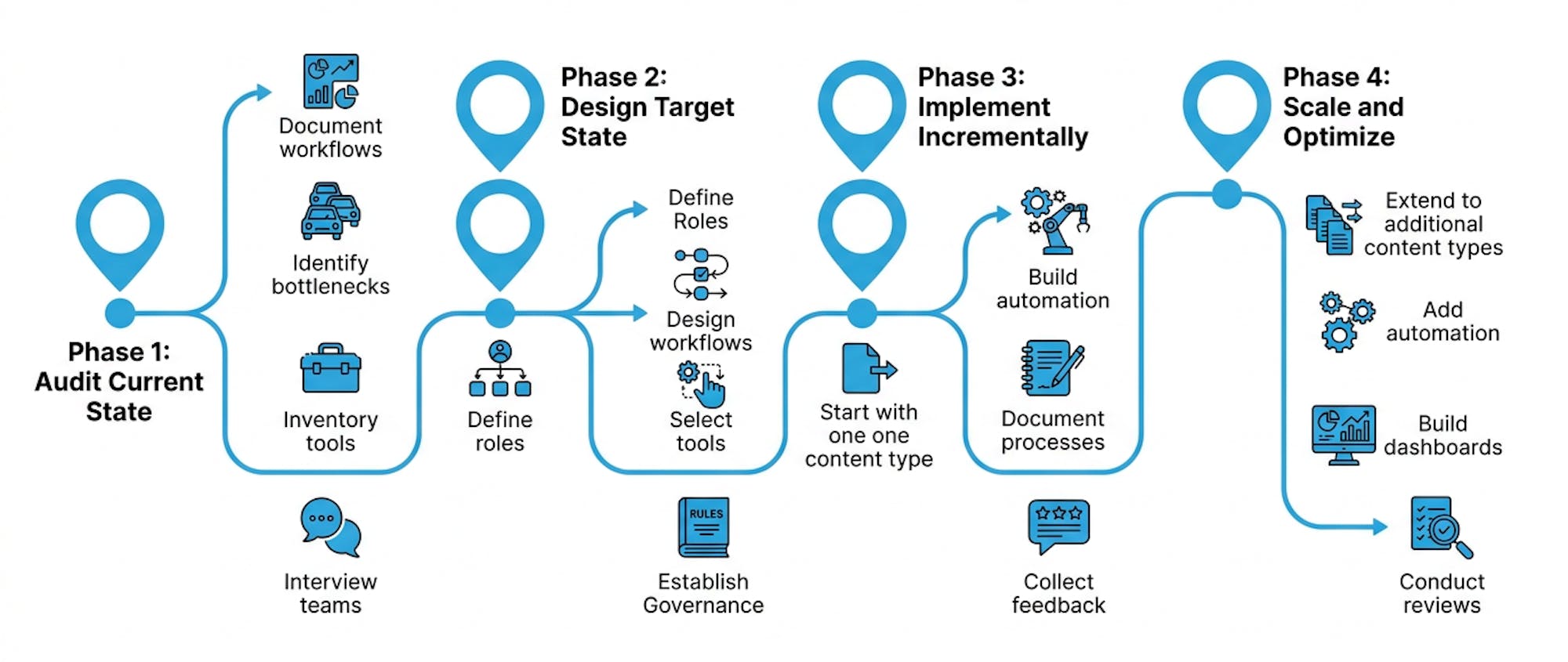
You don't implement ContentOps by buying software. You implement it by changing how your team works.
Phase 1: Audit Current State
- Document existing workflows (even if messy)
- Identify bottlenecks and pain points
- Inventory current tools and their usage
- Interview team members about friction
Phase 2: Design Target State
- Define clear roles and responsibilities
- Design streamlined workflows
- Select core tools (prioritize integration capability)
- Establish governance policies
Phase 3: Implement Incrementally
- Start with one content type or team
- Build automation gradually
- Document everything as you go
- Collect feedback and iterate
Phase 4: Scale and Optimize
- Extend processes to additional content types
- Add automation for repetitive tasks
- Build dashboards for visibility
- Conduct regular reviews and improvements
How Cosmic Supports ContentOps
A headless CMS designed for operational excellence makes ContentOps implementation dramatically easier. Cosmic provides the infrastructure that content teams need to move from chaos to clarity.
AI Agents handle routine content tasks, from generating drafts and optimizing existing content to creating variations, freeing human creators for higher-value work. Three specialized agents (Content, Code, and Computer Use) each excel in their domain and integrate directly with your CMS.
Workflows chain multiple operations together. A single trigger can create content, generate images, update SEO fields, and notify stakeholders. Run them on a schedule or trigger them from content events for fully automated pipelines.
Webhooks connect your CMS to every other tool in your stack. When content publishes, automatically update your search index, trigger social posts, or notify your analytics platform.
Real-time Collaboration with comments, roles, and permissions keeps feedback in context, eliminating the Slack-and-email chaos that derails most content teams.
Flexible Content Modeling lets you build exactly the data structures your workflow needs, without forcing content into rigid templates designed for someone else's use case.
Ready to see it in action? Explore the Cosmic documentation to learn how to set up your first project, or browse community projects built by real teams to see what's possible.
The Future of ContentOps
ContentOps is evolving rapidly. Several trends are reshaping the discipline:
AI-Native Workflows: AI isn't just assisting content creation. It's becoming embedded in every operational step, from brief generation to performance prediction.
Composable Content Architecture: Content stored as modular components that can be assembled differently for each channel, reducing duplication and maintenance.
Real-Time Personalization: Operations designed to deliver dynamically customized content at scale, requiring new measurement and governance approaches.
Predictive Analytics: Using historical data to forecast content performance before publication, enabling smarter resource allocation.
Getting Started
ContentOps isn't a destination. It's a practice. Start where you are:
- Pick your biggest bottleneck
- Document the current workflow
- Design one improvement
- Implement and measure
- Repeat
The teams that master ContentOps don't just produce more content. They produce the right content, faster, with less stress, and with clear visibility into what's working.
That's the operational advantage that separates content teams that scale from those that burn out.