
Tony Spiro
February 5, 2026
Updated August 26, 2026
Anthropic recently released Claude Opus 4.6 with an impressive claim: improvements across agentic coding, computer use, tool use, search, and finance that make it "an industry-leading model, often by a wide margin." We put it to the test.
Today, I want to share what we discovered by building blog applications with both Opus 4.6 and Opus 4.5 using a simple one-shot prompt through the Cosmic AI Platform.
Last updated: August 26, 2026. This revision changed internal links and CTA tracking only. Model, benchmark, and pricing claims are accurate as of the original February 5, 2026 publication date and were not re-verified in this pass.
The Experiment: One Prompt, Two Models
To understand the real differences between these models, we ran a controlled experiment. We gave both Claude Opus 4.6 and Opus 4.5 the same straightforward prompt:
"Create a blog with posts, authors, and categories"
Both applications were built entirely through natural language using the Cosmic AI Platform. No manual coding required. Here are the results:
Blog built with Opus 4.6 (Clone the project)
Blog built with Opus 4.5 (Clone the project)
🚀 Build AI-powered content workflows with Cosmic
The AI-native headless CMS with built-in AI Agents, REST API with sub-100ms responses, and a forever-free plan.
How Opus 4.6 Compares to the Competition
Before diving into our real-world comparison, here is how Claude Opus 4.6 stacks up against Opus 4.5, Sonnet 4.5, Gemini 3 Pro, and GPT-5.2 across a range of industry benchmarks:
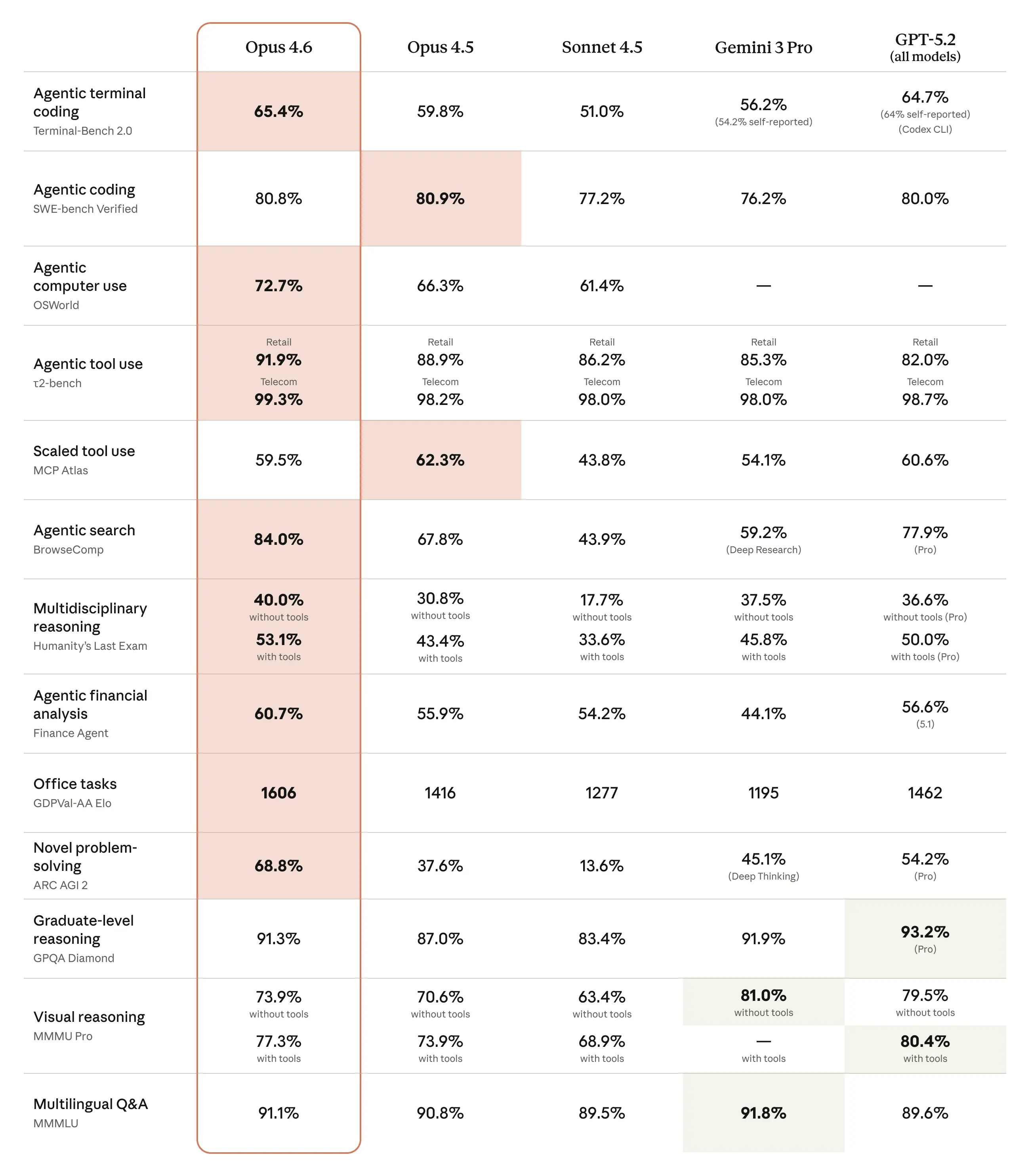
The numbers tell a compelling story. Opus 4.6 leads in agentic terminal coding (65.4% on Terminal-Bench 2.0), agentic computer use (72.7% on OSWorld), agentic search (84.0% on BrowseComp), multidisciplinary reasoning (53.1% with tools on Humanity's Last Exam), agentic financial analysis (60.7% on Finance Agent), office tasks (1606 Elo on GDPVal-AA), and novel problem-solving (68.8% on ARC AGI 2). These are not marginal gains. In several categories, Opus 4.6 outpaces its predecessor by significant margins.
Key Differences We Observed
1. Architecture and Code Quality
The most striking difference was in how each model approached the application architecture:
Opus 4.5 delivered a clean, well-organized blog with thoughtful features including:
- Streamlined navigation (Home, Categories, Authors)
- Cleaner visual hierarchy with emoji accents
- Dedicated Authors page for content attribution
- More focused content presentation
- Simple footer structure with clear sections
Opus 4.6 took a more refined and visually polished approach:
- Elegant branding with the "Inkwell" name and pen emoji identity
- A curated editorial feel with a "Stories that inspire, ideas that matter" tagline
- Featured Article section with prominent visual imagery
- Category browsing directly on the homepage
- Stronger visual design with richer image presentation
Where Opus 4.5 demonstrated good architectural instincts, Opus 4.6 elevated the result. The model seemed to reason more deeply about what makes a blog feel complete and professional, not just functional. This aligns with Anthropic's description that Opus 4.6 "brings more focus to the most challenging parts of a task without being told to."
2. User Experience and Design
Both models created modern, responsive designs, but with distinctly different levels of sophistication:
Opus 4.5 produced a solid, minimal design:
- Clean typography and whitespace
- Functional category and author pages
- Emoji-enhanced visual identity
- Straightforward content presentation
Opus 4.6 demonstrated a leap in design quality:
- Hero section with engaging copy and clear calls-to-action
- Featured article with large, high-quality imagery
- More sophisticated content card layouts
- A more magazine-like editorial presentation
- Better visual hierarchy that guides the reader's eye
As one of Anthropic's Early Access partners noted: "Claude Opus 4.6 is an uplift in design quality. It works beautifully with design systems and it's more autonomous." We saw this reflected directly in our results. Opus 4.6 made stronger creative decisions without additional prompting.
3. Content Strategy and Reasoning
This is where Opus 4.6's enhanced reasoning capabilities were most evident:
Opus 4.5 made solid architectural decisions:
- Dedicated Authors page (anticipating content attribution needs)
- Dedicated Categories page (better content organization)
- Clean separation of concerns
- Scalable information architecture
Opus 4.6 went further with more sophisticated content strategy:
- Created a cohesive brand identity ("Inkwell") rather than a generic blog name
- Crafted compelling sample content (e.g., "Hidden Gems of the Portuguese Coast")
- Designed the homepage as a curated editorial experience
- Made content categories immediately browsable from the hero section
- Chose more visually engaging and diverse content topics
Anthropic highlighted that Opus 4.6 "handles ambiguous problems with better judgment" and "stays productive over longer sessions." We saw this manifest in how the model thought about the blog holistically, treating it as a product experience rather than a collection of pages.
4. Long-Context and Focus Improvements
One of the most significant technical improvements in Opus 4.6 is its handling of long context. According to Anthropic's announcement, on the 8-needle 1M variant of MRCR v2, Opus 4.6 scores 76% compared to Sonnet 4.5's 18.5%. This is described as "a qualitative shift in how much context a model can actually use while maintaining peak performance."
In practical terms, this means Opus 4.6 is better at:
- Maintaining consistency across an entire application build
- Keeping design decisions coherent from start to finish
- Tracking all the requirements from a prompt without dropping details
For our one-shot blog build, this translated into a more cohesive final product where every element felt intentionally designed rather than assembled.
5. New Developer Features
Opus 4.6 ships alongside several new platform capabilities that enhance the development experience:
Adaptive Thinking: Previously, developers had a binary choice between enabling or disabling extended thinking. Now, Claude can decide when deeper reasoning would be helpful. At the default effort level (high), the model uses extended thinking when useful.
Context Compaction: Long-running conversations and agentic tasks often hit the context window. Context compaction automatically summarizes and replaces older context when the conversation approaches a configurable threshold.
1M Token Context (Beta): Opus 4.6 is the first Opus-class model with a 1M token context window, enabling work with much larger codebases and document sets.
128k Output Tokens: Opus 4.6 supports outputs of up to 128k tokens, letting Claude complete larger tasks without breaking them into multiple requests.
Agent Teams: In Claude Code, you can now assemble agent teams to work on tasks together, spinning up multiple agents that coordinate autonomously.
Giving an Agent Safe Access to Your Content
Agent teams and million-token context windows change what you can reasonably hand to an agent. They also raise a question you have to answer before you hand it anything: what is this agent actually allowed to change? Code has branches, pull requests, and CI standing between a bad decision and production. Content usually has none of that. An agent holding a full-access API key can rewrite a live page with nothing in the way.
That gap is the part Cosmic handles. The Cosmic MCP server connects Claude Code, Cursor, or any MCP client to your content with read and write keys scoped per bucket, so an agent can query and update real objects without holding credentials to everything else you run. If you want the permission model explained before you wire anything up, we covered it in AI agent write access: the CMS controls you actually need.
And if the app your agent is building is a React or Next.js front end, the content layer is worth choosing deliberately rather than defaulting to whatever the model scaffolds. We compared the options in the best headless CMS for React and Next.js.
Start free with Cosmic and connect your first agent in a few minutes. The free plan includes 1 Bucket, 2 team members, and 1,000 Objects.
What Industry Leaders Are Saying
Anthropic's announcement featured testimonials from major technology companies that reinforce what we observed:
On Planning and Reasoning:
- "Claude Opus 4.6 is a huge leap for agentic planning. It breaks complex tasks into independent subtasks, runs tools and subagents in parallel, and identifies blockers with real precision." - Sourcegraph
- "Claude Opus 4.6 reasons through complex problems at a level we haven't seen before. It considers edge cases that other models miss." - JetBrains
On Autonomy and Quality:
- "Claude Opus 4.6 autonomously closed 13 issues and assigned 12 issues to the right team members in a single day, managing a ~50-person organization across 6 repositories." - Cognition
- "Claude Opus 4.6 is an uplift in design quality. It works beautifully with our design systems and it's more autonomous." - Lovable
On Long-Running Tasks:
- "Claude Opus 4.6 handled a multi-million-line codebase migration like a senior engineer. It planned up front, adapted its strategy as it learned, and finished in half the time." - Graphite
- "Claude Opus 4.6 is the new frontier on long-running tasks from our internal benchmarks and testing." - Warp
On Finance:
- "The performance jump with Claude Opus 4.6 feels almost unbelievable. Real-world tasks that were challenging for Opus [4.5] suddenly became easy." - Shortcut AI
Safety Improvements
Intelligence gains in Opus 4.6 do not come at the cost of safety. According to Anthropic's system card, Opus 4.6 showed a low rate of misaligned behaviors including deception, sycophancy, encouragement of user delusions, and cooperation with misuse. It also shows the lowest rate of over-refusals of any recent Claude model.
Anthropic ran their most comprehensive set of safety evaluations ever for this release, including new evaluations for user wellbeing, more complex tests of the model's ability to refuse potentially dangerous requests, and new methods from interpretability research.
Financial Analysis: A New Frontier
One area where Opus 4.6 particularly shines is financial analysis. On Anthropic's internal Real-World Finance evaluation, Opus 4.6 improved by over 23 percentage points compared to Sonnet 4.5. It achieves state-of-the-art results on Finance Agent (60.7%) and TaxEval (76.0%).
Alongside the model, Anthropic updated Claude in Excel with improved planning capabilities, pivot table editing, chart modifications, and finance-grade formatting. They also launched Claude in PowerPoint as a research preview for building presentations natively.
For teams in investment banking, private equity, or corporate finance, this represents a meaningful step toward AI-assisted financial modeling and analysis.
What This Means for Development Teams
Having tested both models through the Cosmic AI Platform, here is what I recommend:
When to Use Opus 4.5
- Projects where Opus 4.5's capabilities are sufficient for the task
- Rapid prototyping and iteration on simpler applications
- When you want a solid, clean result without needing the latest features
- Budget-sensitive projects where the latest model features are not critical
When to Use Opus 4.6
- Complex applications requiring sophisticated architectural and design decisions
- Long-running, multi-step development tasks that benefit from 1M token context
- Projects where design quality and creative polish matter significantly
- Financial analysis, research, and document-heavy workflows
- Applications requiring agent team coordination
- When you need the model to make strong autonomous decisions with minimal guidance
- Production applications where the strongest safety profile matters
Pricing
Anthropic has kept pricing consistent between models:
Opus 4.6: $5/$25 per million tokens (input/output)
This is the same price point as Opus 4.5, meaning teams get significant capability improvements at no additional cost. Premium pricing applies for prompts exceeding 200k tokens ($10/$37.50 per million input/output tokens).
The Cosmic AI Platform Advantage
What made this comparison particularly valuable was using the Cosmic AI Platform for both builds. Our platform allowed us to:
- Generate complete applications from natural language prompts
- Deploy instantly to see real-world results
- Manage content through the same intuitive interface
- Compare side-by-side without infrastructure overhead
Both models produced production-ready applications in minutes. The Cosmic AI Platform's integration with GitHub and Vercel meant both blogs were deployed and live almost immediately.
Real-World Performance
Visit both applications yourself:
You will notice that both are fast, responsive, and fully functional. The differences are meaningful:
- Opus 4.5: Clean architecture, good organization, scalable structure, strong fundamentals
- Opus 4.6: Elevated design quality, cohesive brand identity, editorial-grade presentation, stronger creative decisions, more polished overall experience
🚀 Build AI-powered content workflows with Cosmic
The AI-native headless CMS with built-in AI Agents, REST API with sub-100ms responses, and a forever-free plan.
Conclusion: A Meaningful Leap Forward
Claude Opus 4.6 represents a significant upgrade over its predecessor. It demonstrates a qualitative shift in how an AI model approaches creative and architectural decisions.
Key takeaways:
- State-of-the-art benchmarks across agentic coding, search, reasoning, finance, and office tasks
- Stronger design instincts that produce more polished, brand-aware applications
- 1M token context window (beta) for working with larger codebases and documents
- Adaptive thinking that lets the model decide when deeper reasoning is needed
- Agent teams for coordinating multiple agents on complex tasks
- Enhanced safety with the lowest over-refusal rate of any recent Claude model
- Same pricing at $5/$25 per million tokens, making the upgrade a straightforward call
For teams using the Cosmic AI Platform, Opus 4.6 delivers on its promise of being an industry-leading model. The jump from Opus 4.5 to 4.6 is one of the most significant model-to-model improvements we have tested. Every aspect of the output, from code quality to design polish to content strategy, shows meaningful gains.
Related reading
- Claude Sonnet 5 vs Opus 5: a real-world comparison covers the current generation of this same one-shot build test.
- Claude Code vs Codex vs Cursor is the companion piece on picking the coding agent rather than the model.
- AI agent write access: the CMS controls you actually need covers scoped keys and permissions in depth.
- The best headless CMS for React and Next.js for choosing the content layer under the app.
Try It Yourself
Interested in building your own AI-powered applications? Check out the Cosmic AI Platform, sign up for a free Cosmic account, and see what you can create with Claude Opus 4.6. Or explore our Community projects to see what others are building.
Tony Spiro is the CEO of Cosmic, creators of the Cosmic AI Platform for building and deploying applications using natural language. Image source: Anthropic Claude Opus 4.6 announcement.