
Tony Spiro
February 17, 2026

Anthropic recently released Claude Sonnet 4.6 with impressive claims: a full upgrade across coding, computer use, long-context reasoning, agent planning, knowledge work, and design. We put it to the test. Today, I want to share what we discovered by building blog applications with both Sonnet 4.6 and Sonnet 4.5 using a simple one-shot prompt through the Cosmic AI Platform.
The Experiment: One Prompt, Two Models
To understand the real differences between these models, we ran a controlled experiment. We gave both Claude Sonnet 4.6 and Sonnet 4.5 the same straightforward prompt:
"Create a blog with posts, authors, and categories"
Both applications were built entirely through natural language using the Cosmic AI Platform. No manual coding required. Here are the results:
Blog built with Sonnet 4.6 (Clone the project)
Blog built with Sonnet 4.5 (Clone the project)
How Sonnet 4.6 Compares to the Competition
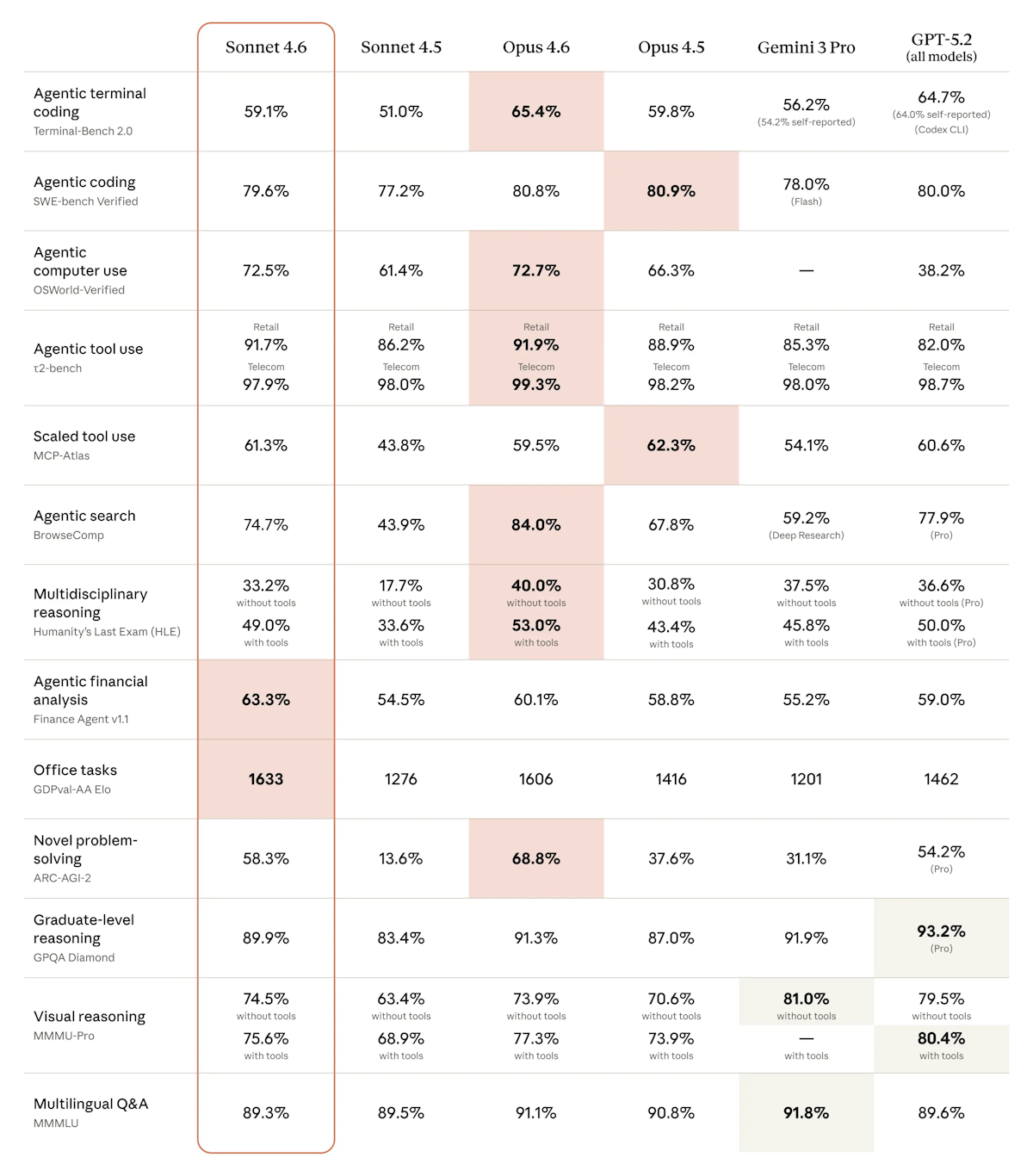
Before diving into our real-world comparison, here is how Claude Sonnet 4.6 stacks up against Sonnet 4.5, Opus 4.5, Gemini 3 Pro, and GPT-5.2 across a range of industry benchmarks:

The numbers tell a compelling story. Sonnet 4.6 approaches or matches Opus-level intelligence across multiple categories while maintaining its lower price point. On agentic coding (SWE-bench Verified), Sonnet 4.6 scores 79.6%, up from 77.2% with Sonnet 4.5. On agentic computer use (OSWorld-Verified), Sonnet 4.6 reaches 72.5% compared to Sonnet 4.5's 61.4%. On agentic tool use (t2-bench), Sonnet 4.6 hits 91.7% retail and 97.9% telecom. Office tasks saw a dramatic leap to 1633 Elo from 1276. And on novel problem-solving (ARC-AGI-2), Sonnet 4.6 jumped to 58.3% from just 13.6%.
These are not marginal gains. In several categories, the improvements are transformative.
Computer Use: From Experimental to Practical
One of the most striking improvements in Sonnet 4.6 is computer use. Since Anthropic first introduced general-purpose computer-using models in October 2024, the Sonnet line has made steady gains on OSWorld, the standard benchmark for AI computer use.

From Sonnet 3.5 (new) scoring 14.9% in October 2024, to Sonnet 3.7 at 28.0%, Sonnet 4 at 42.2%, Sonnet 4.5 at 61.4%, and now Sonnet 4.6 at 72.5%, the trajectory is remarkable. Early Sonnet 4.6 users are reporting human-level capability in tasks like navigating complex spreadsheets and filling out multi-step web forms across multiple browser tabs.
According to Anthropic's announcement, the model also shows major improvements in prompt injection resistance during computer use, performing similarly to Opus 4.6 in safety evaluations.
Key Differences We Observed
1. Architecture and Code Quality
The most striking difference was in how each model approached the application architecture:
Sonnet 4.5 delivered a solid, well-organized blog with thoughtful features including:
- A "Modern Blog Platform" with a welcoming hero section
- Featured Post highlighting with prominent imagery
- Category browsing (Technology, Lifestyle, Travel)
- Recent Posts section with card layouts
- Clean, functional content presentation
Sonnet 4.6 took a more refined and editorially polished approach:
- A cohesive identity as "The Blog" with the tagline "Stories, insights, and ideas from our writers"
- A featured article with large, high-quality lifestyle imagery
- Category filtering directly integrated into the post feed (Design, Lifestyle, Technology)
- More sophisticated content card layouts with author attribution and dates
- A cleaner, more magazine-like reading experience
Where Sonnet 4.5 demonstrated good architectural instincts, Sonnet 4.6 elevated the result. The model seemed to reason more deeply about what makes a blog feel complete and professional, not just functional. This aligns with Anthropic's description that Sonnet 4.6 brings "much-improved coding skills" and that early access developers "often even prefer it to our smartest model from November 2025, Claude Opus 4.5."
2. User Experience and Design
Both models created modern, responsive designs, but with distinctly different levels of sophistication:
Sonnet 4.5 produced a solid, feature-rich design:
- Hero section with descriptive welcome text
- Color-coded category badges
- Featured post with large image display
- Good typography and content hierarchy
- Functional card-based layouts for recent posts
Sonnet 4.6 demonstrated a leap in design quality:
- Sophisticated featured article section with large, atmospheric photography
- More refined typography with better visual hierarchy
- Author names and dates presented with a clean, editorial feel
- Category filtering that feels integrated rather than bolted on
- Overall aesthetic that reads more like a curated publication
As one early access customer noted in Anthropic's announcement: "Claude Sonnet 4.6 has perfect design taste when building frontend pages and data reports, and it requires far less hand-holding to get there than anything we've tested before." We saw this reflected directly in our results. Sonnet 4.6 made stronger creative decisions without additional prompting.
3. Content Strategy and Reasoning
This is where Sonnet 4.6's enhanced reasoning capabilities were most evident:
Sonnet 4.5 made solid content decisions:
- Practical, relatable topics (Remote Team Productivity, Digital Nomad Guide, Getting Started with Headless CMS)
- Multiple categories covering broad interests
- Author attribution with clear bylines
- Content that appeals to a tech-savvy audience
Sonnet 4.6 went further with more sophisticated content strategy:
- Thoughtfully diverse topics spanning lifestyle, design, and technology ("How to Build a Morning Routine That Actually Sticks," "Design Principles Every Developer Should Know," "The Rise of AI-Powered Development Tools")
- Compelling article descriptions that function as genuine hooks rather than summaries
- A more editorial approach to content curation, presenting articles in a way that encourages browsing
- Better balance between practical utility and intellectual curiosity
- Content topics that feel more like an established publication rather than sample data
The difference in content sophistication reflects what Anthropic calls Sonnet 4.6's ability to handle "ambiguous problems with better judgment." When told to create a blog, Sonnet 4.6 thought more holistically about what kind of content would make the blog feel alive and worth reading.
4. Long-Context and Planning Improvements
One of the most significant technical improvements in Sonnet 4.6 is its 1M token context window (in beta) and how effectively it reasons across that context. According to Anthropic, this makes Sonnet 4.6 much better at long-horizon planning.
This was demonstrated clearly in the Vending-Bench Arena evaluation, which tests how well a model can run a simulated business over time. Sonnet 4.6 developed a sophisticated strategy: investing heavily in capacity for the first ten simulated months, then pivoting sharply to profitability in the final stretch.

The chart shows Sonnet 4.6 finishing with roughly $5,700 compared to Sonnet 4.5's approximately $2,100. That is nearly 3x the profit, demonstrating a qualitative shift in strategic planning capability.
For our blog build, this translated into a more cohesive final product where every element, from content topics to visual hierarchy to category structure, felt intentionally designed rather than assembled.
5. New Developer Features
Sonnet 4.6 ships alongside several platform capabilities that enhance the development experience:
Adaptive Thinking: Previously, developers had a binary choice between enabling or disabling extended thinking. Now, Claude can decide when deeper reasoning would be helpful. At the default effort level (high), the model uses extended thinking when useful.
Context Compaction: Long-running conversations and agentic tasks often hit the context window. Context compaction automatically summarizes and replaces older context when the conversation approaches a configurable threshold.
1M Token Context (Beta): Sonnet 4.6 features a 1M token context window, enabling work with much larger codebases and document sets.
Improved Web Search: Claude's web search and fetch tools now automatically write and execute code to filter and process search results, keeping only relevant content in context and improving both response quality and token efficiency.
What Industry Leaders Are Saying
Anthropic's announcement featured testimonials from major technology companies that reinforce what we observed:
On Coding Quality:
"Claude Sonnet 4.6 delivers frontier-level results on complex app builds and bug-fixing. It's becoming our go-to for the kind of deep codebase work that used to require more expensive models."
On Design:
"Claude Sonnet 4.6 has perfect design taste when building frontend pages and data reports, and it requires far less hand-holding to get there than anything we've tested before."
On Computer Use:
"Claude Sonnet 4.6 hit 94% on our insurance benchmark, making it the highest-performing model we've tested for computer use."
On Reasoning:
"Sonnet 4.6 is a significant leap forward on reasoning through difficult tasks. We find it especially strong on branched and multi-step tasks like contract routing, conditional template selection, and CRM coordination."
On Financial Analysis:
"Claude Sonnet 4.6 meaningfully improves the answer retrieval behind our core product. We saw a significant jump in answer match rate compared to Sonnet 4.5 in our Financial Services Benchmark."
Developer Preference: The Numbers Speak
In Claude Code testing, users preferred Sonnet 4.6 over Sonnet 4.5 roughly 70% of the time. Users reported that it more effectively read the context before modifying code and consolidated shared logic rather than duplicating it. This made it less frustrating to use over long sessions than earlier models.
Even more striking, users preferred Sonnet 4.6 to Opus 4.5 (the frontier model from November 2025) 59% of the time. They rated Sonnet 4.6 as significantly less prone to overengineering and "laziness," and meaningfully better at instruction following. They reported fewer false claims of success, fewer hallucinations, and more consistent follow-through on multi-step tasks.
AI Safety Improvements
Intelligence gains in Sonnet 4.6 do not come at the cost of safety. According to Anthropic's safety researchers, Sonnet 4.6 has "a broadly warm, honest, prosocial, and at times funny character, very strong safety behaviors, and no signs of major concerns around high-stakes forms of misalignment."
The model also shows a major improvement in prompt injection resistance compared to Sonnet 4.5, which is especially important for computer use scenarios where malicious actors can attempt to hide instructions on websites.
What This Means for Development Teams
Having tested both models through the Cosmic AI Platform, here is what I recommend:
When to Use Sonnet 4.5
- Projects where Sonnet 4.5's capabilities are sufficient for the task
- Rapid prototyping on simpler applications
- When you want a solid, clean result without needing the latest features
- Situations where you have established workflows that work well with the current model
When to Use Sonnet 4.6
- Complex applications requiring sophisticated architectural and design decisions
- Long-running, multi-step development tasks that benefit from 1M token context
- Projects where design quality and creative polish matter significantly
- Financial analysis, research, and document-heavy workflows
- Applications requiring strong computer use capabilities
- When you need the model to make strong autonomous decisions with minimal guidance
- Production applications where the strongest safety profile matters
- Any project where the performance-to-cost ratio is critical
Pricing
Anthropic has kept pricing consistent between models:
Sonnet 4.6: $3/$15 per million tokens (input/output)
This is the same price point as Sonnet 4.5, meaning teams get significant capability improvements at no additional cost. As Anthropic notes, "Performance that would have previously required reaching for an Opus-class model is now available with Sonnet 4.6."
The Cosmic AI Platform Advantage
What made this comparison particularly valuable was using the Cosmic AI Platform for both builds. Our platform allowed us to:
- Generate complete applications from natural language prompts
- Deploy instantly to see real-world results
- Manage content through the same intuitive interface
- Compare side-by-side without infrastructure overhead
Both models produced production-ready applications in minutes. The Cosmic AI Platform's integration with GitHub and Vercel meant both blogs were deployed and live almost immediately.
Real-World Performance
Visit both applications yourself:
You will notice that both are fast, responsive, and fully functional. The differences are meaningful:
Sonnet 4.5: Clean architecture, good feature set, strong fundamentals, practical content choices
Sonnet 4.6: Elevated design quality, editorial-grade presentation, more sophisticated content strategy, stronger creative decisions, more polished overall experience
Conclusion: A Generational Leap at the Same Price
Claude Sonnet 4.6 represents one of the most significant model-to-model improvements we have tested. It is not just incrementally better. It demonstrates a qualitative shift in what a Sonnet-class model can deliver.
Key takeaways:
- Approaches Opus-level performance across agentic coding, computer use, office tasks, and reasoning at a fraction of the cost
- Computer use scores nearly 5x higher than where the Sonnet line started just 16 months ago (72.5% vs 14.9%)
- Stronger design instincts that produce more polished, publication-quality applications
- 1M token context window (beta) for working with larger codebases and documents
- Adaptive thinking that lets the model decide when deeper reasoning is needed
- 70% user preference over Sonnet 4.5 in Claude Code testing
- Enhanced safety with major prompt injection resistance improvements
- Same pricing at $3/$15 per million tokens, making the upgrade a clear win
For teams using the Cosmic AI Platform, Sonnet 4.6 delivers on its promise of bringing frontier-level performance to more users. The jump from Sonnet 4.5 to 4.6 means that capabilities which previously required an Opus-class model are now accessible to everyone. Every aspect of the output, from code quality to design polish to content strategy, shows meaningful gains.
Try It Yourself
Interested in building your own AI-powered applications? Check out the Cosmic AI Platform, sign up for a free Cosmic account, and see what you can create with Claude Sonnet 4.6. Or explore our Community projects to see what others are building.
The future of development is not choosing between human creativity and AI capability. It is using tools like the Cosmic AI Platform to amplify both.
Tony Spiro is the CEO of Cosmic, creators of the Cosmic AI Platform for building and deploying applications using natural language.
Image source: Anthropic Claude Sonnet 4.6 announcement.
Continue Learning
Ready to get started?
Build your next project with Cosmic and start creating content faster.
No credit card required • 75,000+ developers