
Tony Spiro
April 25, 2026
The term "headless CMS" made sense in 2015. It was a genuine breakthrough: decouple your content from your presentation layer, expose it through an API, and let developers build whatever frontend they wanted. It solved a real problem.
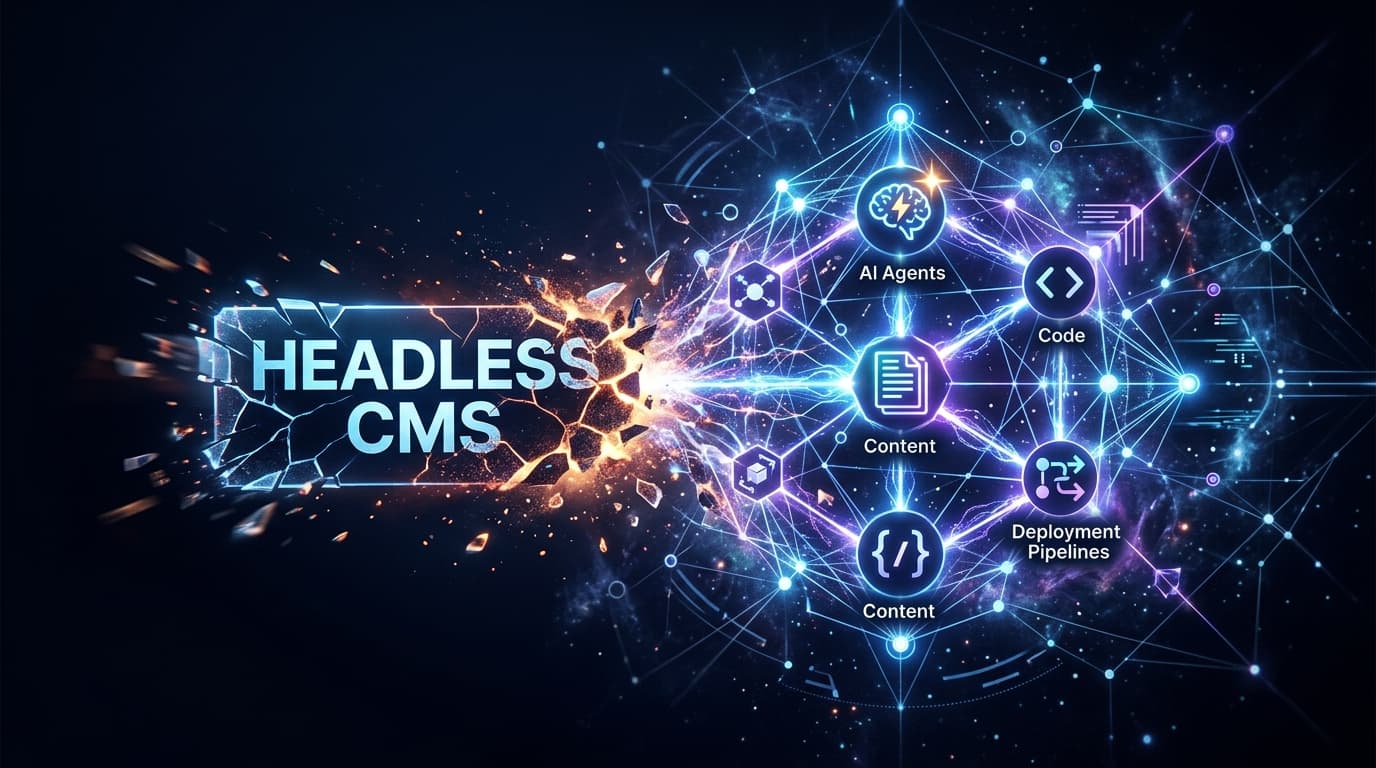
In 2026, calling a platform like Cosmic a "headless CMS" is like calling Vercel a "file host." Technically not wrong. Strategically, completely wrong.
The category has moved. The label hasn't. It's time to name what comes next.
1. The Original Headless CMS Promise (And Why It Was Right for Its Time)
Around 2013 to 2016, the web development world hit a wall. WordPress powered a third of the internet, but it also chained content to PHP templates and a rigid frontend. Enterprise teams were stuck in Sitecore and Adobe Experience Manager, paying six-figure licensing fees for systems that required specialists just to publish a blog post.
Headless CMS changed the contract. Content lived in a structured repository, accessible via API. Developers could build frontends in React, Vue, Angular, or anything else they chose. Content teams could work independently in a clean editor. The decoupling was real and valuable.
Platforms like Contentful (founded 2013) and later Sanity, Storyblok, and Prismic built strong businesses on this premise. The market validated them. According to Grand View Research, the headless CMS market is worth $2 to $4 billion today and is projected to grow to $6 billion or more by 2033.
The problem is not that headless CMS failed. The problem is that it succeeded, and then the world kept moving.
2. What Developer Teams Actually Need in 2026
Talk to any engineering lead at a modern product company and ask them what they need from their content infrastructure. You will not hear "a better API for structured content." You will hear something like this:
- We need our marketing team to launch new landing pages without filing a Jira ticket.
- We need our AI agents to be able to read and write content programmatically.
- We need our content workflows to trigger downstream actions: Slack notifications, data syncs, deployment pipelines.
- We need our editors to work in Slack or WhatsApp, not a separate dashboard.
- We need our platform to handle the full lifecycle: create, publish, personalize, and retire content.
This is not a content management problem. It is a content infrastructure problem. And content infrastructure in 2026 looks nothing like a headless CMS from 2016.
The broader composable content and modern CMS market, which includes content infrastructure, AI tooling, and app platform components, is estimated at $10 to $25 billion by MarketsandMarkets. The composable content and modern CMS market is broadly projected to reach tens of billions by the early 2030s. The headless CMS slice of that is real but narrow.
Teams that limit their thinking to "headless CMS" are scoping themselves into a shrinking corner of a much larger map.
3. The Category Convergence Happening Right Now
Something interesting is happening across the developer tools landscape. The clean category lines that existed five years ago are dissolving.
CMS platforms are becoming dev platforms. Contentful launched an app framework. Sanity built a structured content operating system with Studio. Storyblok added visual editing. They are all reaching for more of the stack.
Dev platforms are becoming content platforms. Vercel launched CMS integrations and visual editing tooling. Netlify acquired multiple CMS products. Cloudflare Pages added content workflows. Infrastructure companies want to own content delivery end-to-end.
AI tooling is collapsing into both. Large language models need structured content to stay grounded. AI agents need APIs to read and write content programmatically. The AI layer and the content layer are converging whether the vendors want them to or not.
The result: every serious platform is building toward the same destination. The companies that still describe themselves primarily by their 2016 category name are telling you something about their product roadmap thinking.
4. Why the Wrong Category Label Is Costing Teams Money and Time
This is not just a semantics debate. Category labels drive buying decisions, and wrong labels create wrong criteria.
When a CTO goes to evaluate a "headless CMS," they bring a headless CMS checklist: API performance, content modeling flexibility, editor experience, pricing per seat. These are legitimate criteria. But they are incomplete criteria for 2026.
They are not asking:
- Can AI agents in my team's Slack channel query and update this content without a human in the loop?
- Can I build a full internal tool or customer-facing app on this platform, not just a marketing site?
- Can my team define automated workflows that span content creation, approval, and deployment?
- Does this platform have an MCP Server so tools like Claude Code and Cursor can work directly with my content?
- Can I extend the platform with Agent Skills, so my editors can trigger complex workflows from a chat interface?
When teams do not ask these questions, they end up buying a headless CMS and then separately buying an AI platform, a workflow tool, an internal tooling framework, and a handful of Zapier integrations to stitch it all together. The category label caused them to under-scope the problem. They pay for it in budget, in developer time, and in the fragility of integrations that break whenever any vendor changes an API.
The composable architecture that headless CMS promised has, paradoxically, created significant overhead. "Best of breed" composable stacks can mean 8 to 12 separate vendors, contracts, and points of failure for a mid-market product team.
5. What the New Category Looks Like
The new category does not have a consensus name yet. That is partly what makes this moment interesting, and partly what makes it strategically important to define it now.
Here is what it includes:
Content infrastructure. Structured content models, a fast REST API and TypeScript SDK, global CDN delivery, media management. The table stakes that headless CMS established. Still necessary, but no longer sufficient.
AI-native agents. Not AI bolted on top of a content editor. AI agents that are first-class members of your team. They live in Slack, WhatsApp, and Telegram. They can read content, write content, trigger workflows, and respond to natural language requests from editors and developers alike. They operate on schedules or respond to events. As Lauren Reeder and Stephanie Zhan at Sequoia note, "agents are AI that can act" and increasingly they will be the ones executing complex multi-step tasks on behalf of teams.
Workflow automation. Multi-step automated processes that chain content operations, approvals, notifications, and external API calls into coherent pipelines. Not a third-party integration layer: native workflow execution.
Developer-first extensibility. An MCP Server that lets AI coding tools like Claude Code and Cursor interact directly with your content infrastructure. Agent Skills that make content operations available as composable building blocks for any AI assistant.
App platform capabilities. The ability to build not just content-driven websites but full applications on the same infrastructure. Content becomes data. The CMS becomes the backend.
This is not a feature list. It is a different mental model for what a content platform is. Content is no longer a static repository that gets queried. It is a live, programmable layer that participates in your product.
6. Where Cosmic Fits in the New Map
Cosmic (YC W19) started as a headless CMS. It has the API performance, the content modeling, and the editor experience that enterprises require. Companies like FINN, Tripwire Interactive, Parque Explora, and Vuetify chose it and stayed because the fundamentals are solid.
FINN's co-founder Maximilian Wuhr put it directly: "Cosmic is: us never having to ask a developer to change anything on the backend of our website."
That outcome, non-technical teams operating independently, is the original headless CMS promise fulfilled. But Cosmic has not stopped there.
Today, Cosmic is an AI-powered content and app platform. Here is what that means in concrete terms:
- AI Agents in Slack, WhatsApp, and Telegram. Your team can interact with your content infrastructure through the tools they already use. Editors can request content, trigger updates, and get summaries without leaving their messaging app.
- Workflows. Multi-step automated pipelines that orchestrate content operations, approvals, and integrations. Build once, run automatically.
- MCP Server. Cosmic exposes an MCP (Model Context Protocol) Server, which means AI coding tools like Claude Code and Cursor can interact directly with your content. Developers work faster; context does not get lost.
- Agent Skills for Cursor and Claude Code. Composable content operations available natively to the AI tools your developers already use.
- REST API and TypeScript SDK. Battle-tested, fast, and developer-friendly. The foundation has not changed; the ceiling has gone up dramatically.
The market segment Cosmic competes in is not a $4 billion headless CMS market. It is a $25 billion-plus content infrastructure and AI-powered app platform market.
Calling it a headless CMS is like calling Vercel a file host. Accurate at the edges. Completely wrong about what it is.
The category will be named. We're naming it now.
An Agentic Content Platform is not a headless CMS with AI bolted on. It is a platform where AI agents are first-class participants in every content operation: writing, editing, publishing, coding, deploying, measuring. Where workflows chain agents together across the full stack. Where your content infrastructure is not a repository you query but a programmable layer that acts.
The companies that recognize this shift early will stop evaluating "headless CMS vendors" and start asking a different question: which platform lets my team move fastest when humans and agents are working together?
That is the question Cosmic is built to answer.
The label has changed. The work starts now.
Ready to see what AI-powered content infrastructure looks like? Start free on Cosmic or book a demo with Tony to talk through what your stack could look like.
Cosmic is an AI-powered content and app platform. Explore our features, check out pricing, or read the docs.
Continue Learning

Claude Sonnet 5.5 vs Sonnet 5: What Changed, and Should You Switch?


Tony Spiro and Mia
October 6, 2026
Announcing the Cosmic AI Support Agent
Tony Spiro and Mia
October 5, 2026