
Claude Opus 4.8 Is Out: What It Means for AI-Native Development Teams

Tony Spiro
May 28, 2026
Model lineup updated June 2026: Claude Fable 5 has launched as the new Mythos-class tier above Opus. It leads every major benchmark, compressed a 50M-line Stripe codebase migration into a single day, and ships at $10/$50 per million tokens. See Claude Fable 5: What It Is and What It Means for Developers. Opus 4.8 remains the strong choice for the Opus tier and a natural default for teams not yet evaluating Fable 5.
Anthropic shipped Claude Opus 4.8 today, May 28, 2026. If you are building agentic systems, coding assistants, or any product that relies on an AI model to take sustained, multi-step actions in the real world, this release deserves your attention.
Opus 4.8 is framed by Anthropic as "a modest but tangible improvement" on its predecessor. In agentic contexts, where reliability compounds across dozens of sequential steps, even incremental gains in judgment, honesty, and tool-calling precision translate into meaningfully better products.
Here is what shipped, why it matters, and where Opus 4.8 fits in the updated model lineup.
Updated Model Hierarchy (June 2026)
| Model | Tier | Best For |
|---|---|---|
| Claude Fable 5 | Mythos-class (top tier) | Long-horizon autonomy, vision, large migrations |
| Claude Opus 4.8 | Opus-class | Agentic coding, computer use, sustained reasoning |
| Claude Sonnet 4.6 | Sonnet-class | Everyday coding, content, cost-efficient workloads |
Opus 4.8 remains the right model for most high-stakes agent workloads. Fable 5 is the answer for tasks that push Opus to its limits.
Opus 4.8 Benchmark Breakdown
| Benchmark | Claude Opus 4.8 | Claude Opus 4.7 | GPT-5.5 | Gemini 3.1 Pro |
|---|---|---|---|---|
| SWE-Bench Pro (agentic coding) | 69.2% | 64.3% | 58.6% | 54.2% |
| Terminal-Bench 2.1 (terminal coding) | 74.6% | — | 78.2% | — |
| Humanity's Last Exam (reasoning, with tools) | 57.9% | — | — | — |
| OSWorld-Verified (computer use) | 83.4% | 82.3% | — | — |
| GDPval-AA (knowledge work) | 1890 | 1753 | — | — |
| Finance Agent v2 | 53.9% | — | — | — |
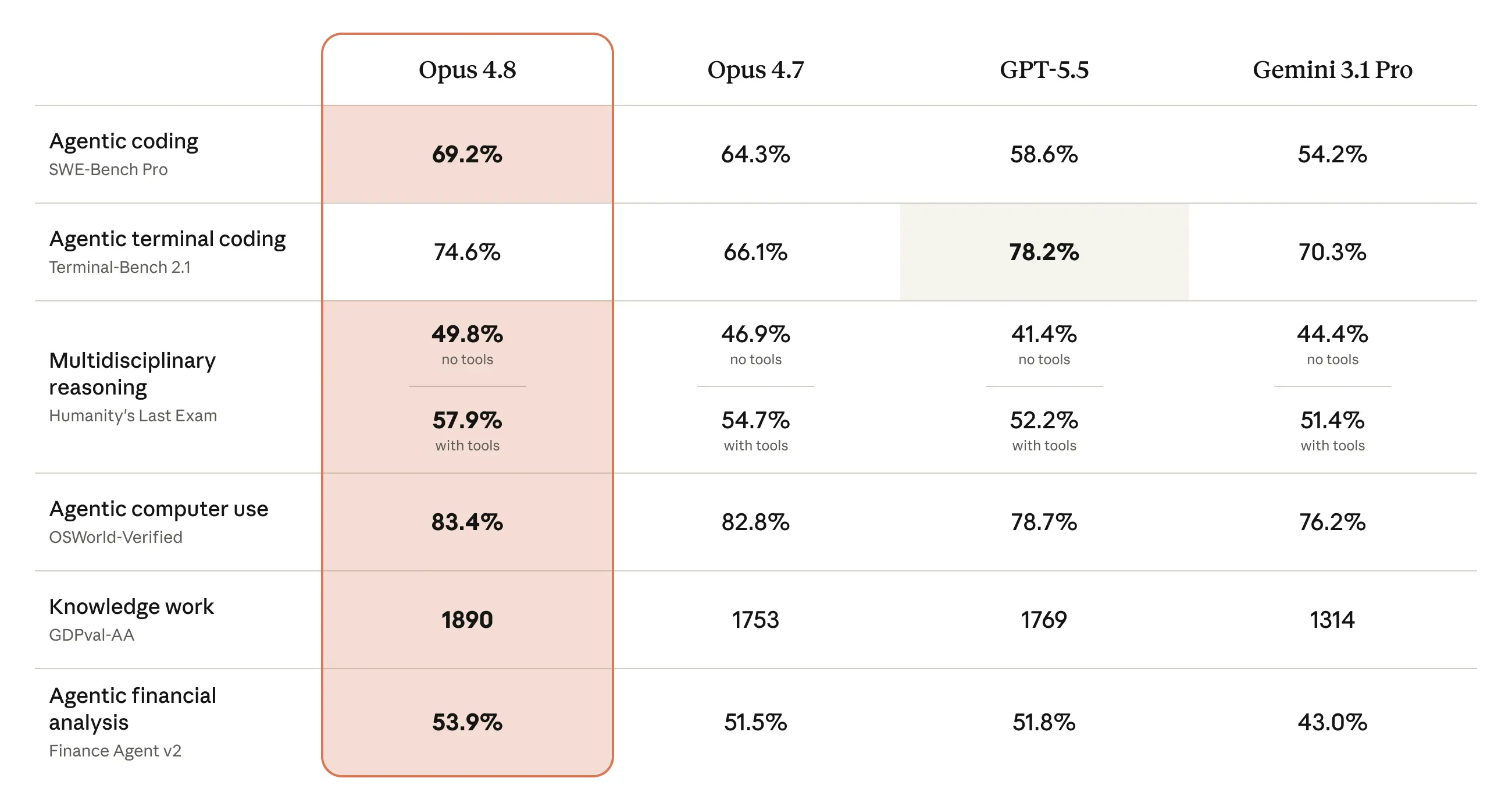
Source: Anthropic, May 28, 2026
A few notes:
Agentic coding (SWE-Bench Pro): Opus 4.8 leads all tested models at 69.2%.
Terminal coding (Terminal-Bench 2.1): GPT-5.5 leads here at 78.2% with the Codex CLI harness. Opus 4.8 scores 74.6% using the Terminus-2 public harness.
Computer use (OSWorld-Verified): 83.4% puts Opus 4.8 at the top of this category.
What's New Beyond the Benchmarks
Honesty as a Feature
Opus 4.8 is approximately 4x less likely than Opus 4.7 to let flaws in its own code pass without flagging them. For anyone who has watched an AI confidently deliver broken code, this is a real quality-of-life improvement.
Effort Control
Opus 4.8 introduces effort levels: default (high), extra, and max. Higher effort means more thinking time and better results on difficult tasks.
Fast Mode: 2.5x Speed, Now 3x Cheaper
Fast mode runs at 2.5x the speed of regular mode, now priced at $10 per million input tokens and $50 per million output tokens — 3x cheaper than fast mode was for prior Opus models.
Dynamic Workflows in Claude Code
Shipping alongside Opus 4.8 is Dynamic Workflows, available in research preview for Max, Team, and Enterprise plan users. Claude Code can now plan work upfront and spin up tens to hundreds of parallel subagents within a single session.
Jarred Sumner, creator of Bun, used Dynamic Workflows to rewrite Bun from Zig to Rust: 750,000 lines of Rust, 99.8% of the test suite passing, shipped from first commit to merge in 11 days.
Why This Matters for AI-Native Development Teams
Opus 4.8's improvements in honesty and judgment are arguably more important than the benchmark gains. A model that knows what it does not know, and says so, is significantly more useful in production than one that confidently produces wrong answers.
For teams considering the step up to Fable 5: Opus 4.8's 69.2% on SWE-Bench Pro is already the best in class among Opus-tier models. Fable 5 raises that ceiling further for tasks that need it.
How Cosmic Uses Opus 4.8
Cosmic uses Claude Opus 4.8 as the recommended model for high-reasoning content and code operations in the platform. Cosmic Workflows chain Content, Code, and Computer Use agents together on a schedule or via webhook trigger.
Cosmic also ships an MCP Server that connects directly to Claude Code and Cursor. See Hosted MCP: Cosmic in Cursor, Claude, and Codex with Zero Install for the full setup.
Start Building
Start free on Cosmic or book a quick intro with Tony if you want to talk through a specific use case.
Sources: Introducing Claude Opus 4.8 | Dynamic Workflows in Claude Code Image from original announcement article.
Continue Learning



Claude Sonnet 5.5 vs Sonnet 5: What Changed, and Should You Switch?


Tony Spiro and Mia
October 6, 2026

Announcing the Cosmic AI Support Agent
Tony Spiro and Mia
October 5, 2026