
Tony Spiro
April 21, 2026
The headless CMS space has spent 2025 and 2026 racing to slap the word "AI" onto every feature. Most of it is AI-assisted editing at best. A writing suggestion here, an SEO score there.
But two platforms have gone further than the rest: Sanity and Cosmic. Both have invested seriously in AI, and both use the word "agents." That's roughly where the similarity ends.
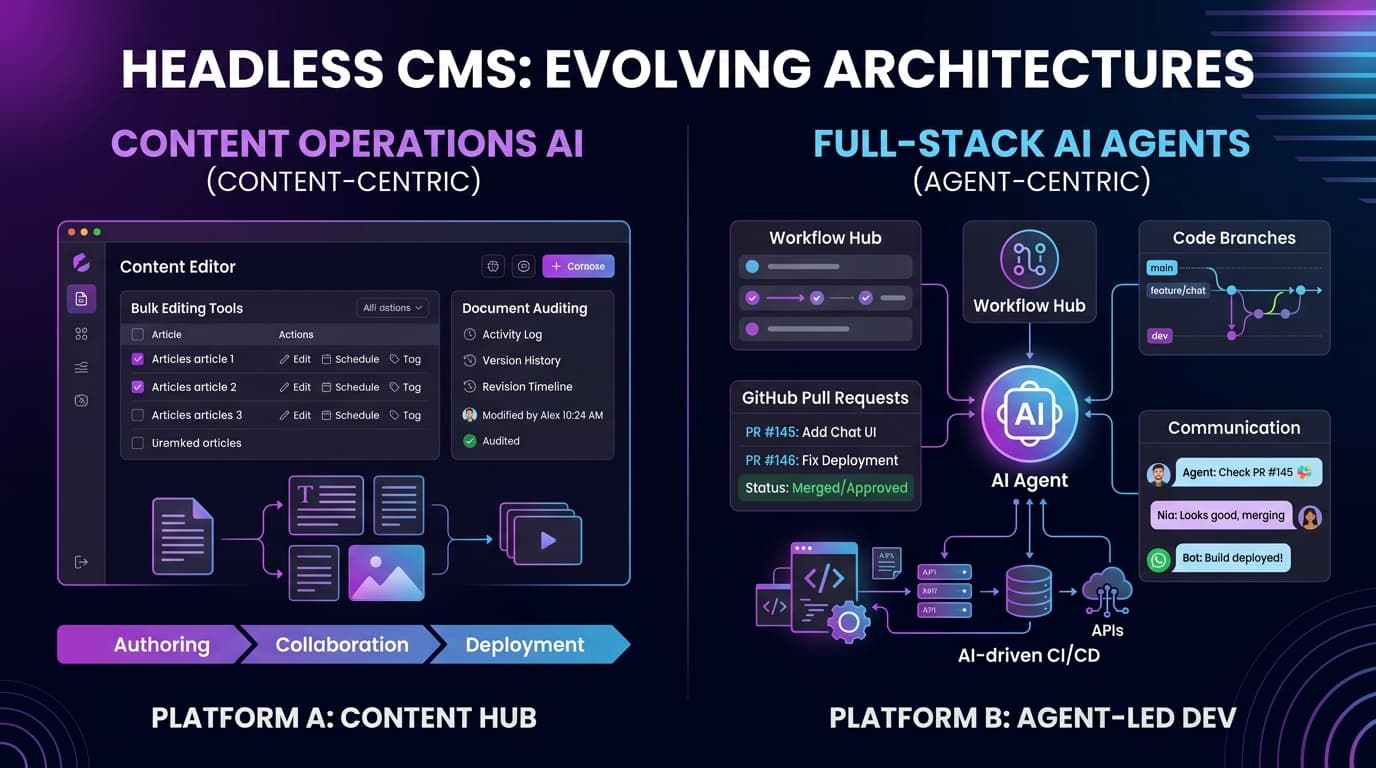
Sanity's Content Agent is a powerful tool for running content operations at scale. Cosmic's agents build software. They commit code, open pull requests, automate browser tasks, and communicate with your team in Slack. These are categorically different products operating in different layers of your stack.
This comparison breaks down exactly what each platform offers, where each one excels, and which one is the right fit depending on what you're actually trying to build.
The Agents Comparison
What Sanity's Content Agent Does
Sanity's Content Agent is focused on content operations. According to Sanity's own documentation, it can:
- Run bulk edits across thousands of documents through conversation
- Audit content health: find missing fields, stale content, quality issues
- Bulk replace URLs, brand names, or text patterns across large document sets
- Transform press releases or briefs into structured articles with metadata
- Search the web to identify content gaps and trends
- Stage all changes for review before committing
This is genuinely impressive for editorial teams. If you manage a large publishing operation with thousands of documents and need a way to enforce consistency, audit quality, or do bulk rewrites without engineering resources, Sanity's Content Agent addresses that problem well.
It also integrates with Slack and offers an API so you can embed it in other tools. The architecture is multi-agent under the hood, with specialized agents for queries, edits, and images.
The scope, however, is explicitly content operations inside the CMS. Sanity's Content Agent does not write application code, does not touch your GitHub repository, does not create branches or pull requests, and does not deploy software.
What Cosmic's AI Agents Do
Cosmic ships four distinct agent types:
Team Agents live in Slack, WhatsApp, and Telegram. They have persistent memory, custom personas, and goals. A Team Agent can be your content lead, a growth assistant, or a support agent. It participates in your actual communication channels, not just within the CMS dashboard.
Content Agents generate and manage CMS content: blog posts, landing pages, AI images, AI video. They run on schedules, respond to webhooks, and can be chained into multi-step workflows.
Code Agents connect directly to GitHub repositories. They create branches, commit code changes, build features, fix bugs, and open pull requests. A Code Agent can receive a feature request in Slack and deliver a pull request to your GitHub repo. This is not a content tool. This is a software development tool.
Computer Use Agents control browsers using visual AI. They record demo videos, extract data from web pages, cross-post media, and automate any browser-based workflow.
These four agent types can be chained together in Workflows. An example workflow: a Content Agent generates product descriptions and SEO metadata, a Code Agent builds the storefront pages in a Next.js repository and opens a PR, and a Computer Use Agent then tests the checkout flow and records a demo video. All three steps run in sequence, automatically, with real-time monitoring and approval gates.
The core distinction: Sanity's Content Agent manages what's inside your CMS. Cosmic's agents operate across your entire development stack.
A Concrete Code Comparison
Let's look at what it actually looks like to query content from each platform.
Fetching content from Cosmic (REST API + TypeScript SDK)
import { createBucketClient } from '@cosmicjs/sdk';

const cosmic = createBucketClient({
  bucketSlug: 'your-bucket-slug',
  readKey: 'your-read-key',
});

// Fetch published blog posts with MongoDB-style queries
const { objects: posts } = await cosmic.objects
  .find({
    type: 'blog-posts',
    'metadata.category': 'engineering',
  })
  .props(['id', 'title', 'metadata', 'slug'])
  .sort('-created_at')
  .limit(10);
Cosmic's REST API returns responses in under 100ms. The TypeScript SDK uses MongoDB-style query operators ($lt, $gt, $in, $regex) so filtering is familiar and expressive. There is no proprietary query language to learn.
Fetching content from Sanity (GROQ)
import { createClient } from '@sanity/client';

const client = createClient({
  projectId: 'your-project-id',
  dataset: 'production',
  apiVersion: '2024-01-01',
  useCdn: true,
});

// GROQ query
const posts = await client.fetch(
  `*[_type == 'post' && category == 'engineering'] | order(_createdAt desc)[0...10] {
    _id, title, slug, body, category
  }`
);
Sanity uses GROQ, a proprietary query language you need to learn. It is powerful and expressive for complex relational queries, but adds a learning curve for developers already familiar with SQL or MongoDB-style filtering. Sanity also offers their query language alongside standard options, but GROQ is the primary pattern throughout their ecosystem.
Key differences:
- Cosmic: REST API, TypeScript SDK, MongoDB-style operators, sub-100ms responses, no proprietary syntax
- Sanity: GROQ query language, REST API, CDN-backed delivery, strong real-time/live preview capabilities
Framework Support
Sanity has built strong positioning around Next.js and TypeScript, and they deserve credit for their Visual Editing and Live Preview tooling. The Sanity Studio is a fully customizable React application.
Cosmic supports every major JavaScript framework:
| Framework | Cosmic Support |
|---|---|
| Next.js | Yes |
| React | Yes |
| Vue | Yes |
| Nuxt | Yes |
| Astro | Yes |
| Remix | Yes |
| Svelte | Yes |
| Gatsby | Yes |
Cosmic is framework-agnostic by design. The REST API and TypeScript SDK work with any JavaScript environment. If you're building with Astro, Nuxt, or Svelte, you get the same first-class experience as Next.js developers.
Cosmic also ships Agent Skills for AI coding tools: Cursor, Claude Code, GitHub Copilot, and 16+ others. Agent Skills install Cosmic's context directly into your IDE's AI assistant so it understands your content model and API without you needing to explain it. The MCP Server provides 17 tools for managing Cosmic content through Claude, Cursor, or any MCP client.
Sanity also ships an MCP Server. Both platforms are investing in AI coding tool integrations, which reflects where developer tooling is heading.
Pricing: A Fair Comparison
Cosmic Pricing (verified April 2026)
| Plan | Price | Buckets | Team Members | Objects | AI Agents |
|---|---|---|---|---|---|
| Free | $0/mo | 1 | 2 | 1,000 | 3 (manual only) |
| Builder | $99/mo | 2 | 3 | 5,000 | 5 (with scheduling) |
| Team | $299/mo | 3 | 5 | 20,000 | 15 (with scheduling) |
| Business | $499/mo | 5 | 10 | 50,000 | 25 (with scheduling) |
| Enterprise | Custom | Custom | Custom | Custom | Custom |
Additional users: $29/user/month. No credit card required to start. Free plan is genuinely free forever, not a 14-day trial.
AI token allowances by plan: 300k (Free), 500k (Builder), 1M (Team), 3M (Business). Token packs available at $25 for 2M, $110 for 10M, $475 for 50M.
Sanity Pricing (verified April 2026)
| Plan | Price | Seats | Datasets | Documents |
|---|---|---|---|---|
| Free | $0/mo | Up to 20 | 2 (public only) | 10,000 |
| Growth | $15/seat/mo | Up to 50 | 2 (private or public) | 25,000 |
| Enterprise | Custom | Custom | Custom | Custom |
Sanity's pricing model is per-seat at the Growth tier: $15 per user per month. For a team of 10, that's $150/month before any add-ons. Dedicated support is a $799/month add-on. SSO is a $1,399/month add-on. An extra dataset costs $999/month.
The model is different. Sanity's entry point is lower per seat for small teams, but add-ons add up fast for growing organizations. Cosmic's pricing is predictable by plan tier, with one flat rate covering the platform and all core features.
Neither model is inherently better. The right choice depends on team size, feature needs, and how you value predictable vs. usage-based billing.
Head-to-Head Feature Comparison
| Feature | Cosmic | Sanity |
|---|---|---|
| Free plan | Yes, forever. No credit card. | Yes, up to 20 seats |
| AI Content Operations | Yes (Content Agents) | Yes (Content Agent) |
| AI Code Agents (GitHub/PRs) | Yes | No |
| AI Computer Use (browser automation) | Yes | No |
| AI Team Agents (Slack/WhatsApp/Telegram) | Yes | Slack only (Content Agent) |
| Multi-agent Workflows | Yes | No |
| REST API | Yes, sub-100ms | Yes |
| TypeScript SDK | Yes | Yes |
| Proprietary query language | No (MongoDB-style operators) | Yes (GROQ) |
| MCP Server | Yes (17 tools) | Yes |
| Agent Skills (Cursor, Claude Code, etc.) | Yes (16+ integrations) | MCP only |
| CLI | Yes (AI-powered, zero to production) | Yes |
| Next.js | Yes | Yes |
| Astro / Nuxt / Svelte / Remix / Gatsby | Yes | Varies |
| Visual editing / Live preview | Yes | Yes (mature, feature-rich) |
| AI image generation | Yes (built into SDK) | Yes (via Content Agent) |
| AI video generation | Yes | No |
| Localization | Add-on ($99/mo) | Included (unlimited locales) |
| Revision history | Add-on ($99/mo) | 3 days (Free), 90 days (Growth) |
| Webhooks | Add-on ($99/mo) | Included (4 on Free, 24 on Growth) |
| Per-seat pricing | Additional users $29/user/mo | $15/seat/mo (Growth) |
| YC-backed | Yes (W19) | No |
The Content Operations vs. Software Development Question
The real decision here comes down to what layer of your stack you want AI to operate in.
Choose Sanity's Content Agent if:
- Your primary AI use case is managing large volumes of existing content
- You need bulk editing, content audits, and gap analysis across thousands of documents
- Your team is editorial-first and the bottleneck is content operations, not engineering
- You need Sanity's Visual Editing and real-time collaborative Studio
- GROQ's query power is worth the learning investment for your data model
Choose Cosmic's AI agents if:
- You want AI that extends beyond the CMS and into your codebase
- Your team needs Code Agents creating branches and opening pull requests automatically
- You want AI team members living in Slack, WhatsApp, or Telegram with persistent memory
- Multi-agent Workflows that chain content generation, code deployment, and browser testing matter to you
- You want a predictable flat-rate pricing structure with a genuinely free forever plan
- Your team uses Cursor, Claude Code, or GitHub Copilot and wants CMS context baked into your IDE
For FINN, the car subscription platform, the value of Cosmic was direct: "Cosmic is: us never having to ask a developer to change anything on the backend of our website." said Maximilian Wuhr, Co-Founder at FINN. The ability for non-technical team members to manage content without developer involvement is a core part of what both platforms offer, but the ceiling of what's possible is very different.
Developer Experience: Both Are Strong, With Different Tradeoffs
Sanity has invested significantly in developer experience. The Sanity Studio is a genuinely excellent React-based editor that is fully customizable. GROQ is a powerful query language once you learn it. Their documentation is thorough. Their community is large.
Cosmic's developer experience is built around familiarity and speed. The REST API uses standard patterns. The TypeScript SDK is straightforward. The CLI can take you from zero to a deployed Next.js application in minutes:
npm install -g @cosmicjs/cli
cosmic login
cosmic build -p "A blog with authentication and a newsletter signup"
cosmic deploy start --watch
The CLI generates a full-stack Next.js project, wires in your content model, and deploys to production. The AI-powered CLI also manages agents, workflows, webhooks, and billing from the terminal.
For teams already using Cursor or Claude Code, Cosmic's Agent Skills install Cosmic's full context directly into the AI assistant. This means your AI coding tool understands your object types, metafield schemas, and API patterns without you needing to explain them in every prompt.
Frequently Asked Questions
Does Cosmic support Next.js?
Yes. Cosmic has first-class support for Next.js, including App Router and Server Components. The TypeScript SDK integrates directly with Next.js data fetching patterns.
Does Sanity use REST API?
Sanity primarily uses GROQ (its proprietary query language) and also offers a REST API. Cosmic uses a standard REST API with MongoDB-style query operators and no proprietary syntax.
Can Cosmic AI agents write code?
Yes. Cosmic's Code Agents connect to GitHub repositories, create branches, commit changes, and open pull requests. This is one of the core distinctions from Sanity's Content Agent.
What is the difference between Sanity's Content Agent and Cosmic's AI agents?
Sanity's Content Agent handles content operations inside the CMS: bulk edits, audits, document transformations. Cosmic's agents operate across content creation, code development, browser automation, and team communication. They are different in scope and purpose.
Is Cosmic free?
Yes. Cosmic's Free plan is $0/month forever with no credit card required. It includes 1 Bucket, 2 team members, 1,000 Objects, 300k AI tokens, and 3 AI agents (manual execution).
Does Cosmic have localization?
Yes, as an add-on at $99/month (or $199/month bundled with Webhooks, Revision History, and Automatic Backups).
The Verdict
Both Sanity and Cosmic are serious, well-built headless CMS platforms. Neither is a bad choice. The question is what you need AI to actually do.
If you need an AI that manages your content operations at scale inside the CMS, Sanity's Content Agent is genuinely impressive. Bulk editing thousands of documents through conversation is a real capability, not a demo.
If you need AI that operates across your full stack: writing content, building features in GitHub, communicating in Slack, testing in the browser, and chaining all of that into automated workflows, Cosmic is in a different category. The agents are not add-ons. They are the product.
The fact that Cosmic agents live in Slack and WhatsApp, create pull requests, and deploy code is not a minor feature difference. It's a fundamentally different vision of what a CMS can be in 2026.
Ready to see it for yourself?