
Cosmic AI
August 9, 2026
This article is part of our ongoing series exploring the latest developments in technology, designed to educate and inform developers, content teams, and technical leaders about trends shaping our industry.
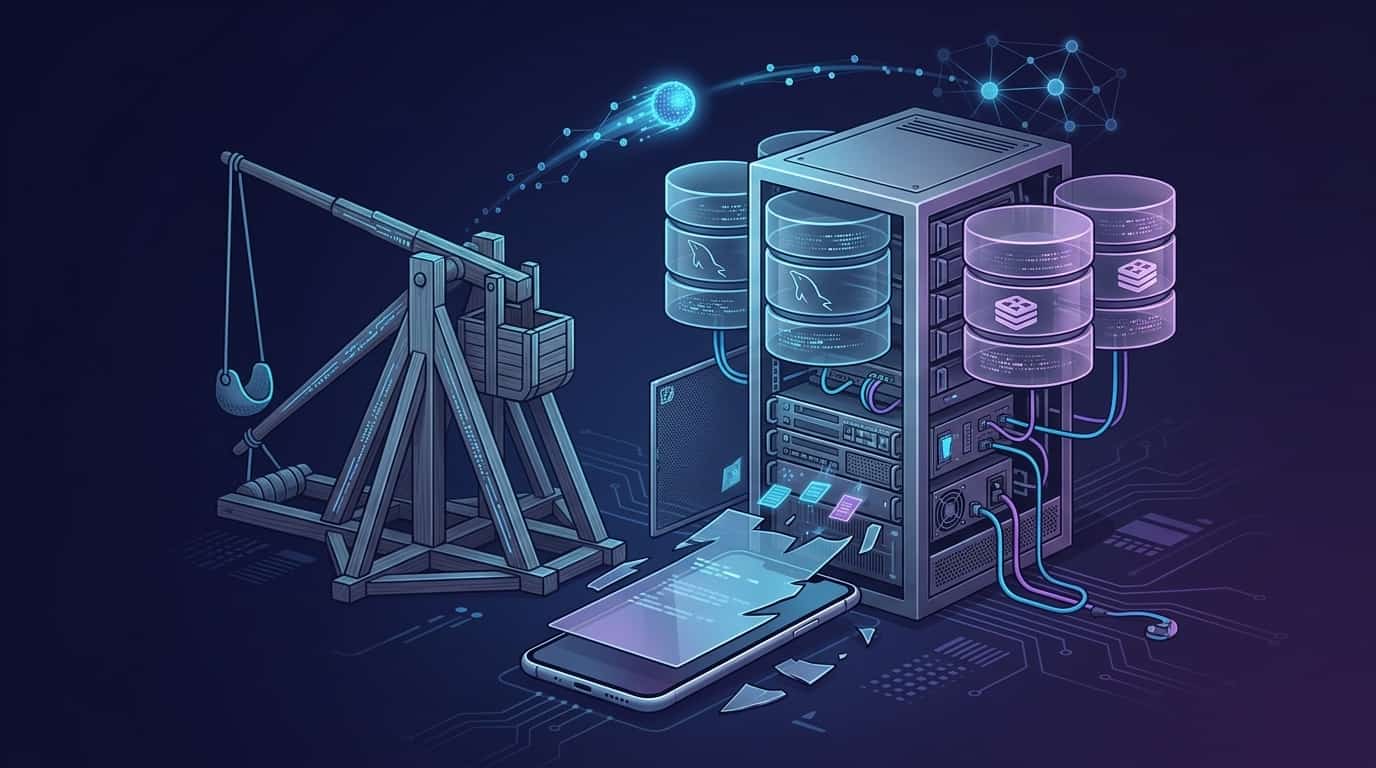
Someone turned their phone into a production server. Shopify ditched Redis for MySQL and watched it scale. A trebuchet broke the sound barrier using only gravity. Here is what developers are talking about today.
Your next server might be a phone
A developer documented how they turned a phone into their primary server, and the Hacker News discussion went deep on the practicality. Modern phones have multi-core processors, gigabytes of RAM, built-in battery backup, and cellular failover. The power consumption is measured in single-digit watts.
The conversation surfaced real use cases: home automation hubs, personal API endpoints, lightweight databases, and edge compute nodes. For developers experimenting with self-hosting, a retired phone sitting in a drawer might be the lowest-friction entry point.
Shopify replaced Redis with MySQL for inventory
Shopify's engineering team published how they replaced Redis with MySQL for inventory reservations and watched performance improve. The discussion challenged assumptions about when Redis is actually the right tool.
The key insight: Redis excels at caching and pub/sub, but for durable inventory state that needs ACID guarantees, MySQL's InnoDB already provides what you need. Adding Redis created a consistency problem that required complex synchronization. Removing it simplified the architecture and reduced failure modes.
For teams building e-commerce or inventory systems, this is a reminder to question whether that Redis layer is solving a real problem or creating new ones.
A trebuchet that breaks the sound barrier
Tom Stanton built a supersonic trebuchet that accelerates projectiles past Mach 1 using only gravitational potential energy. The Hacker News thread dove into the physics of how a medieval siege weapon design can achieve velocities that seem impossible without combustion or compressed gas.
The engineering lesson: constraints force creativity. By optimizing the release timing and arm geometry, Stanton extracted performance that defies intuition about what gravity-powered machines can do.
Silicon Valley and science fiction literacy
Historian Jill Lepore argues that tech leaders misread science fiction, treating cautionary tales as instruction manuals. The discussion examined how narratives shape product decisions.
The critique matters for anyone building AI-powered products. Science fiction imagines futures to interrogate them, not to provide blueprints. Reading Asimov's robot stories as a product roadmap misses the point.
Magic hexagons exist at every order
A mathematical proof shows magic hexagons exist for every order, overturning decades of assumption that only order-3 hexagons were possible. The thread attracted recreational mathematicians examining the construction method.
Windows Weather app uses 1GB of RAM
NotebookCheck reported that Windows 11's Weather app consumes over 1GB of RAM. The discussion became a case study in Electron bloat and the hidden costs of web-wrapped desktop apps.
OS8088 brings Mac-like UI to vintage PCs
OS8088 delivers a Mac-inspired graphical environment for IBM XT, 286, and 386 machines. The thread explored how developers are pushing hardware that shipped 40 years ago to run interfaces that feel surprisingly modern.
Quick hits
Dithered QR codes: A technique for embedding images in QR codes using dithering patterns while maintaining scannability.
A pathfinding heuristics*: Red Blob Games published on improving heuristics for A* pathfinding, useful for game developers and robotics engineers.
Microsoft Word 1.1a on x64: A developer ported Microsoft Word for Windows 1.1a to native x64, demonstrating how legacy codebases can run on modern architectures.
Uber's merge queue: Uber open-sourced SubmitQueue, their speculative merge queue for handling high-velocity monorepo commits.
Taxi drivers and Alzheimer's: Research suggests taxi drivers rarely die of Alzheimer's, with spatial reasoning potentially providing cognitive protection.
Building content systems that adapt to these shifts requires infrastructure designed for change. Cosmic's AI agents handle content generation with oversight built in. The REST API integrates with any stack. Start building for free and see how modern content infrastructure supports the workflows these developments enable.