What is React?
React (or ReactJS, React.js) is a JavaScript library for building user interfaces. It enables you to build robustly dynamic single-page web applications by using a component-based architecture, purposed for greater code reusability.
React can also render on the server-side using Next.js, or on mobile apps using React Native. Originally developed at Facebook (now Meta), it remains the most popular frontend library in the JavaScript ecosystem.
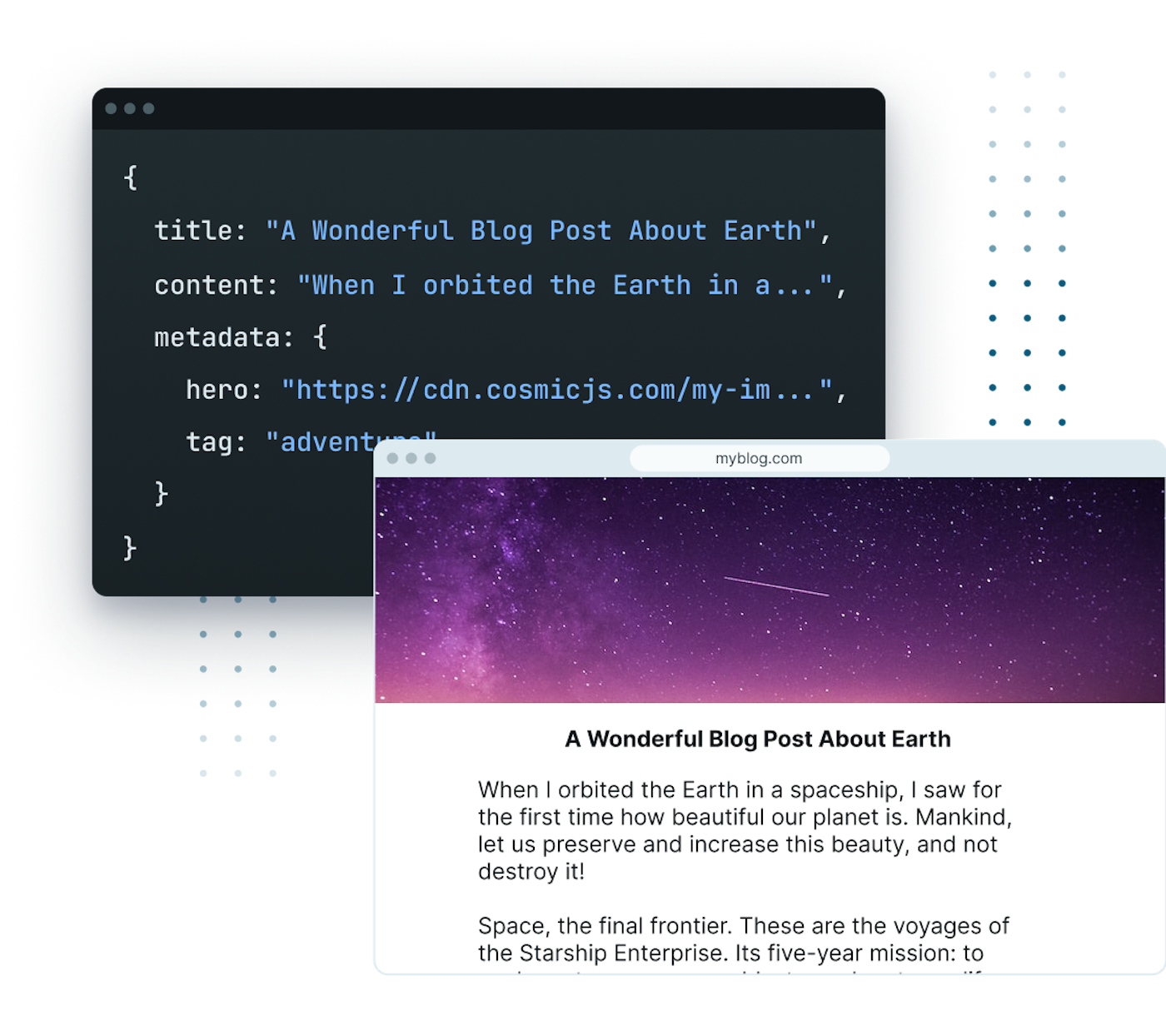
A headless CMS uses API data to display content on a custom frontend.
What is a CMS?
React only provides the "front-end" user interface (UI), handling the visual presentation of an application's content. React applications must be complemented with a compatible "back-end" database to store and retrieve content. That data source also needs a way to be managed. This is where a content management system (CMS) comes in.
What is a React CMS?
To provide content to a React application, data is served either:
- Client-side (from the browser or app) on-demand
- Server-side on-demand
- At build time (static generation)
A React CMS is created when a React UI is integrated with a CMS to handle content. To communicate with React, a CMS must offer a compatible application programming interface (API), such as a REST API or a JavaScript SDK.
A headless CMS can be used as a flexible data source for your React application to supply content via client-side, server-side, or static generation approaches. The common choices for rendering React on a server are Next.js, which is built directly around React, and Astro, which renders React components through its official React integration. Both support static generation and server rendering.
This page covers how to wire a CMS into a React app. If you are still comparing vendors and want a side-by-side evaluation, read the best headless CMS for React and Next.js instead, which scores the major options against each other.
Why use a headless CMS as a React CMS?
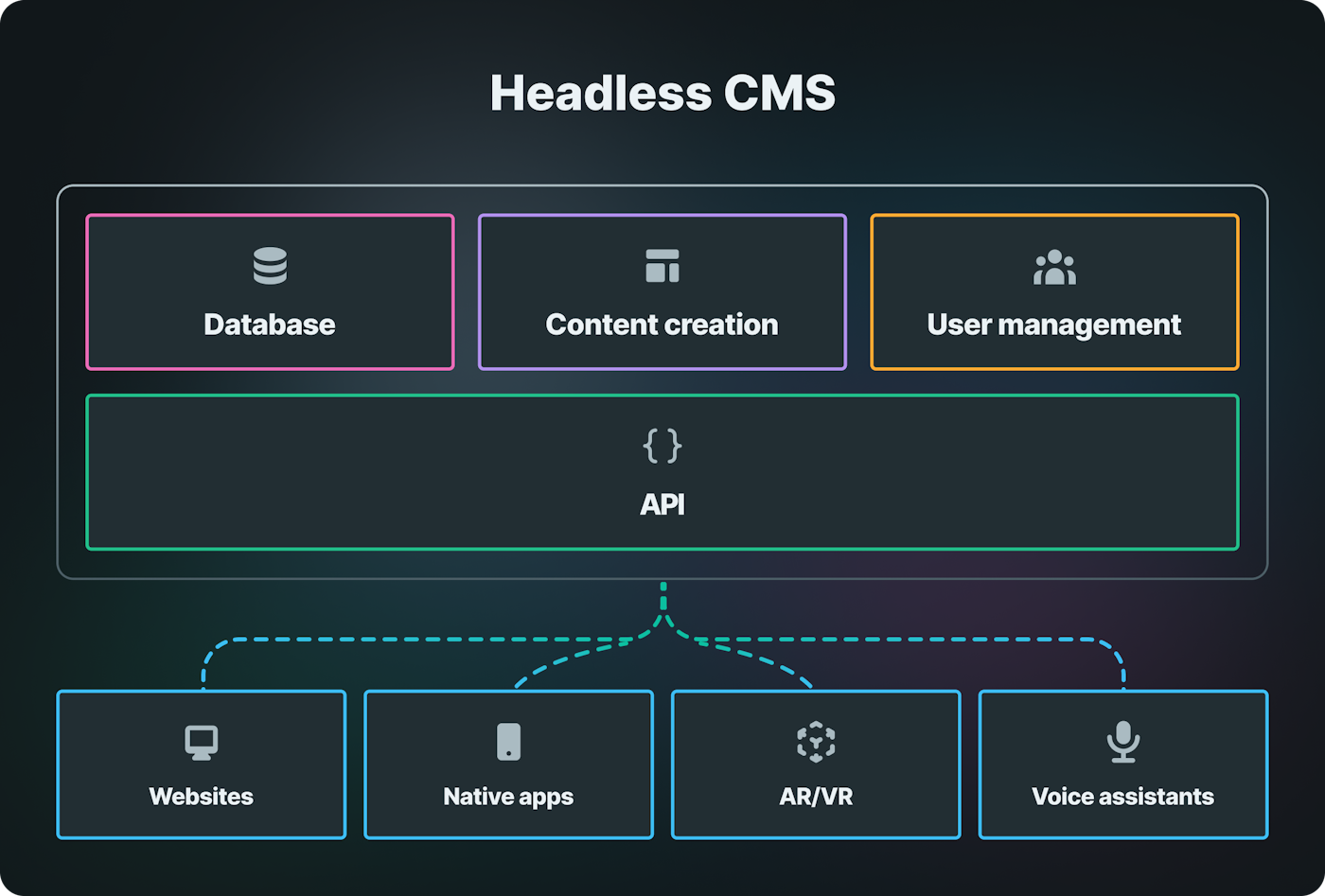
Using an API, a headless CMS can deliver content to any number of frontends.
A headless CMS gives your React application content over an API without asking you to operate the CMS itself. Content is accessible and extensible, delivered to any destination, which lets you skip infrastructure maintenance and spend development time on presentation and application business logic.
It is worth being precise about the alternative, because a common claim about traditional systems is overstated. WordPress does ship a REST API, and the WordPress REST API Handbook states directly that it can "bring your WordPress content into completely separate applications." You can absolutely put a React frontend on WordPress. The real difference is operational: with a self-managed install you still own hosting, core and plugin updates, security patching, and the performance of the database underneath. With a managed headless CMS that layer belongs to the vendor.
If you are specifically moving a React frontend off WordPress, our WordPress alternative breakdown covers what changes in your content model, your API layer, and your hosting bill.
React headless CMS content components
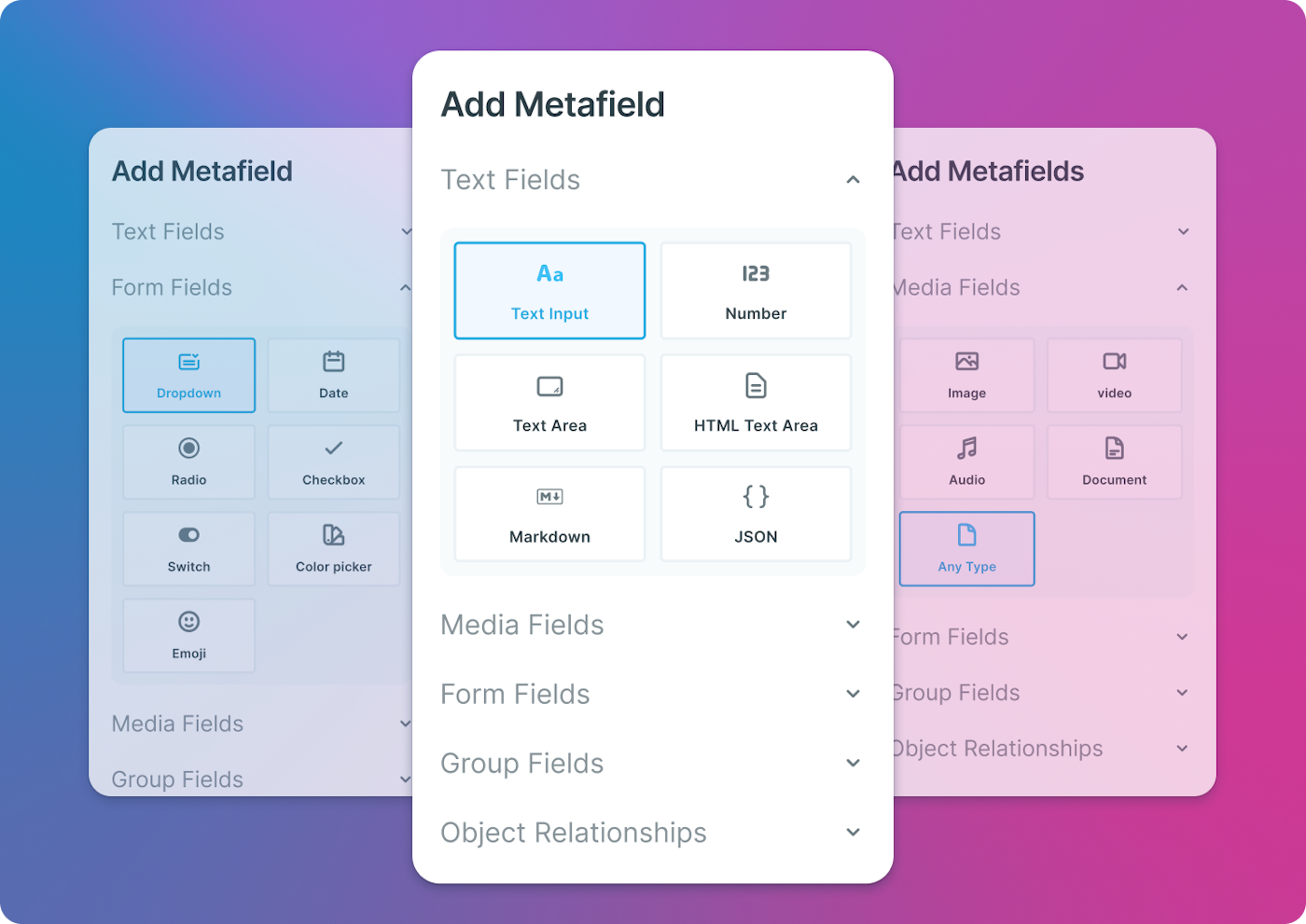
A headless CMS like Cosmic natively facilitates React's component-based JavaScript architecture. React components integrate with Cosmic's content model, supporting JSON data Objects, Metafields, and Object Relationships, making it easy to create reusable React CMS components. This native JavaScript component synchronicity with React makes Cosmic headless CMS ideal for any React application's content needs.
If you are designing those types from scratch, our content modeling guide covers how to structure Objects and relationships so your React components map cleanly onto them.
React CMS Data Compatibility and Accessibility
Using available API tools like our REST API or Cosmic JavaScript SDK, developers can create powerful user experiences using Cosmic as their React CMS.
Here is an example of fetching content for a React component:
import { createBucketClient } from '@cosmicjs/sdk';

const cosmic = createBucketClient({
  bucketSlug: 'YOUR_BUCKET_SLUG',
  readKey: 'YOUR_BUCKET_READ_KEY',
});

// Fetch blog posts for your React app
const { objects: posts } = await cosmic.objects
  .find({ type: 'blog-posts' })
  .props('title,slug,metadata.excerpt,metadata.featured_image')
  .limit(10);
Fetching content in React Server Components
If you are on the Next.js App Router, you can call the SDK directly inside a Server Component. Your read key stays on the server, and there is no client-side loading state to manage.
// app/blog/page.tsx
import { createBucketClient } from '@cosmicjs/sdk';

const cosmic = createBucketClient({
  bucketSlug: process.env.COSMIC_BUCKET_SLUG!,
  readKey: process.env.COSMIC_READ_KEY!,
});

export default async function BlogPage() {
  const { objects: posts } = await cosmic.objects
    .find({ type: 'blog-posts' })
    .props('title,slug,metadata.excerpt')
    .depth(1);

  return (
    <ul>
      {posts.map((post) => (
        <li key={post.slug}>{post.title}</li>
      ))}
    </ul>
  );
}
For a client-rendered React app built with Vite, Create React App, or React Router, the same SDK call works inside a useEffect hook or a data library such as SWR or React Query. Use a read key in browser code, never a write key.
Spin up a free Bucket and try these calls against real content, no credit card required.
Using a CMS with React Native
React Native has no DOM and no build-time HTML step, so a CMS that depends on rendering templates or on a web-only preview iframe is a poor fit. An API-first CMS avoids the problem entirely: the same REST endpoint and the same @cosmicjs/sdk client work in a React Native app exactly as they do on the web, because the response is JSON.
// Works in React Native, no web-specific dependencies
import { createBucketClient } from '@cosmicjs/sdk';

const cosmic = createBucketClient({
  bucketSlug: process.env.EXPO_PUBLIC_COSMIC_BUCKET_SLUG,
  readKey: process.env.EXPO_PUBLIC_COSMIC_READ_KEY,
});

export async function getPosts() {
  const { objects } = await cosmic.objects
    .find({ type: 'blog-posts' })
    .props('title,slug,metadata.excerpt,metadata.featured_image')
    .limit(20);
  return objects;
}
Two practical notes. Only ever ship a read key into a mobile bundle, since anything in the bundle is recoverable. And request images at the size the device actually needs by appending width and format parameters to the imgix URL, which matters more on mobile data than it does on desktop. See the image CDN page for the available transformations.
Should you build your own CMS with React?
Building an admin UI in React is a reasonable exercise, and for a genuinely small project it can be the right call. What people tend to underestimate is everything behind the form: authentication and roles, validation, media upload and processing, draft and publish states, revision history, localization, backups, an API layer, and then keeping all of it patched. That work never appears in the initial estimate and it never stops.
The middle path is usually the best one. Use a headless CMS for storage, editing, and delivery, then build your React frontend however you like. You keep total control of the presentation layer, which is the part that differentiates your product, and you stop maintaining the part that does not.
What to consider when choosing a React headless CMS
When choosing a headless CMS for React, take into consideration the following factors:
- Ease-of-use
- Availability
- Performance
- Security
- Features
- AI capabilities
- Customizability
- Future-proofing
React CMS ease-of-use
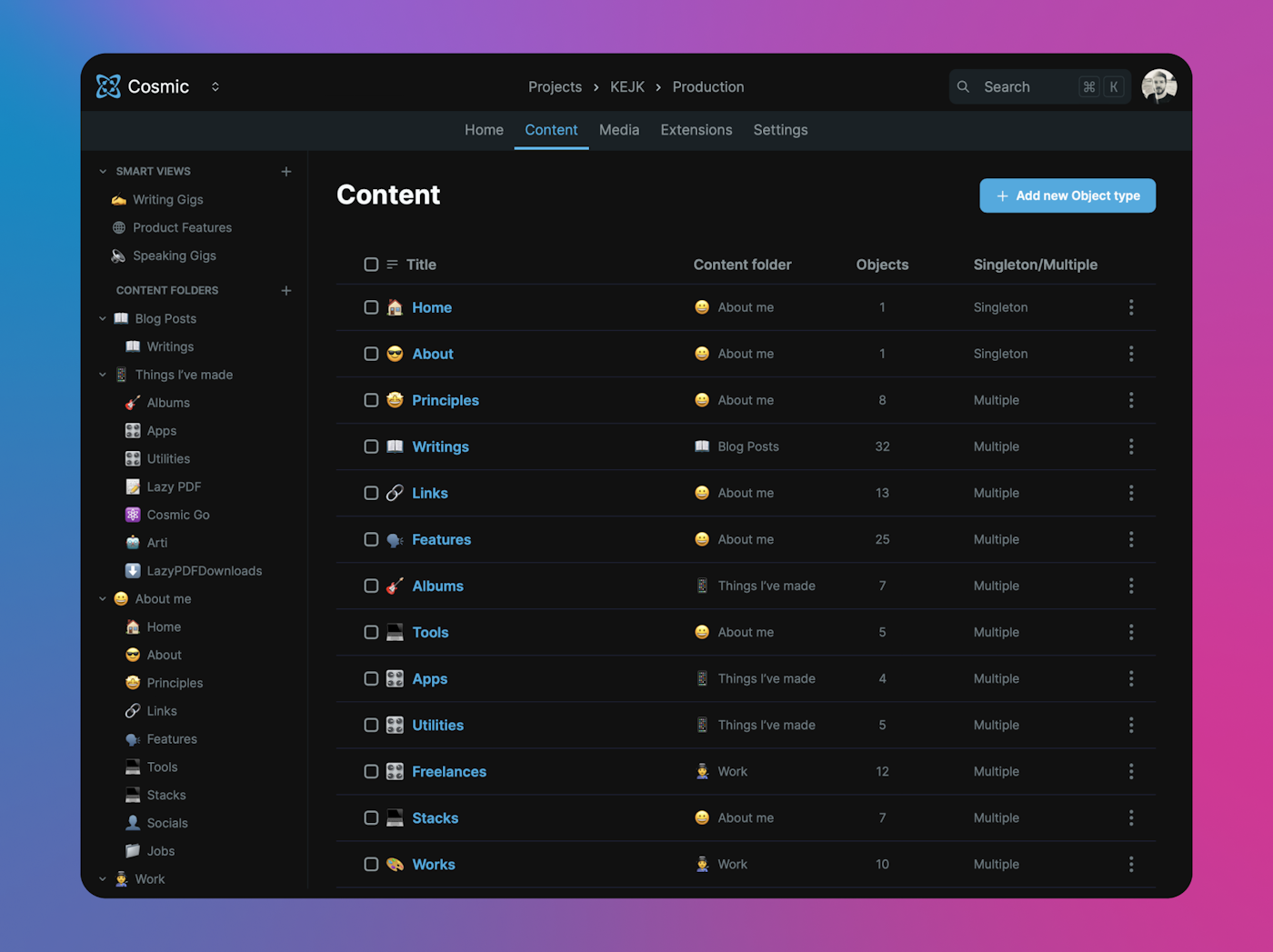
When choosing any content management system as your React CMS, it's essential to consider the experience for both the developer and the content creator. The goal of a CMS is to deliver an easy-to-use dashboard for content creators while giving the developers comprehensive integration tools. A headless CMS, by definition, is only focused on these two experiences, and not on the presentation layer.
The Cosmic content management dashboard and APIs have simplified convoluted and repetitious procedures, and circumvented common issues. Powerful API design and tooling is available for developers, complemented by a coherent management dashboard for content creators.
Availability of React CMS server
The most important factor of any reliable network-based React CMS application is its availability, or uptime. Without a reliable headless CMS foundation, access to the React CMS application will be impossible, inconsistent, or otherwise unstable.
Performance and speed of React headless CMS
Cosmic headless CMS serves content within the best performance recommendations of under 600 milliseconds as advocated by Google. Compliance with this best performance recommendation provides React CMS end-users the optimal user experience (UX), improving search engine optimization (SEO) and user retention.
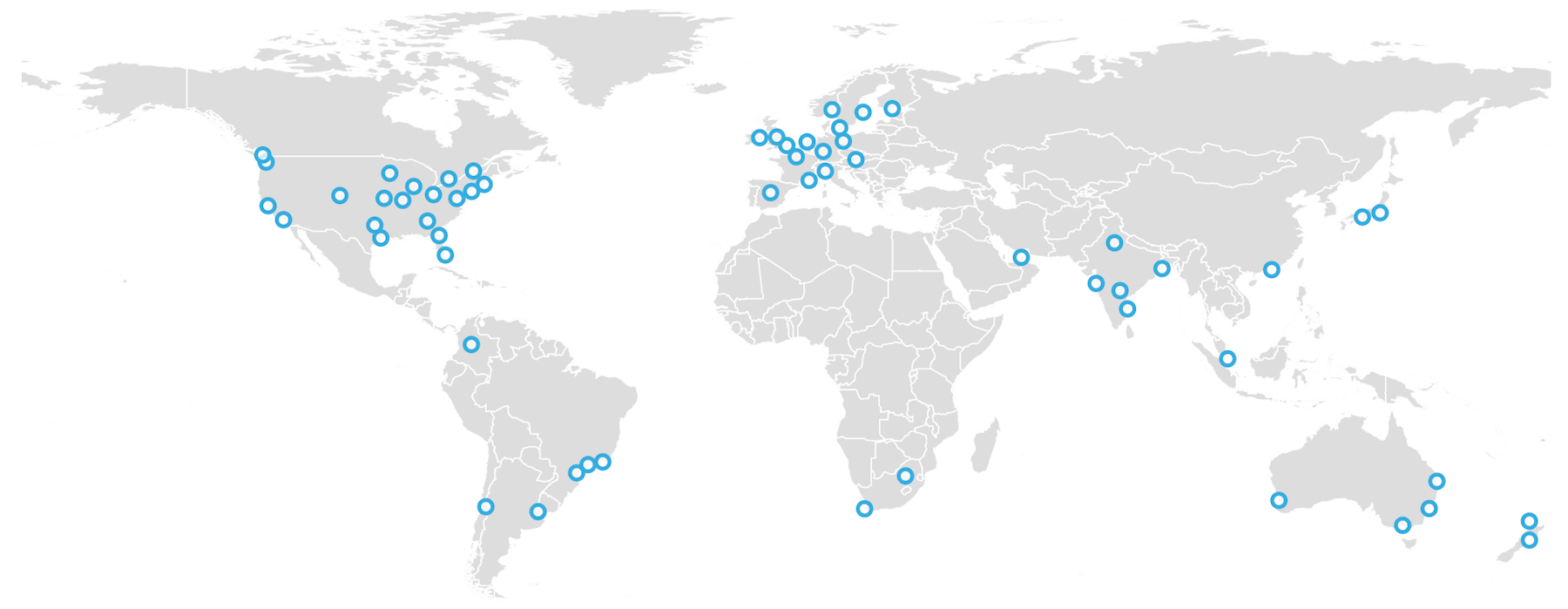
Cosmic headless CMS integration with React creates a React CMS that stores and delivers content within milliseconds powered by our global CDNs. This performance is assured by Cosmic's global network of best-in-class headless CMS servers that consistently ensure minimal latency as your React CMS.
Images get the same treatment. Every file you upload is served through our image CDN with on-the-fly resizing, cropping, and format conversion, so a React component can request exactly the width and format each breakpoint needs instead of shipping one oversized asset to every device.
Security for React CMS

Headless CMS data is securely delivered by the Cosmic APIs within industry standard 256-bit SSL encryption in transit and in storage in our global data centers. Additional security via two-factor authentication is also available for free. This industry standard level of security comes included with all Cosmic accounts.
With a self-hosted CMS, server patching, SSL configuration, and access control stay on your team's plate. Cosmic operates that layer for you.
React CMS feature sets
Core content operations are included on every plan: the REST API, the JavaScript and TypeScript SDK, flexible content modeling, media hosting through the image CDN, role-based team access, and AI agents and workflows.
Four workflow features are sold as paid add-ons rather than bundled into the base plans, and it is worth knowing that before you budget:
- Webhooks ($99/month) automatically send data to the URL of your choice whenever content is edited in your Bucket, which is how you trigger a rebuild or notify a third-party app.
- Localization ($99/month) lets you publish multiple versions of your content in different languages, with over 400 locales. Retrieving localized content is as simple as adding a locale parameter to your API request.
- Revision History ($99/month) tracks every change made to your content so you can roll back to any previous version.
- Automatic Backups ($99/month) back up your entire Bucket on a schedule.
All four are available together as a bundle for $199/month, which the pricing page lists as a 50% saving against buying them individually. Automatic Backups includes a 14-day free trial; the other three do not advertise one.
AI-powered React CMS
Modern React applications deserve a CMS with modern capabilities. Cosmic integrates AI directly into the content management workflow through agents. There is one kind of agent, and you switch on the capabilities each one needs:
- Content - read from and write to the CMS. Draft posts, product descriptions, and landing pages, then publish them.
- Code - work against a connected GitHub repository. Build React components, wire API integrations, and open pull requests.
- Communication - talk to your team in Slack, WhatsApp, or Telegram, so content work happens in the channel where the team already is.
- Browser automation - drive a real browser to research, verify a live page, or complete a multi-step task on a site.
Agents can be scheduled with recurring goals, so a content pipeline for your React application runs without someone kicking it off. Plans include both agents and workflows: the Free plan comes with 1 agent and 1 workflow, and the higher plans raise both limits.
If you are still picking the coding agent that will build the React app itself, Claude Code vs Codex vs Cursor compares the three on model choice, where the agent executes, and what each plan actually costs. The model underneath that agent is a separate decision: Claude vs GPT-5.2 vs Gemini 3 compares the three on context window, published benchmarks, and token cost, and Claude Sonnet vs Opus covers the tier tradeoff if you have already settled on Claude. Once that agent needs to touch real content, the four real controls you get when you give an AI agent write access is direct about what is enforceable today and what is only a team convention. Cosmic issues read and write as separate keys, so you can hand an agent a read key and watch every write tool come back blocked before you wire it into anything that matters. The Cosmic MCP server is how Claude Code, Cursor, and Codex connect to a single Bucket.
"Cosmic is: us never having to ask a developer to change anything on the backend of our website." - Maximilian Wuhr, Co-Founder at FINN
React CMS customizability
A CMS must be sufficiently customizable to fulfill the functional requirements demanded by the developer, and the content management needs of the content creator. Cosmic offers the ability to customize content models with flexible metafields, including text, rich text, markdown, numbers, dates, files, images, JSON, relationships, and more. This flexibility ensures your React CMS adapts to your project's unique requirements.
React CMS future-proofing and ongoing support
Unlike systems that require manual attention for updates, security patches, and hosting, Cosmic manages your infrastructure so you can focus on building your React application. As React evolves with features like Server Components and new rendering patterns, your content layer remains stable and accessible through the same REST API.
Content portability matters here too. Your content is stored as JSON Objects and is retrievable in full through the API at any time, so migrating away is an export rather than a rescue project.
What a React CMS costs on Cosmic
| Plan | Price | Buckets | Team members | Objects |
|---|---|---|---|---|
| Free | $0/month | 1 | 2 | 1,000 |
| Builder | $99/month | 2 | 3 | 5,000 |
| Team | $299/month | 3 | 5 | 20,000 |
| Business | $499/month | 5 | 10 | 50,000 |
| Enterprise | Custom | Custom | Custom | Custom |
The Free plan requires no credit card and includes 1 agent and 1 workflow, which is enough to build and ship a real React frontend. Beyond the plan limits, additional team members are $29/user/month and additional Buckets are $29/Bucket/month. The four workflow add-ons described above are $99/month each or $199/month bundled. Full limits for API requests, bandwidth, and AI tokens are on the pricing page.
Cosmic as your React CMS
Cosmic is the AI-powered headless CMS built for modern development teams. Backed by Y Combinator (W19), Cosmic provides everything you need for your React CMS:
- REST API with JavaScript SDK and CLI tools
- AI agents with content, code, communication, and browser capabilities
- Scheduled agent goals for automated content operations
- Global CDN with automatic image optimization via imgix
- Flexible content models with relationships and JSON fields
- Works on web and React Native from the same API and SDK
- Multi-user collaboration with role-based access
Companies like FINN, Vuetify, Tripwire Interactive, and Plato use Cosmic to power their React applications.
Keep reading
- Best headless CMS for React and Next.js for a side-by-side comparison of the major vendors.
- WordPress alternative if you are migrating an existing WordPress site to a React frontend.
- API-first CMS for how the REST API behaves under load, and the per-plan request limits.
- Content modeling for structuring Objects and relationships before you build components.
- Image CDN for how media is resized, cropped, and delivered to React components.
- Headless CMS guide for a broader look at architecture, API standards, and AI capabilities in 2026.
- Claude vs GPT-5.2 vs Gemini 3 for choosing the model that will drive your content agent.
Start building for free with no credit card. If you would rather see it applied to your own stack first, book a 15-minute intro call with our CEO or talk to sales.
Cosmic plan, seat, Bucket, and add-on figures above were read from the Cosmic pricing page on September 11, 2026. The WordPress REST API capability described above was verified against the WordPress REST API Handbook on September 1, 2026.