Answer Engine Optimization (AEO) for Headless CMS: How Structured Content Wins AI Search

Tony Spiro
June 15, 2026
Search behavior is shifting. A growing share of information queries now resolve inside AI-powered answer engines: ChatGPT, Perplexity, Google AI Overviews, Claude, and Bing Copilot. These systems don't rank ten blue links. They synthesize an answer from sources they trust, cite those sources inline, and move on.
For content teams, this creates a new optimization discipline: Answer Engine Optimization (AEO), sometimes called Generative Engine Optimization (GEO). The question AEO asks is: will an AI answer engine cite your content when a user asks a question you should own?
For headless CMS teams specifically, the answer depends heavily on how content is structured at the API level. This post covers what AEO is, why structured content is the technical foundation it runs on, and what you need to do in your CMS today to start winning citations in AI-generated answers.
What Is Answer Engine Optimization (AEO)?
Answer Engine Optimization (AEO) is the practice of structuring, formatting, and distributing content so that AI answer engines can reliably extract, trust, and cite it. It overlaps with traditional SEO (domain authority, backlinks, and freshness still matter) but adds new requirements around content structure, answer completeness, and machine-readable metadata.
The key insight: AI answer engines don't crawl pages like a search bot looking for keyword density. They ingest structured data, look for authoritative and complete answers, and favor content they can parse without ambiguity. A wall of flowing prose is harder to cite correctly than a clean heading hierarchy with a direct answer in the first two sentences.
AEO vs. Traditional SEO
| Dimension | Traditional SEO | AEO / GEO |
|---|---|---|
| Primary goal | Rank in organic listings | Get cited in AI-generated answers |
| Key signals | Backlinks, keywords, freshness | Structure, completeness, authority |
| Content format | Long-form prose, keyword-rich | Clear H2/H3 hierarchy, direct answers |
| Metadata | Title tags, meta descriptions | Schema.org, structured data, API-first delivery |
| Speed of feedback | Weeks to months | Faster (AI indexes frequently) |
| Citation mechanism | Click-through ranking | Inline citation in AI answer |
Why Headless CMS Is the Technical Foundation for AEO
A traditional monolithic CMS couples your content to your presentation layer. The HTML that goes to a browser is the same format that search bots and AI crawlers see. That works fine for basic SEO. For AEO, it creates a structural problem: AI systems have to reverse-engineer the meaning of your content from rendered HTML, fighting through navigation elements, footers, sidebar ads, and other page chrome to find the actual answer.
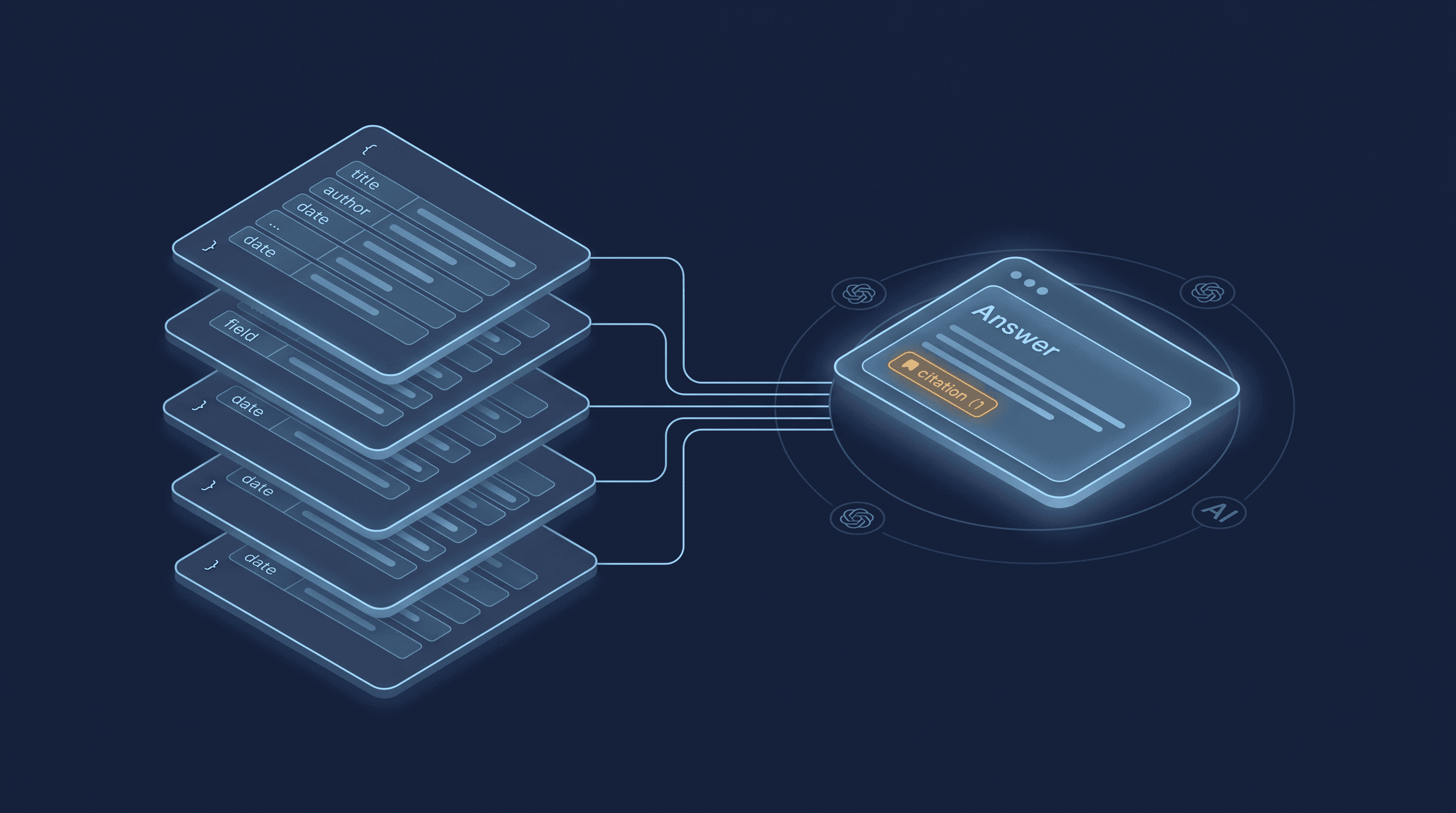
A headless CMS separates content from presentation entirely. Your content lives in structured objects with named fields: title, teaser, body, author, published_date, category, tags. An AI system querying your REST API gets clean, machine-readable JSON. It knows exactly which field is the answer, which field is the metadata, and which object type the content belongs to.
This is the core structural advantage headless brings to AEO. And it compounds: because headless content is delivered via API, you can serve the same structured data to AI crawlers, to your web frontend, to a mobile app, and to an MCP server that lets AI agents read and write your content directly.
How AI Answer Engines Evaluate Content for Citation
Understanding the evaluation criteria helps you structure content to meet them. Based on observable patterns in how systems like Perplexity, ChatGPT Search, and Google AI Overviews select sources, these factors consistently appear:
1. Topical Authority and Domain Trust
AI answer engines inherit signals from search. If your domain has accumulated authority on a topic through consistent, high-quality publishing, AI systems are more likely to treat it as a reliable source for that topic. This is why a CMS vendor that publishes deeply technical content about headless architecture will be cited on headless CMS questions more often than a general tech blog that touched the subject once.
Headless CMS application: Maintain a structured content type for authoritative reference content. Use consistent taxonomy (categories, tags) so AI systems can identify your topical clusters.
2. Answer Completeness
AI systems favor content that fully answers the likely user intent without requiring the reader to visit multiple sources. A post that defines AEO, explains why it matters, provides an actionable framework, and includes concrete examples will outperform a shallow overview that only defines terms.
Headless CMS application: Use structured fields to ensure completeness at the content model level. A metafield schema for your editorial content types can enforce that every piece has a teaser (the direct answer), a body (the explanation), and supporting tags (the topical context).
3. Structured Data and Schema Markup
Schema.org markup signals content meaning to AI systems. An Article schema tells the answer engine: this is a primary document, authored by a named person, on a specific date. A FAQPage schema makes individual Q&A pairs directly extractable.
Headless CMS application: A headless CMS with a proper REST API makes schema injection straightforward. Your frontend can generate schema.org JSON-LD from the structured fields your CMS already stores. In Cosmic, for example, the author, published_date, and category fields map directly to the author, datePublished, and articleSection properties in Article schema.
4. Freshness and Update Signals
AI answer engines weight recency for time-sensitive topics. A post published in 2026 on a 2026-relevant topic will outperform an identical 2023 post on questions where currency matters.
Headless CMS application: Store published_date and a last_updated field as distinct structured fields. This lets your frontend output accurate dateModified in schema markup, which AI crawlers use to assess freshness.
5. Direct Answer Format
Content that answers the question in the first two sentences of a section is more easily extractable than content that buries the answer in paragraph four. The heading + direct answer pattern is the foundation of AI-friendly writing.
Example of AEO-optimized structure:
## What is Answer Engine Optimization (AEO)?
Answer Engine Optimization (AEO) is the practice of structuring
content so that AI-powered answer engines can reliably extract,
trust, and cite it. [Explanation continues...]
Example of AEO-unfriendly structure:
## The Evolution of Search
Search has changed a lot over the years. With the rise of AI
and machine learning, we've seen new modalities emerge that
challenge our traditional assumptions about how...
[Three paragraphs later] ...which brings us to AEO.
The AEO Content Checklist for Headless CMS Teams
Content Structure
- Every article starts with a direct, complete answer to the primary question
- H2 headings are written as questions or clear topic statements, not clever titles
- Key definitions are in their own clearly headed sections
- Comparison tables use markdown or structured data, not image screenshots
- FAQs are modeled as structured repeater fields, not buried in body copy
CMS Schema Design
Your content layer is the foundation everything else is built on. Get the schema right and AEO becomes a frontend concern; get it wrong and no amount of markup will compensate.
- Content type schema includes
published_dateandmodified_dateas distinct date fields - Author is a structured relationship field (not freeform text) that maps to a named entity
- Category and tag taxonomy is consistent and machine-readable
- Teaser / excerpt field stores a concise direct answer (not a marketing hook)
- FAQ items are structured repeaters, not markdown embedded in a body field
Technical Delivery
- REST API delivers clean JSON with named fields (not rendered HTML)
- Frontend generates Article schema.org JSON-LD from CMS structured fields
- FAQPage schema is generated from FAQ repeater fields
-
datePublishedanddateModifiedin schema.org reflect actual CMS field values - Canonical URLs are set and consistent across API delivery and frontend rendering
- Core Web Vitals pass (AI crawlers trust faster, more reliable domains)
Distribution
- Content is published to your primary domain (AI engines weight first-party publication)
- Backlink profile is active (domain authority still matters to AEO)
- Content is cross-posted to communities where AI crawlers have high coverage (Reddit, Hacker News, Stack Overflow)
- RSS or Sitemap XML is current so AI indexers discover new content quickly
How Cosmic's API-First Architecture Supports AEO
Cosmic is built around a clean REST API that delivers every content object as structured JSON. That's the foundational architecture. Every object you create in Cosmic has:
- Named metadata fields defined by your content model schema
- Structured relationships (author, category, tags) resolved to typed objects, not strings
- ISO timestamps for creation and modification dates
- Clean slugs that map to canonical URLs
This means the AEO checklist above maps almost directly to Cosmic's data model.
Schema.org Injection from Cosmic Fields
Here's how to generate Article schema.org markup from a Cosmic blog post object using the @cosmicjs/sdk:
import { createBucketClient } from '@cosmicjs/sdk';

const cosmic = createBucketClient({
  bucketSlug: process.env.COSMIC_BUCKET_SLUG as string,
  readKey: process.env.COSMIC_READ_KEY as string,
});

// Fetch a single post with structured fields
const { object: post } = await cosmic.objects
  .findOne({ type: 'blog-posts', slug: 'your-post-slug' })
  .props(['id', 'title', 'slug', 'metadata', 'created_at', 'modified_at']);

// Generate Article schema.org JSON-LD
const articleSchema = {
  '@context': 'https://schema.org',
  '@type': 'Article',
  headline: post.title,
  description: post.metadata.teaser,
  author: {
    '@type': 'Person',
    name: post.metadata.author?.title,
  },
  datePublished: post.metadata.published_date,
  dateModified: post.modified_at,
  publisher: {
    '@type': 'Organization',
    name: 'Cosmic',
    url: 'https://cosmicjs.com',
  },
  mainEntityOfPage: {
    '@type': 'WebPage',
    '@id': `https://cosmicjs.com/blog/${post.slug}`,
  },
};

// Inject into page <head> as JSON-LD
// <script type="application/ld+json">{JSON.stringify(articleSchema)}</script>
FAQ Schema from Structured Repeater Fields
If your Cosmic blog post type includes an FAQ repeater field, you can generate FAQPage schema automatically:
const faqSchema = {
  '@context': 'https://schema.org',
  '@type': 'FAQPage',
  mainEntity: post.metadata.faqs?.map((faq: { question: string; answer: string }) => ({
    '@type': 'Question',
    name: faq.question,
    acceptedAnswer: {
      '@type': 'Answer',
      text: faq.answer,
    },
  })) ?? [],
};
This is one of the highest-leverage AEO moves available: FAQ content structured in your CMS becomes directly extractable by AI answer engines via FAQPage schema, without any additional markup work per post.
AEO Content Types That Drive Citations
Not every content type has equal AEO value. Based on observable citation patterns across AI answer engines, these formats generate the most citations:
1. Definitive Definitional Guides
Content that directly answers "What is X?" for important terms in your category. AI answer engines return to these repeatedly for definitional queries. Target the core vocabulary of your category.
2. Comparison Pages
"X vs Y" content is heavily cited because users asking comparison questions inside AI answer engines get answers drawn directly from well-structured comparison tables.
3. How-To Tutorials with Code
Step-by-step tutorials with working code examples are trusted by AI engines because the content is verifiable. Code either works or it doesn't. This signals authoritative, expert-level content.
4. FAQ Collections
Structured FAQ content with FAQPage schema is directly extractable. Build an FAQ repeater into your CMS content model and make it a standard field on every major content type.
5. Pricing and Feature Comparison Tables
Evergreen factual tables that compare pricing, features, and specifications are heavily cited in purchasing-intent queries.
AEO for Headless CMS Teams: The Practical Roadmap
If you're starting from scratch on AEO, here's a prioritized order of operations:
Week 1: Schema audit
Review your content model schema in your CMS. Confirm that author, date, category, and teaser are structured fields, and not buried in a generic body field. Add a FAQ repeater field if you don't have one.
Week 2: Schema.org injection
Ship Article and FAQPage schema.org JSON-LD to all published content. Verify with Google's Rich Results Test.
Week 3: Content formatting audit
Review your top 20 traffic pages. Rewrite any that don't put the direct answer within the first two sentences of each H2 section. Convert any answer content buried in prose into headed sections.
Week 4: Coverage gaps
Identify the core definitional queries in your category that you don't yet own. Write one authoritative definitional guide per major term. Prioritize terms where AI answer engines currently return no clear authoritative source.
Ongoing: Freshness
Set a 90-day review cycle for your top AEO pages. Update modified_date in your CMS when substantive changes are made. AI engines weight freshness, and a stale page that hasn't been touched in 18 months will lose citations to a fresher competitor even with weaker domain authority.
Real Teams Using Structured Content as a Competitive Moat
Cosmic customers who invested early in structured content schemas have a natural AEO advantage: their content is already in clean, API-deliverable JSON with named fields, structured relationships, and consistent taxonomy. Adding schema.org injection and FAQ repeaters is a frontend implementation, not a content migration.
Teams running traditional CMSs face a harder path: their content is often locked in rendered HTML, with author and date information in inconsistent formats, and FAQ content embedded in prose rather than structured fields. Getting to AEO-ready on a monolithic CMS means retrofitting structure that headless teams built in at the data model level.
Get Started with AEO on Cosmic
If you're building on Cosmic, you're already starting from a strong structural position. The REST API delivers clean JSON, your content model enforces named fields, and the SDK makes schema.org injection straightforward.
Next steps:
- Review your content schema in your Cosmic bucket and add any missing structured fields (author relationship, published_date, FAQ repeater)
- Add schema.org JSON-LD to your frontend using the SDK examples above
- Audit your top content for direct-answer formatting on each H2 section
- Start free at app.cosmicjs.com/signup if you're not on Cosmic yet
- Talk to Tony to discuss AEO strategy and how Cosmic's structure supports it: calendly.com/tonyspiro/cosmic-intro
AI answer engines are rewarding teams that treat content as structured data. Headless CMS teams are positioned to win that race. The question is whether you've done the work to take the position.