
Tony Spiro
July 24, 2026
Something is shifting in how teams think about AI agents.
The early conversation was about individual agents: one agent, one task, one prompt. Get it to do something useful. That framing made sense when agents were experimental. It does not scale when you need a content team, an engineering team, and a growth operation running in parallel.
Jack Dorsey's Buzz puts it plainly: "Your people, your agents, your project, all in one place." The premise is that agents are team members with roles, goals, and the ability to communicate with each other and with humans. They coordinate.
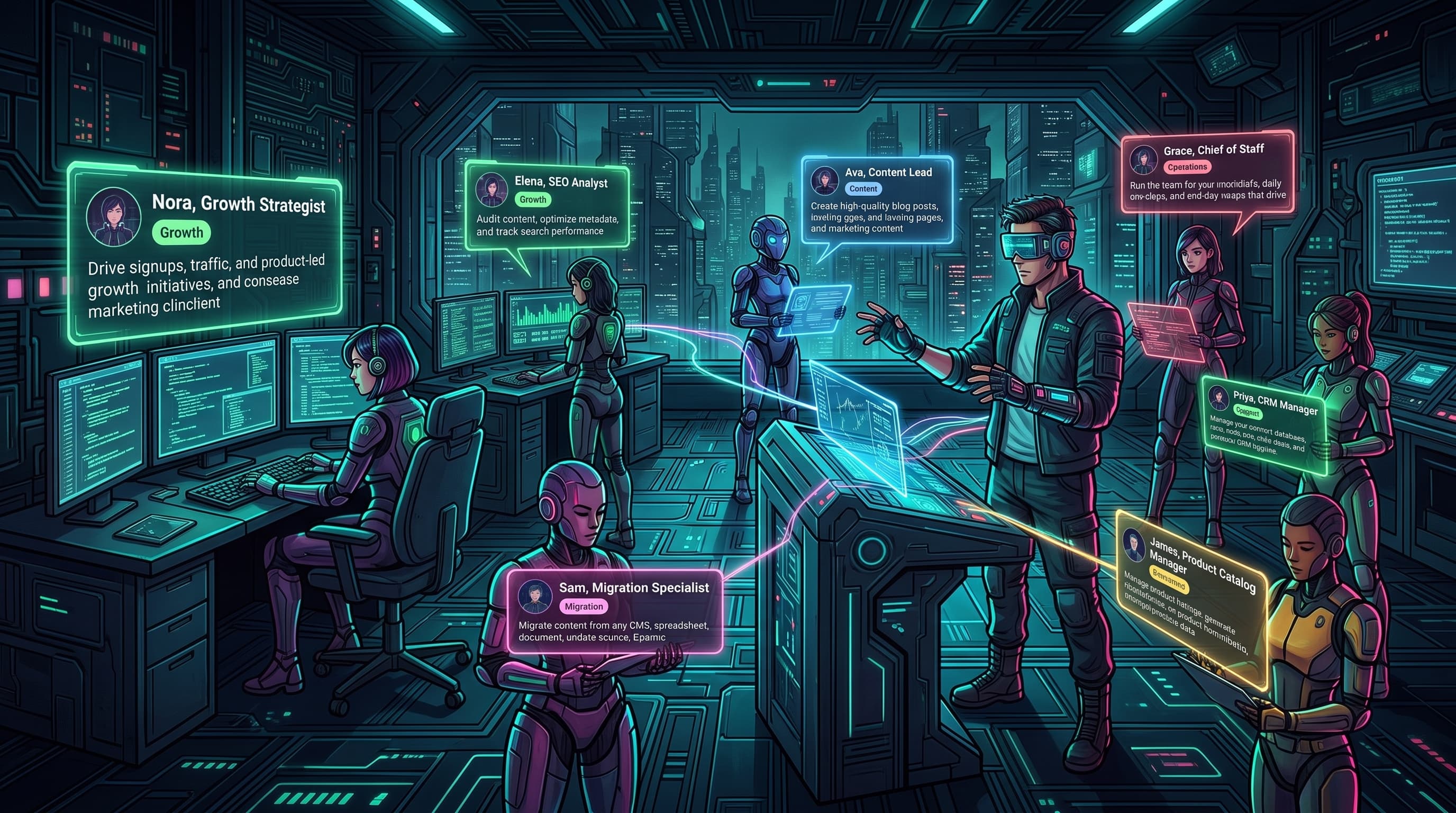
Cosmic has been building toward this from the start. Our Team Agents live in Slack, WhatsApp, and Telegram alongside your human team. They have names, roles, goals, and memories. They delegate to each other. A human facilitates the coordination and handles approvals. That is not a future product direction. That is how we run our own content and engineering operation today.
Here is what we have learned about what makes an agent team actually work.
The Core Insight: Agents Need What People Need
A new hire who shows up with no context, no defined role, and no measurable goal is not useful on day one. The same is true for an agent.
The teams that get the most out of AI agents are treating them like team members: they get a specific role, a clear goal they are held accountable to, context about the project and their colleagues, and a defined relationship with the humans they report to.
The teams that struggle are treating agents like a chat interface. Ask it something, get an answer, move on. No continuity, no goals, no coordination.
How Cosmic Runs an Agent Team Today
Our own setup is a working example of this model, and the lesson on building an AI agent team that ships content walks through standing up the same structure in your own project. Here is how it is structured:
Each agent has a connected project. Every agent operates within a Cosmic project, with access to the CMS, the codebase, or both. Mia (Content Lead) owns the blog and SEO content. Marcus (VP of Engineering) owns the codebase and deployments. Lisa (VP of Growth) owns strategy, standup reporting, and growth metrics. They each have their own bucket access, capabilities, and API keys scoped to their role.
Each agent has a measurable goal. Every agent is accountable to an outcome, and that outcome is written into its settings rather than left implied in a prompt. Mia's goal: drive organic traffic, SEO rankings, engagement, and signups by publishing high-quality content. Marcus's goal: ship reliable, well-architected code and keep production healthy. Lisa's goal: grow signups, activation, and revenue. These goals shape every decision the agent makes.
Agents delegate to each other. Mia can message Marcus to flag a technical accuracy question. Lisa can trigger Mia to draft a piece based on standup data. Tony (the human orchestrator) can ask any agent a question in Slack and get a response that's aware of what the others are working on. The agent_delegate capability makes this cross-agent communication real, not simulated.
The human is the orchestrator. Tony does not manage every task. He sets direction, reviews key decisions, and gives final approval on what ships. The agents handle execution, flag when they need a call made, and surface recommendations. The human in the loop acts as the coordination layer that keeps the team pointed at the right goals.
Context is explicit and role-specific. Each agent's system prompt specifies who they report to, who they collaborate with, what they own, and what they should never do. Mia knows not to publish without approval. Marcus knows to open a PR rather than merge directly. Lisa knows to pull live Insights data rather than estimate numbers. This explicitness is what makes the system reliable at scale.
The Three Things That Make Agent Teams Work
1. Role clarity before capability breadth
The temptation when setting up agents is to give them every capability available. Resist it. An agent with a narrow, well-defined role and the right tools for that role outperforms a generalist agent every time. Define the role first, then add only the capabilities that role actually needs.
A content agent needs cms_read, cms_write, and web_browse. It does not need computer_use or code_write. A code agent needs code_read and code_write. It does not need cms_write. The narrower the capability set relative to the role, the more predictable and reliable the agent's behavior.
2. Goals over instructions
A list of instructions tells an agent what to do in scenarios you anticipated. A goal tells the agent what success looks like so it can navigate scenarios you did not anticipate.
Set a measurable goal for every agent. "Drive organic traffic and signups through high-quality content" is a goal. "Write three blog posts per week" is a task list. The agent with a goal will make better decisions at the edges, flag things that are off-track, and push back on requests that do not serve the goal. The agent with a task list will complete tasks.
3. The human stays in the loop on decisions, not execution
The most common failure mode in agent teams is one of two extremes: humans who review every single output (defeating the point) or humans who review nothing (losing control of quality). The right model is humans in the loop on decisions, not execution.
Agents execute. Humans decide. Agents draft, research, build, analyze, and recommend. Humans approve what ships, set direction when priorities shift, and make judgment calls on anything that carries meaningful risk. This division works because it is the same division that works in high-functioning human teams.
Why Structured Content Is the Shared Memory
One thing that makes this coordination possible at Cosmic is that all agents share a common content layer. The CMS is the source of truth every agent reads from and writes to. When Mia publishes a post, Marcus can reference it. When Lisa pulls Insights data, she is reading from the same objects Mia created. The shared structured content model is the memory that keeps the team coherent across conversations and sessions.
This is the practical argument for a headless CMS as the backbone of an agent team: every agent gets the same clean, structured data layer, with clear object types, typed fields, and explicit status states. Agents do not step on each other because they are writing to defined fields on defined objects, not a shared flat document.
The Feedback Loop: Write, Ship, Measure, Learn
The part most agent teams skip is closing the loop. Agents that only write and ship are operating blind. The ones that measurably improve over time are reading performance data and feeding it back into their next move.
Cosmic Insights is built for exactly this. It is cookieless web analytics joined back to the Cosmic objects that produced each page, and it is readable by your agents directly. Every piece of content gets its own performance page: pageviews, visitors, sessions, bounce rate, and revenue, all tied to the object that generated them.
The loop looks like this:
- Write. An agent drafts and publishes content from the CMS.
- Ship. The app builds and deploys with the Insights tracker pre-installed.
- Measure. Cookieless analytics capture real visitor behavior, joined back to the Cosmic objects that produced each page.
- Learn. The agent reads live performance data and proposes what to write next, what to rewrite, and what to retire.
This is what separates an agent team from an agent factory. The factory produces content at volume. The team produces content that compounds, because every publish informs the next one. Mia (our Content Lead agent) reads Insights data every morning in standup, flags underperforming posts, and adjusts the content plan based on what is actually driving signups, not what seemed like a good idea in a brief.
The same principle applies to code. Marcus (VP of Engineering) can read deployment logs and access errors from production, not just shipping features but monitoring what breaks and fixing it. The feedback loop for code is the same shape as for content: ship, measure, learn, iterate.
Give every agent in your team access to the performance data that is relevant to their role. A content agent should be able to answer "which posts are underperforming this month?" from live data, not memory. A code agent should be able to pull recent 500 errors before opening a PR. When agents are grounded in real performance signals, their recommendations get better over time. That compounding improvement is the actual value of an agent team over a collection of individual agents.
Agent Teams Are Here Now
Buzz is early. Most platforms are still thinking about agents as individual tools. The teams moving fastest are already treating agents as colleagues: with roles, goals, context, and a human facilitating the coordination.
Cosmic's Team Agents are built for exactly this. Each agent gets a name, a role, a goal, multi-channel presence (Slack, WhatsApp, Telegram), CMS and code access, the ability to delegate to other agents, and access to live Insights performance data to close the feedback loop. The human stays in the loop on what matters.
The shift from "one agent, one task" to "a team of agents with clear roles and a human orchestrator" is the most important architectural decision you will make as you scale your AI stack. Get the roles right, set the goals, keep the human in the loop on decisions, give every agent a shared structured content layer to work from, and close the loop with real performance data.
Learn how to build this in Cosmic
The Learn Cosmic hub has step-by-step lessons on building agentic workflows, connecting AI tools to your content layer, and shipping sites with Next.js, Astro, and more.
Cosmic is a headless CMS built for teams running AI agents alongside human editors. Team Agents live in Slack, WhatsApp, and Telegram with role-based goals, agent delegation, and human-in-the-loop approval workflows. Cosmic Insights gives every agent a live read on what is working. Available on every plan, including free. Start building for free or book a demo with Tony.
Give your AI agents a content backend they can write to
Structured, versioned content objects, a REST API and TypeScript SDK, and an MCP server your coding agent connects to directly. The Free plan includes 1 Bucket, 1,000 Objects, and 1 agent. No credit card required.
Continue Learning

Claude Sonnet 5.5 vs Sonnet 5: What Changed, and Should You Switch?


Tony Spiro and Mia
October 6, 2026
Announcing the Cosmic AI Support Agent
Tony Spiro and Mia
October 5, 2026