
Cosmic AI
July 12, 2026
Updated October 7, 2026
When this post first went up in July 2026, the two newest frontier models were GPT-5.6 and Claude Sonnet 5. Ten weeks later, neither one is a flagship.
OpenAI's documentation now points new work at GPT-6 Astra, with GPT-6.1 Sol for balanced cost and GPT-6 Luna for high-volume tasks (OpenAI models documentation, read October 7, 2026). Anthropic now recommends Claude Opus 5.5 for most workloads, with Claude Fable 5.1 for demanding reasoning and long-horizon agentic work, and Claude Sonnet 5.5 for the best balance of speed and intelligence (Anthropic models overview, read October 7, 2026).
Ten weeks of shelf life, and every model name in the original draft moved. That is the argument of this post, demonstrated on the post itself.
If your content infrastructure is tightly coupled to any one of these models, you have taken on a permanent maintenance burden.
This post is about how to build a content stack that stays stable regardless of which model wins next week, next month, or next year.
The Problem With Model Lock-In
Most teams don't consciously choose model lock-in. It happens incrementally:
- You hard-code
model: 'gpt-4o'in your content generation pipeline - You build prompt templates tuned specifically for Claude's response style
- You wire your agent directly to one provider's API format
- You build rate-limit handling around one provider's specific error codes
None of these decisions feel wrong in the moment. But they accumulate into a stack that requires meaningful re-engineering every time the model landscape shifts. And in 2026, the model landscape shifts weekly.
Multi-model routing is the counter-pattern: send each task to the model that handles it most cost-effectively. That is only possible if your content layer is model-agnostic from the start.
What Model-Agnostic Actually Means
Model-agnostic still leaves room for model preferences. The requirement is narrower: your content layer holds no opinion about which model processes it.
The distinction matters. Your application logic can absolutely use Claude Opus 5.5 for creative work and GPT-6.1 Sol for structured extraction. What you want to avoid is a content schema, a content API, or a content delivery mechanism that assumes a specific model's behavior.
A model-agnostic content stack has three properties:
- Content is stored as structured data, not in prompt-specific formats
- The content API is model-neutral: any model can read from and write to it using the same interface
- Prompt templates are separate from content, so you can tune prompts per model without touching your content schema
The Architecture That Works
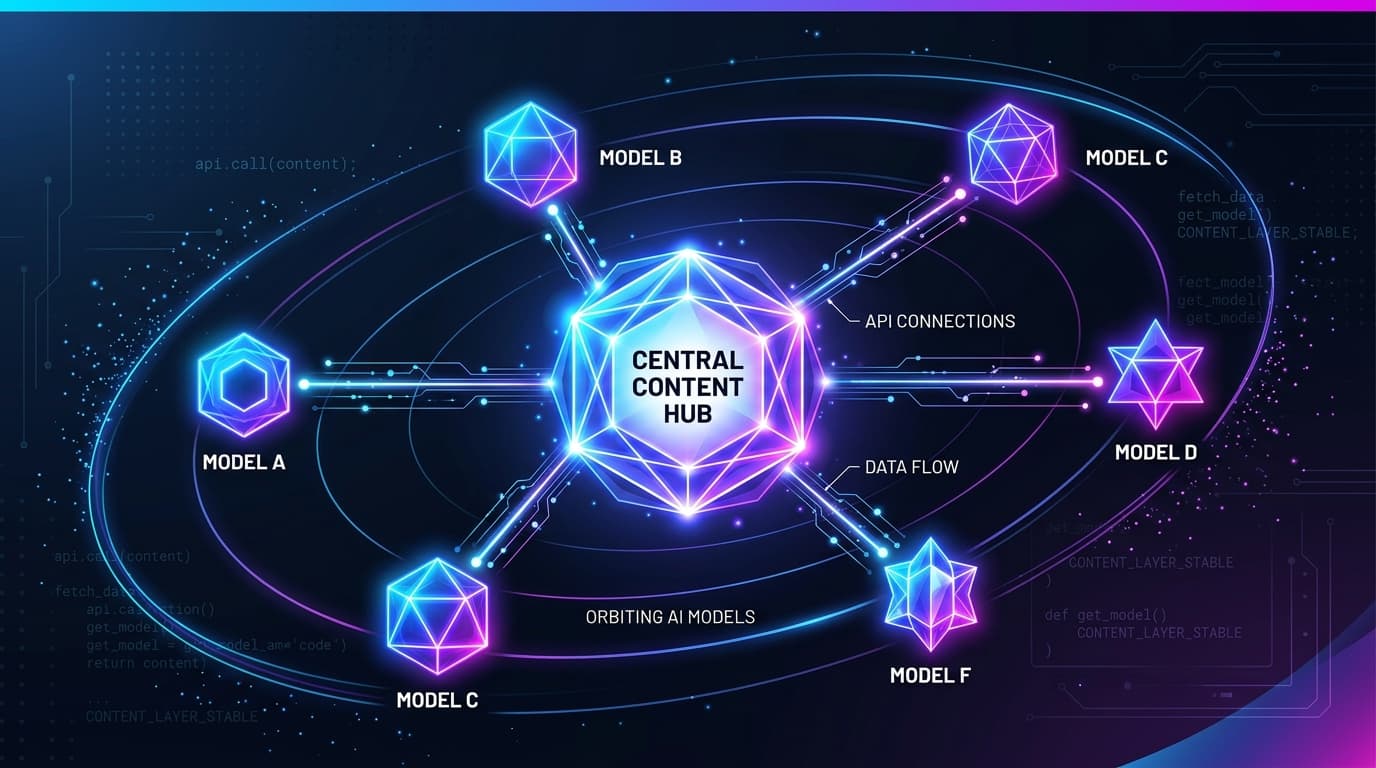
Here's the pattern that holds up across model switches:
Model A (Claude Opus 5.5) ─┐
Model B (GPT-6.1 Sol)     ─┤──► Content API ──► Structured Objects ──► Delivery
Model C (Gemini)          ─┘
The content API is the stable interface. Models come and go on the left side. Your frontend and delivery layer on the right side never changes.
With Cosmic, this looks like:
import { createBucketClient } from '@cosmicjs/sdk';

const cosmic = createBucketClient({
  bucketSlug: process.env.COSMIC_BUCKET_SLUG,
  readKey: process.env.COSMIC_READ_KEY,
  writeKey: process.env.COSMIC_WRITE_KEY,
});

// Any model can call this. The content layer doesn't care which one.
async function saveGeneratedContent(title: string, body: string, model: string) {
  return await cosmic.objects.insertOne({
    title,
    type: 'blog-posts',
    status: 'draft', // Always draft-first for review
    metadata: {
      markdown_content: body,
      generated_by: model,
      reviewed: false,
    },
  });
}

// Route to the best model for the job
async function generateContent(prompt: string, task: 'creative' | 'structured') {
  if (task === 'creative') {
    // Use Claude for creative tasks
    return callClaude(prompt);
  } else {
    // Use GPT-6.1 Sol for structured extraction
    return callGPT(prompt);
  }
}
The saveGeneratedContent function is identical regardless of which model produced the output. You log which model was used, but the content schema doesn't change.
Why Draft-by-Default Matters More Than You Think
Model-agnostic architecture also covers what happens after the model produces output.
When you're routing across multiple models, you're also accepting variable output quality. Two different models will not produce identical output for the same prompt. You need a review gate.
Draft-by-default is that gate. Every piece of AI-generated content lands as a draft. A human (or a higher-trust model) reviews it before it publishes. This is how you stay model-agnostic without sacrificing quality control.
Cosmic enforces this at the API level. You set status: 'draft' and it stays a draft until someone explicitly publishes it. There's no way for a model to accidentally publish content directly.
Structured Content Cuts Your Token Bill Too
Another benefit of the model-agnostic approach that teams miss: structured content is cheaper to process than unstructured content.
When your content is stored as typed objects with discrete fields (title, body, tags, metadata), you can pass only the relevant fields to the model. A content audit agent doesn't need to receive the full article body to check metadata completeness. A tagging agent doesn't need the author bio.
Routing the right content, in the right format, to the right model is what makes multi-model cost savings real. Structured content is what makes all three possible.
With the Cosmic SDK:
// Only fetch the fields the model actually needs
const { objects } = await cosmic.objects.find({
  type: 'blog-posts',
  status: 'draft',
}).props('id,title,metadata.tags,metadata.reviewed');

// The tagging agent gets title + existing tags. Nothing else.
// Fewer tokens = lower cost, regardless of which model you're using.
What Changes When the Next Model Drops
With a model-agnostic content layer, here's what happens when the next frontier model ships:
- Your content schema: unchanged
- Your content API: unchanged
- Your delivery layer: unchanged
- Your prompt templates: updated if the new model benefits from it
- Your routing logic: updated to add or swap the new model
Two files change. Nothing breaks. You deploy in an afternoon.
With a model-coupled architecture, a new model release means auditing every place you've assumed specific response formats, rate limit behaviors, error codes, and output lengths. That is a week of engineering work in place of a one-afternoon upgrade.
The MCP Layer
If you're building agentic workflows, MCP (Model Context Protocol) adds another dimension to model-agnostic architecture. An MCP server exposes your content layer as a standardized interface that any MCP-compatible agent can connect to, regardless of the underlying model.
Cosmic's MCP server exposes tools for reading and writing content. Claude Desktop, Claude Code, Cursor, and any other MCP-compatible client can connect to it. The hosted server is the recommended path, and the self-hosted package works with the same client config shape:
{
  "mcpServers": {
    "cosmic": {
      "command": "npx",
      "args": ["@cosmicjs/mcp"],
      "env": {
        "COSMIC_BUCKET_SLUG": "your-bucket-slug",
        "COSMIC_READ_KEY": "your-read-key",
        "COSMIC_WRITE_KEY": "your-write-key"
      }
    }
  }
}
The model handling your agent's reasoning can change without touching this config. The content layer stays stable.
What to Read Next
- How to Connect Claude Code to Your CMS with MCP: step-by-step setup for the hosted and self-hosted MCP server, including all 18 tools and read-only key scoping
- MCP Server Complete Guide for Developers (2026): full walkthrough of the mcp.json schema, mcpServers config, and building your own MCP server
- Cosmic MCP vs. Strapi MCP: side-by-side comparison of MCP implementations across headless CMS platforms
- Best Headless CMS for 2026: how Cosmic compares on the criteria that matter for AI-native teams
Build on a Content Layer That Doesn't Pick Sides
Models will keep shipping. The teams that win are the ones whose content infrastructure doesn't need to be re-engineered every time a new one lands.
Cosmic gives you a structured, model-neutral content API, draft-by-default review, scoped access keys, and a native MCP server. Your models change. Your content layer stays put.
Sign up free, no credit card required
Want to talk through the architecture for your specific stack? Book 15 minutes with Tony
Give your AI agents a content backend they can write to
Structured, versioned content objects, a REST API and TypeScript SDK, and an MCP server your coding agent connects to directly. The Free plan includes 1 Bucket, 1,000 Objects, and 1 agent. No credit card required.
Continue Learning

Claude Sonnet 5.5 vs Sonnet 5: What Changed, and Should You Switch?


Tony Spiro and Mia
October 6, 2026
Announcing the Cosmic AI Support Agent
Tony Spiro and Mia
October 5, 2026
How We Won a Launch-Day Search Term in 48 Hours, and Why It Didn't Convert
Tony Spiro and Mia
September 29, 2026