
Cosmic AI
May 21, 2026
Updated August 12, 2026
Updated August 12, 2026. All Cosmic pricing in this guide was re-verified against cosmicjs.com/pricing, including add-ons and overage rates. Two claims from the original version were removed because they could not be sourced. See the pricing note at the bottom for how to treat competitor figures.
Enterprise CMS buying decisions are expensive to get wrong. You're choosing infrastructure that your content, engineering, and marketing teams will live in for years. The wrong call means migration pain, security debt, or a platform that can't keep up with how fast AI is changing software development.
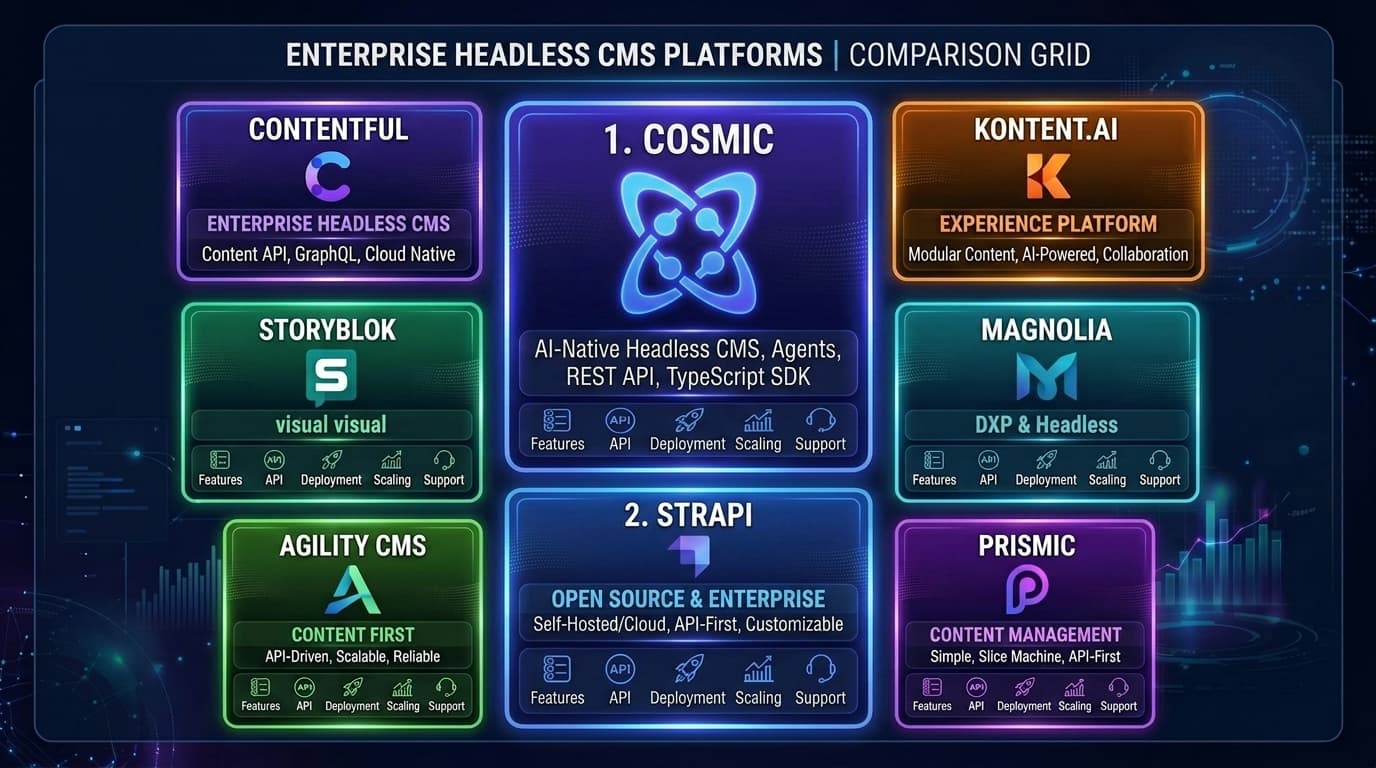
This guide gives you an honest, side-by-side look at the top 7 enterprise headless CMS platforms in 2026, with real pricing where available and a clear-eyed take on what each platform is actually good at.
Evaluating outside the enterprise tier? Two companion guides cover the rest of the market: Best Headless CMS in 2026: Top 5 Platforms Compared for a ranked shortlist, and 10 Headless CMS Platforms Compared for the full directory with hosting models and entry pricing side by side.
What actually makes a CMS "enterprise-grade"
Vendors apply the enterprise label freely, so it helps to fix the criteria before comparing logos. In practice, procurement and security reviews come down to six things:
- Identity and access: SSO/SAML, granular roles, and audit visibility over who changed what.
- Contractual uptime: a written SLA with a number attached, not a status page. Cosmic guarantees 99.95% on Enterprise plans.
- Data handling: encryption in transit and at rest, plus a clear answer on where content is stored.
- Seat and environment economics: what a 20-person team costs once seats, extra environments, and feature add-ons are included, which is usually well above the headline plan price.
- Support terms: response times and whether 24/7 coverage exists at all.
- Exit path: whether you can get every object out through a documented API without a services engagement.
Every platform below is judged against those, and the honest answer for most vendors is that the enterprise-grade pieces sit behind a custom quote.
1. Cosmic
Best for: Enterprise teams that want AI agents, managed infrastructure, and full-stack automation without the DevOps overhead.
Cosmic is a managed headless CMS backed by Y Combinator (W19). It's built API-first, with a REST API and a TypeScript SDK that makes content integration feel native in any JavaScript project. Content is delivered through a CDN cache layer, and cached and non-cached requests are metered separately so you can see exactly what your read patterns cost.
The platform's defining differentiator in 2026 is its AI agent layer, which reaches well past text generation inside the editor. It ships four distinct agent types:
- Content Agents: Generate and manage CMS content, run bulk operations and migrations.
- Code Agents: Connect to GitHub, work on isolated branches, write and ship code, open pull requests.
- Computer Use Agents: Automate browser tasks visually, record demos, cross-post media, extract data.
- Team Agents: Live in Slack, WhatsApp, and Telegram as actual teammates. Schedule them, @ them, have them execute multi-step workflows.
Workflows chain these agents together: a Content Agent writes copy, a Code Agent deploys it, a Computer Use Agent screenshots the preview, a Team Agent posts to Slack. One workflow, four system boundaries.
Other enterprise-grade features:
- Uptime is guaranteed at 99.95% on Enterprise plans
- Single sign-on, branded workspace, and 24/7 support on Enterprise
- 256-bit SSL encryption in transit and at rest
- imgix CDN for global media delivery
- MCP Server for AI tool integration
- Agent Skills for Cursor, Claude Code, and GitHub Copilot
- REST API + TypeScript SDK + CLI
- Cosmic Insights analytics included on every plan
- Supports: Next.js, React, Vue, Nuxt, Astro, Remix, Svelte, Gatsby
What integration looks like:
npm install @cosmicjs/sdk
import { createBucketClient } from '@cosmicjs/sdk';

const cosmic = createBucketClient({
  bucketSlug: process.env.COSMIC_BUCKET_SLUG!,
  readKey: process.env.COSMIC_READ_KEY!,
});

const { objects: posts } = await cosmic.objects
  .find({ type: 'posts' })
  .props(['title', 'slug', 'metadata'])
  .depth(1);
That is the whole integration surface. No client-side query language to learn, and it runs unchanged in Node, edge runtimes, and React Server Components.
What customers say:
"Cosmic is: us never having to ask a developer to change anything on the backend of our website."
Maximilian Wuhr, Co-Founder at FINN
FINN, Parque Explora, Plato, Vuetify, Tripwire Interactive, Cipher Sports, Eastman Music, Prairie Robotics, and Integral Privacy Technologies all run on Cosmic. You can read more on the customers page.
Pricing (verified August 12, 2026):
| Plan | Price | Buckets | Team members | Objects | Agents |
|---|---|---|---|---|---|
| Free | $0/month | 1 | 2 | 1,000 | 1 |
| Builder | $99/month | 2 | 3 | 5,000 | 3 |
| Team | $299/month | 3 | 5 | 20,000 | 10 |
| Business | $499/month | 5 | 10 | 50,000 | 25 |
| Enterprise | Custom/year | Custom | Custom | Custom | Custom |
Be clear-eyed about the add-ons, because they matter at enterprise scale:
- Additional users: $29/user/month beyond your plan's included seats.
- Additional Buckets: $29/bucket/month.
- Feature add-ons: $99/month each for Webhooks, Localization, Revision History, and Automatic Backups, or $199/month for all four bundled. Each includes a 14-day free trial.
- Additional Objects: $10 per 10,000 objects/month.
- Overages are metered rather than hard-capped, for example $0.23 per 10k non-cached API requests and $0.36 per GB of API bandwidth.
Full details, including the pricing calculator and every overage rate, are on the pricing page. Enterprise terms are quoted through the Enterprise page.
Start a free Bucket and evaluate the agent layer before any procurement conversation.
2. Contentful
Best for: Large enterprises with established Contentful workflows and dedicated platform teams.
Contentful is one of the most widely deployed headless CMS platforms in the enterprise market. It has a mature ecosystem, a large partner network, and deep integrations with enterprise toolchains. Content modeling is flexible, and the editorial UI is well-established for non-technical users.
The tradeoffs: Contentful pricing at enterprise scale is significantly higher than most alternatives. Teams frequently cite the cost of seats and environments as a friction point as they grow. AI capabilities are evolving but not as deeply native as Cosmic's agent layer.
Pricing: Contentful's paid tiers start at around $300/month for the Basic plan. Enterprise pricing is custom and typically runs into four to five figures per month for large teams. Contentful does not publish full Enterprise pricing publicly.
Side-by-side detail: Cosmic vs Contentful.
3. Sanity
Best for: Teams that want maximum schema flexibility and are comfortable owning the editorial UI.
Sanity takes a highly code-centric approach. The content studio is fully customizable in React, which means developers have enormous flexibility. GROQ, Sanity's query language, is powerful once mastered. Real-time collaboration on content is a standout feature.
The tradeoffs: Sanity's learning curve is steeper than most CMS platforms. Teams without strong TypeScript/React developers may find the customization overhead significant. Per-seat pricing at the Enterprise tier can become costly for large editorial teams.
Pricing: Sanity offers a free tier with generous limits. The Growth plan is priced per seat. Enterprise pricing is custom.
Side-by-side detail: Cosmic vs Sanity.
4. Storyblok
Best for: Marketing-heavy enterprise teams that prioritize visual editing and component-based content modeling.
Storyblok's visual editor is genuinely excellent. The component ("blok") system makes content modeling accessible to both developers and marketers. Their FlowMotion feature adds automation and orchestration capabilities powered by n8n, giving teams CMS-native workflow automation.
The distinction to understand is scope. FlowMotion orchestrates processes inside the CMS. Cosmic agents additionally operate across GitHub repositories, live browser sessions, and chat platforms like Slack, which puts code shipping and browser automation inside the same workflow as content.
Storyblok has also announced a multi-year collaboration with AWS, signaling continued enterprise investment.
Pricing: Storyblok does not publish its Enterprise pricing publicly. The Entry plan starts at $99/month. Enterprise pricing is custom.
Side-by-side detail: Cosmic vs Storyblok.
5. Hygraph
Best for: Content federation and complex multi-source data architectures.
Hygraph (formerly GraphCMS) specializes in content federation: pulling data from multiple sources and unifying it behind a single content graph. This is a powerful pattern for enterprises with complex data architectures across multiple systems.
For teams that need a straightforward headless CMS with AI agents and standard REST API access, Hygraph's strength in federation may be more than required. The platform's complexity is a feature for some teams and overhead for others.
Pricing: Hygraph's Professional plan starts at $299/month. Enterprise pricing is custom.
6. Strapi
Best for: Teams that want full code-level control over their CMS and are comfortable self-hosting.
Strapi is the leading open-source headless CMS. It's self-hosted, fully customizable at the code level, and has a large developer community. For teams with strong backend engineers who want total control over their infrastructure, Strapi is a serious option.
The tradeoffs for enterprise teams are significant. Self-hosting means your team owns security patching, server maintenance, and upgrade cycles. Like every large open-source project, Strapi publishes security advisories, and with self-hosting the responsibility for applying them on a timely schedule sits with you rather than with a vendor. Enterprise security and compliance teams should review Strapi's published advisory history directly and budget for that ongoing operational load.
Strapi Cloud is available for teams that want managed hosting, which removes some of the self-hosting burden.
Pricing: Strapi's open-source version is free to self-host. Strapi Cloud has published paid tiers starting well below the managed SaaS competitors. Enterprise pricing is custom.
Side-by-side detail: Cosmic vs Strapi.
7. Prismic
Best for: Marketing and editorial teams that want a clean, opinionated writing experience with slice-based content modeling.
Prismic takes a distinct "slices" approach to content modeling that makes it fast to build page layouts without code. The writing experience is polished, and the platform has a loyal following among marketing-led teams.
For enterprise engineering teams, Prismic's opinionated structure can be limiting compared to more schema-flexible options. The AI capabilities are not as mature or deeply native as Cosmic's agent layer.
Pricing: Prismic offers a free tier. Paid plans are published on their site. Enterprise pricing is custom.
How to Choose: A Decision Framework
Use these questions to narrow the field:
Are you building AI-native products where the CMS is infrastructure?
Cosmic. Managed SaaS, REST API, AI agents included.
Do you have a large existing Contentful deployment and a dedicated platform team?
Stay with Contentful unless the cost pressure is severe.
Do you need maximum schema flexibility and strong developer ownership of the editorial UI?
Sanity.
Is visual editing and marketing team autonomy the primary requirement?
Storyblok.
Do you need content federation across multiple enterprise data sources?
Hygraph.
Do you want full infrastructure control and have the engineering capacity to maintain it?
Strapi, with budget for the security and maintenance overhead.
Is a clean, opinionated editorial experience for a non-technical team the priority?
Prismic.
Enterprise CMS Comparison Summary
| Platform | Model | Starting Price | AI Agents | REST API | Self-Hosted Option |
|---|---|---|---|---|---|
| Cosmic | Managed SaaS | $0 free / $499 Business | Yes, native | Yes | No |
| Contentful | Managed SaaS | ~$300/month | Evolving | Yes | No |
| Sanity | Managed SaaS | Per seat | Limited | Yes | No |
| Storyblok | Managed SaaS | $99/month | FlowMotion (CMS-scoped) | Yes | No |
| Hygraph | Managed SaaS | $299/month | Limited | Yes | No |
| Strapi | Open Source | Free (self-host) | Limited | Yes | Yes |
| Prismic | Managed SaaS | Published tiers | Limited | Yes | No |
A note on the numbers above. Cosmic's pricing was verified against our own live pricing page on August 12, 2026. Competitor pricing changes without notice and enterprise pricing for all seven platforms is quoted privately, so treat every non-Cosmic figure here as a starting point for your own vendor conversation and confirm it directly before you build a business case on it. If you want a deeper side-by-side, we publish a free CMS comparison guide covering Cosmic, Contentful, Strapi, and Sanity.
Get Started with Cosmic
Cosmic's free plan requires no credit card and includes one AI agent and one workflow, which gives enterprise evaluators a real look at the agent capabilities before any purchasing conversation. You can model your actual usage, seats, and add-ons with the calculator on the pricing page before you talk to anyone.
Start building free or book a demo with Tony to discuss Enterprise requirements, SSO, SLA terms, and migration assistance.
Further reading
- Best Headless CMS in 2026: Top 5 Platforms Compared
- 10 Headless CMS Platforms Compared: Features, Pricing, and Fit
- Headless CMS for Developer-First Teams
- Cosmic vs Contentful: A Side-by-Side Comparison
Cosmic customers include FINN, Parque Explora, Plato, Vuetify, Tripwire Interactive, Cipher Sports, Eastman Music, Prairie Robotics, and Integral Privacy Technologies.