
Tony Spiro
May 11, 2026
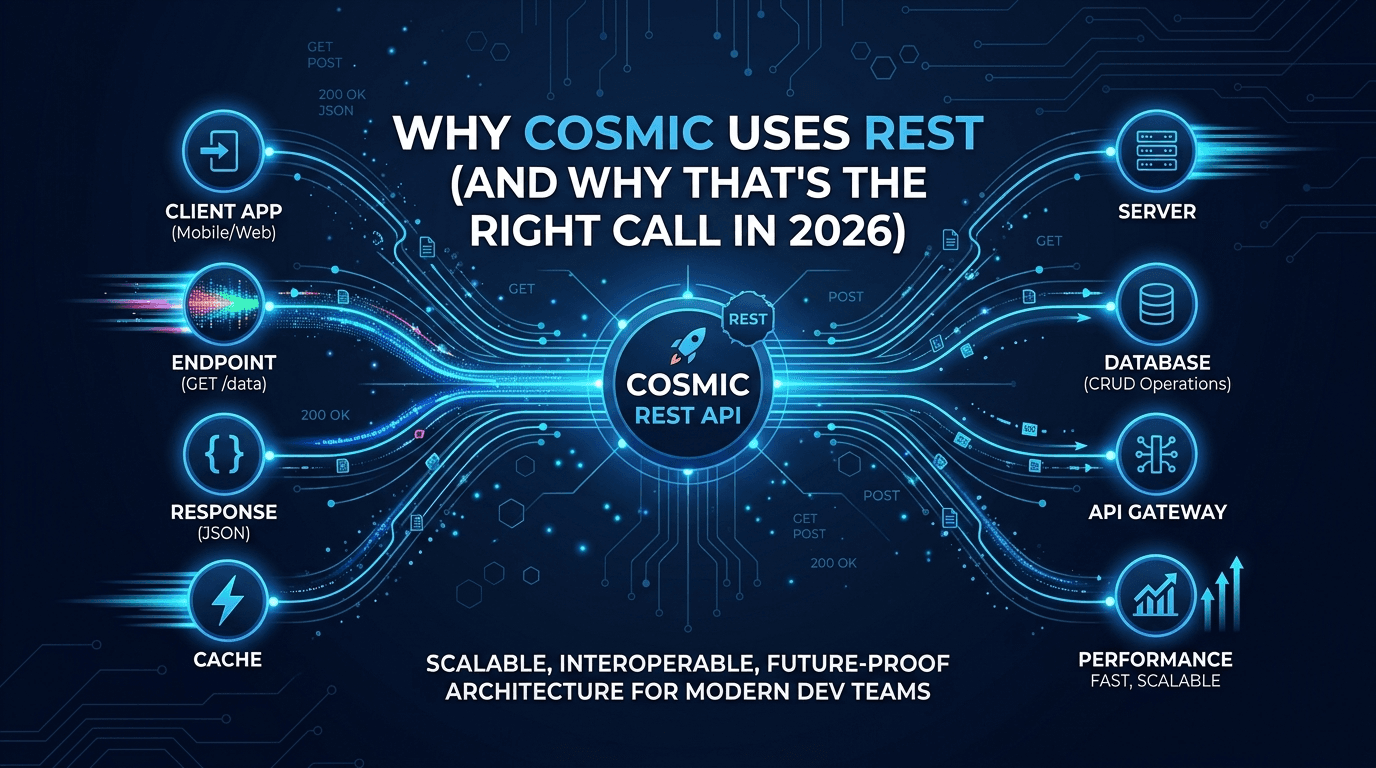
Why Cosmic Uses REST (and Why That's the Right Call in 2026)
Every few years, a new API paradigm gets declared the future. GraphQL had its moment. And it's genuinely good — for certain use cases. But "good for certain use cases" and "better default for most teams" are different claims. REST is still the right default, and in 2026 there's a new reason it matters: AI agents.
Here's an honest breakdown of the tradeoffs, and why Cosmic is REST-first by design.
The Honest GraphQL vs REST Comparison
Let's be direct about where each one wins.
Where GraphQL excels
- Precisely shaped responses. GraphQL lets clients request exactly the fields they need. On mobile or low-bandwidth environments, this can meaningfully reduce payload size.
- Single endpoint for complex graphs. When your data has deeply nested relationships and you need to traverse them in a single request, GraphQL's query model can simplify client code.
- Rapid iteration on the client side. Frontend teams can adjust what data they fetch without waiting for a backend API change.
- Type-safe schema introspection. Tooling like Apollo DevTools and GraphQL Codegen is genuinely excellent for teams that invest in the ecosystem.
Where REST wins
- Simplicity. A REST endpoint is a URL. Any HTTP client — curl, fetch, Postman, a Python script, an AI agent — can consume it without understanding a schema or learning a query language.
- Cacheability. HTTP caching is built for REST. GET requests to a stable URL can be cached at the CDN layer with no additional tooling. GraphQL's POST-by-default convention makes this harder.
- Debuggability. When something breaks, a REST API gives you a URL you can open in a browser, paste into Postman, or log directly. GraphQL errors can be harder to trace without dedicated tooling.
- Ecosystem breadth. REST is universal. Every language, every framework, every tool speaks REST.
- Operational simplicity. No query parser, no resolver overhead, no N+1 query problems to solve. For most content APIs, the queries are simple enough that REST's structure is a feature, not a limitation.
The honest verdict on GraphQL
GraphQL makes sense for complex, client-driven data fetching scenarios — large product catalogs with dozens of relationship types, mobile apps with strict bandwidth constraints, teams with mature frontend infrastructure. It's a real tool for real problems.
But most content APIs are not that complex. A blog post has a title, a body, some metadata, and maybe a category. A landing page has sections and a hero image. REST handles these cases cleanly, with less overhead and more cacheability.
Why 2026 Changes the Calculation: AI Agents
Here's the new variable: AI agents are now part of most content workflows. And REST is dramatically better suited for agent consumption than GraphQL.
REST endpoints are trivially parseable by LLMs
A REST endpoint is a URL with predictable structure: GET /objects?type=blog-posts&limit=10. An AI agent can construct this URL from a natural language instruction without understanding a schema. The response is JSON — structured, flat, predictable.
GraphQL requires the agent to understand the schema, construct a valid query document, and handle the query syntax correctly. That's more tokens, more failure modes, and more prompting complexity.
Caching matters for agent workflows
AI agents often make repeated, similar requests — checking content status, fetching object counts, reading metadata. CDN-cached REST responses make this cheap and fast. GraphQL's POST-by-default pattern bypasses CDN caching entirely, meaning every agent request hits your origin.
Direct URL-based queries are auditable
When an AI agent fetches content via a REST endpoint, the request is a plain URL you can log, inspect, and replay. This matters for debugging agent workflows and for understanding what your agents are actually doing.
The emerging standard: REST + structured JSON
Tools like Model Context Protocol (MCP) and the major LLM provider SDKs are all built around REST + JSON. The ecosystem is converging on REST as the lingua franca for agent-to-service communication — because it's the most universally parseable format.
Cosmic's REST API in Practice
Cosmic's REST API is designed to be fast, predictable, and easy for both humans and AI agents to consume.
Sub-100ms response times globally via CDN caching. Whether it's a developer building a Next.js page or an AI agent fetching content to include in a generated article, the API is consistently fast.
Here's a simple example using the Cosmic TypeScript SDK — which wraps the REST API with full type safety:
import { createBucketClient } from '@cosmicjs/sdk'

const cosmic = createBucketClient({
  bucketSlug: process.env.COSMIC_BUCKET_SLUG as string,
  readKey: process.env.COSMIC_READ_KEY as string,
})

// Fetch recent blog posts
const { objects: posts } = await cosmic.objects
  .find({ type: 'blog-posts' })
  .props(['id', 'title', 'slug', 'metadata.teaser', 'created_at'])
  .sort('-created_at')
  .limit(10)

console.log(posts)
The SDK compiles down to simple REST requests. No schema introspection. No query document compilation. Just a URL, a JSON response, and TypeScript types.
You can also call the REST API directly without the SDK:
curl "https://api.cosmicjs.com/v3/buckets/my-bucket/objects?type=blog-posts&limit=10&read_key=YOUR_READ_KEY"
That URL is cacheable at the CDN layer, inspectable in a browser, and consumable by any HTTP client — including an AI agent with no Cosmic-specific knowledge whatsoever.
The Decision in Plain Terms
For most content APIs, REST is faster to implement, easier to cache, simpler to debug, and better suited for the AI-agent workflows that are becoming standard in 2026.
GraphQL is the right call when you have complex, client-driven data fetching needs and a team that's ready to invest in the ecosystem. Those situations exist. But they're not the default.
Cosmic is REST-first because REST is the right default for content delivery — and because in a world where AI agents are increasingly reading and writing your content, the simplicity and cacheability of REST becomes even more valuable, not less.
Start Building with Cosmic
The Cosmic REST API is available on the free plan, no credit card required. Fetch your first objects in under five minutes.
Want to talk through your architecture? Book time with Tony, Cosmic's CEO.