
Claude Sonnet 5: Benchmarks, Pricing, and What Developers Need to Know (2026)

Tony Spiro
June 30, 2026
Updated August 26, 2026
Anthropic released Claude Sonnet 5 on June 30, 2026. This is the most capable and agentic Sonnet model yet, with performance approaching Opus 4.8 at significantly lower cost. Here's everything developers need to know.
Source: Anthropic, Introducing Claude Sonnet 5, published June 30, 2026.
Updated July 31, 2026: Anthropic has since shipped Claude Opus 5. If you are choosing between the two current-generation models for real work, read Claude Sonnet 5 vs Opus 5: A Real-World Comparison. Everything below covers Sonnet 5 as launched on June 30, 2026.
Pricing correction, August 20, 2026. An earlier version of this post stated that Sonnet 5 introductory pricing would end on August 31, 2026 and rise to $3/$15 on September 1. We re-checked claude.com/pricing on August 20, 2026 and could not substantiate that. The page lists Sonnet 5 at $2 per million input tokens and $10 per million output tokens, with no introductory label, no end date, and no announced increase. We have removed the deadline and kept $3/$15 only as a planning scenario, clearly marked as such. See the Pricing section for details. Re-checked again on August 26, 2026 against Anthropic's models overview: still $2/$10, still no introductory label.
What Is Claude Sonnet 5?
Claude Sonnet 5 is Anthropic's latest mid-tier model, positioned between Haiku (fast, cheap) and Opus (most capable). Anthropic describes it as delivering near-Opus-4.8 performance at Sonnet pricing, with particular strength in agentic, multi-step tasks.
Sonnet 5 is the new default model for Free and Pro plans, and is also available on Max, Team, Enterprise, Claude Code, and the Claude API.
Benchmark Results
All figures are sourced directly from the official Anthropic announcement as published on June 30, 2026. These benchmark numbers were not independently re-verified in the August 20 or August 26, 2026 passes.
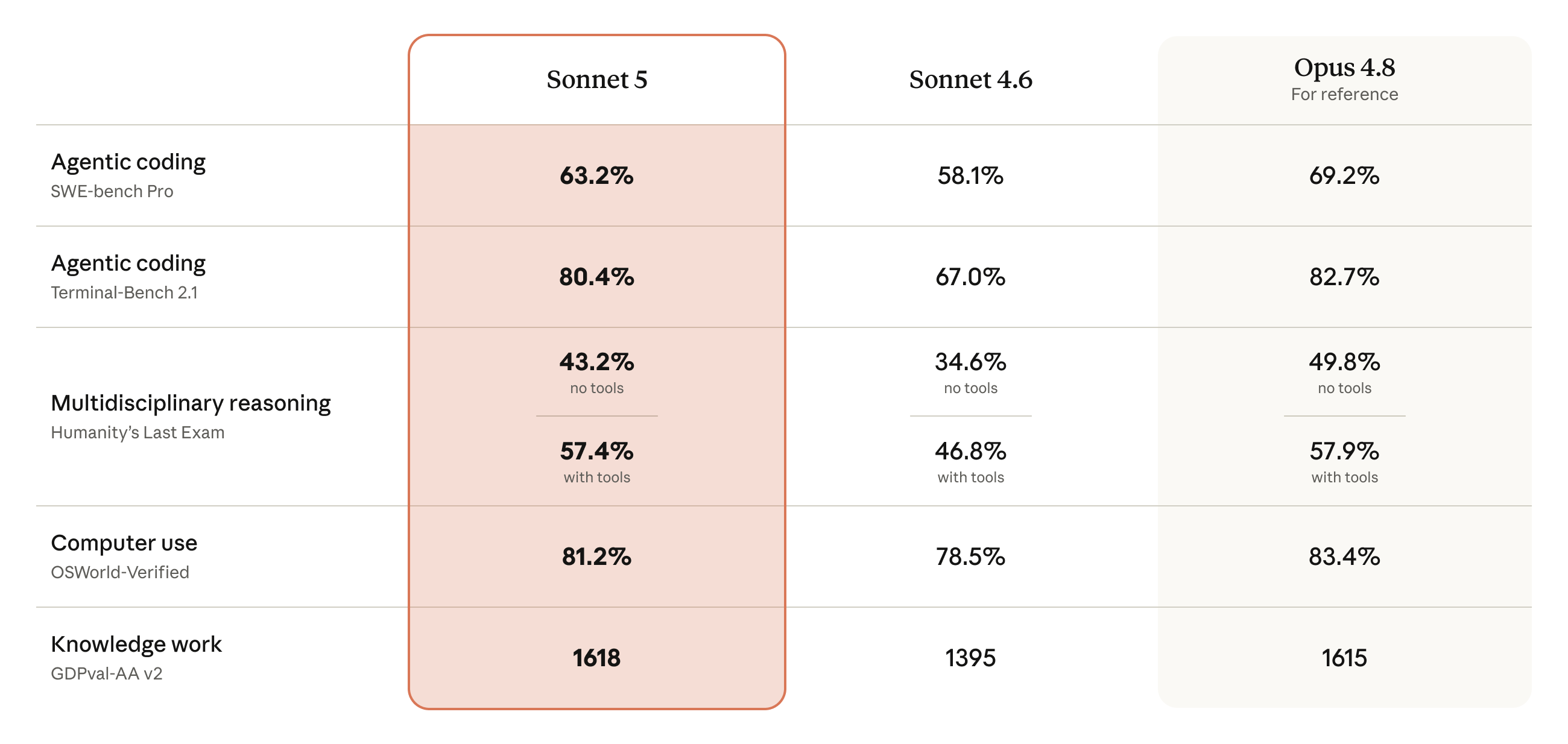
- SWE-bench Verified: 72.7% (Sonnet 4.6: 62.3% / Opus 4.8: 79.4%)
- Terminal-bench: 76.1% (Sonnet 4.6: 55.4%), the biggest jump at +20.7 points
- GPQA Diamond: 78.0% (Sonnet 4.6: 68.0%)
- MMMU: 76.3% (Sonnet 4.6: 70.4%)
- MathVista: 76.6% (Sonnet 4.6: 67.2%)
- CharacterEval: 90.3% (Sonnet 4.6: 81.0%)
The Terminal-bench jump (+20.7 points) is the headline number for agent builders. It measures performance in real terminal environments on multi-step agentic coding tasks, exactly the workload Sonnet 5 is designed for.
Agentic Cost vs Performance
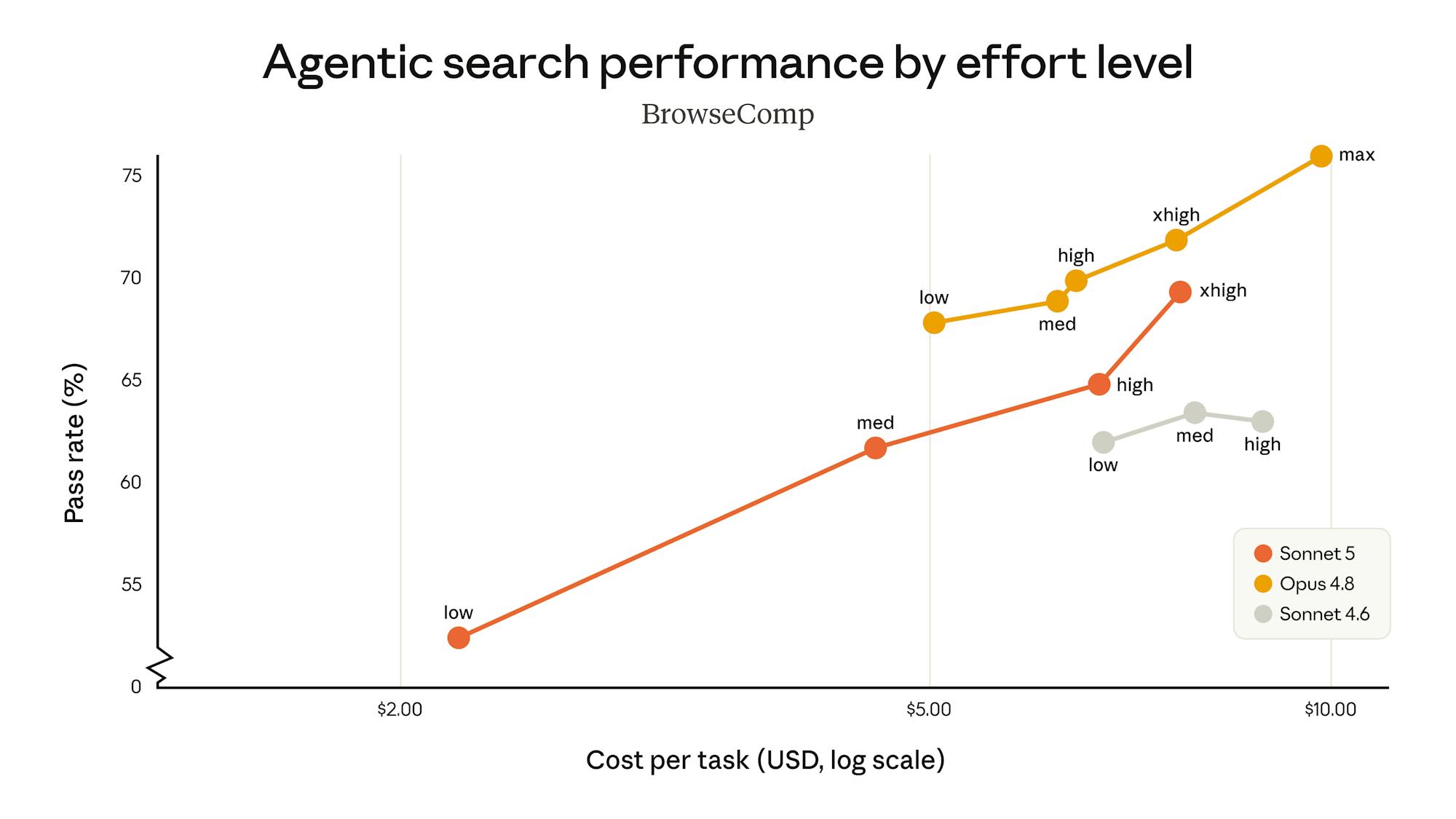
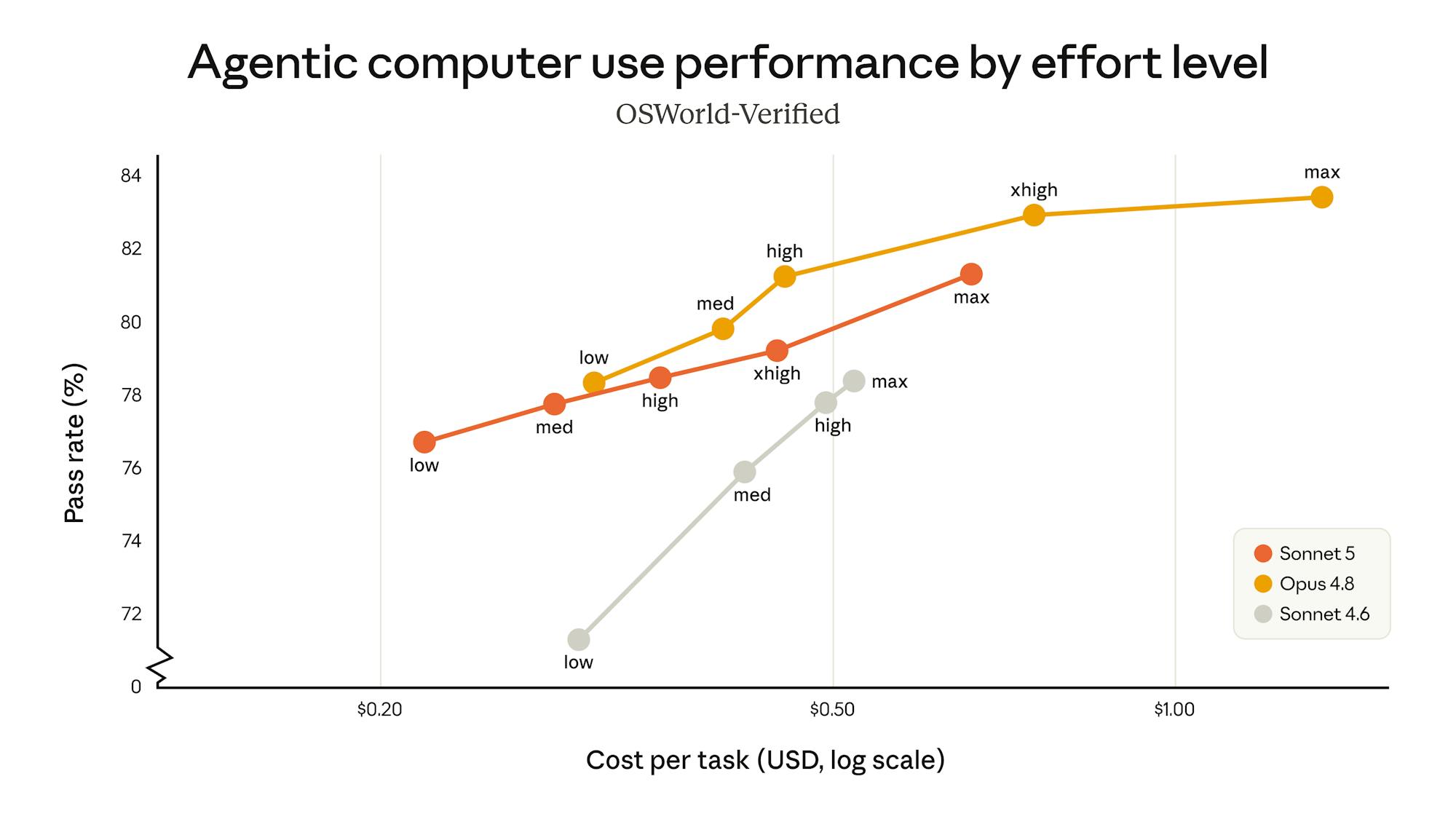
The cost/performance charts show Sonnet 5 sitting in a compelling position: better than every previous Sonnet and Haiku on agentic tasks, at a fraction of Opus pricing. For teams running high-volume agent workflows, this is a meaningful efficiency improvement.
From the announcement:
"Claude Sonnet 5 can update Salesforce account tiers, send a launch announcement to enterprise contacts, and finish end to end."
Anthropic is explicitly positioning this as a model for real, multi-step autonomous work.
Pricing
Current API rates, verified against Anthropic's models overview on August 26, 2026:
| Model | Input / 1M | Output / 1M | Context window |
|---|---|---|---|
| Sonnet 5 | $2 | $10 | 1M tokens |
| Opus 5 | $5 | $25 | 1M tokens |
| Fable 5 | $10 | $50 | 1M tokens |
| Haiku 4.5 | $1 | $5 | 200K tokens |
All four current models carry a 128K max output except Haiku 4.5 at 64K. Anthropic's own guidance on that page is to start with Opus 5 for complex agentic coding and reach for Fable 5 only when you need the highest available capability.
For reference, Anthropic's pricing page lists these as legacy models (checked August 20, 2026):
| Legacy model | Input / 1M | Output / 1M |
|---|---|---|
| Sonnet 4.6 | $3 | $15 |
| Sonnet 4.5 | $3 | $15 |
| Opus 4.8 | $5 | $25 |
| Opus 4.5 | $5 | $25 |
| Opus 4.1 | $15 | $75 |
About the "introductory pricing" question
An earlier version of this post said Sonnet 5's $2/$10 was introductory and would rise to $3/$15 on September 1, 2026. On August 20, 2026 we could not verify that anywhere on Anthropic's live pricing page: Sonnet 5 is listed at $2/$10 with no introductory qualifier and no stated end date. The August 26, 2026 re-check found the same thing. We have removed the deadline rather than repeat a claim we cannot source.
If you want a conservative budget, modelling Sonnet 5 at $3/$15 is a reasonable planning scenario, since that is where the previous Sonnet generation sits. Treat it as a hedge you chose, not as an announced price change. A pipeline spending $400/month at $2/$10 would spend roughly $600/month at $3/$15 on identical volume.
Important tokenizer note: Sonnet 5 uses a new tokenizer. The same input can map to 1.0 to 1.35x more tokens than on previous models. Audit your token budgets before switching in production.
Safety
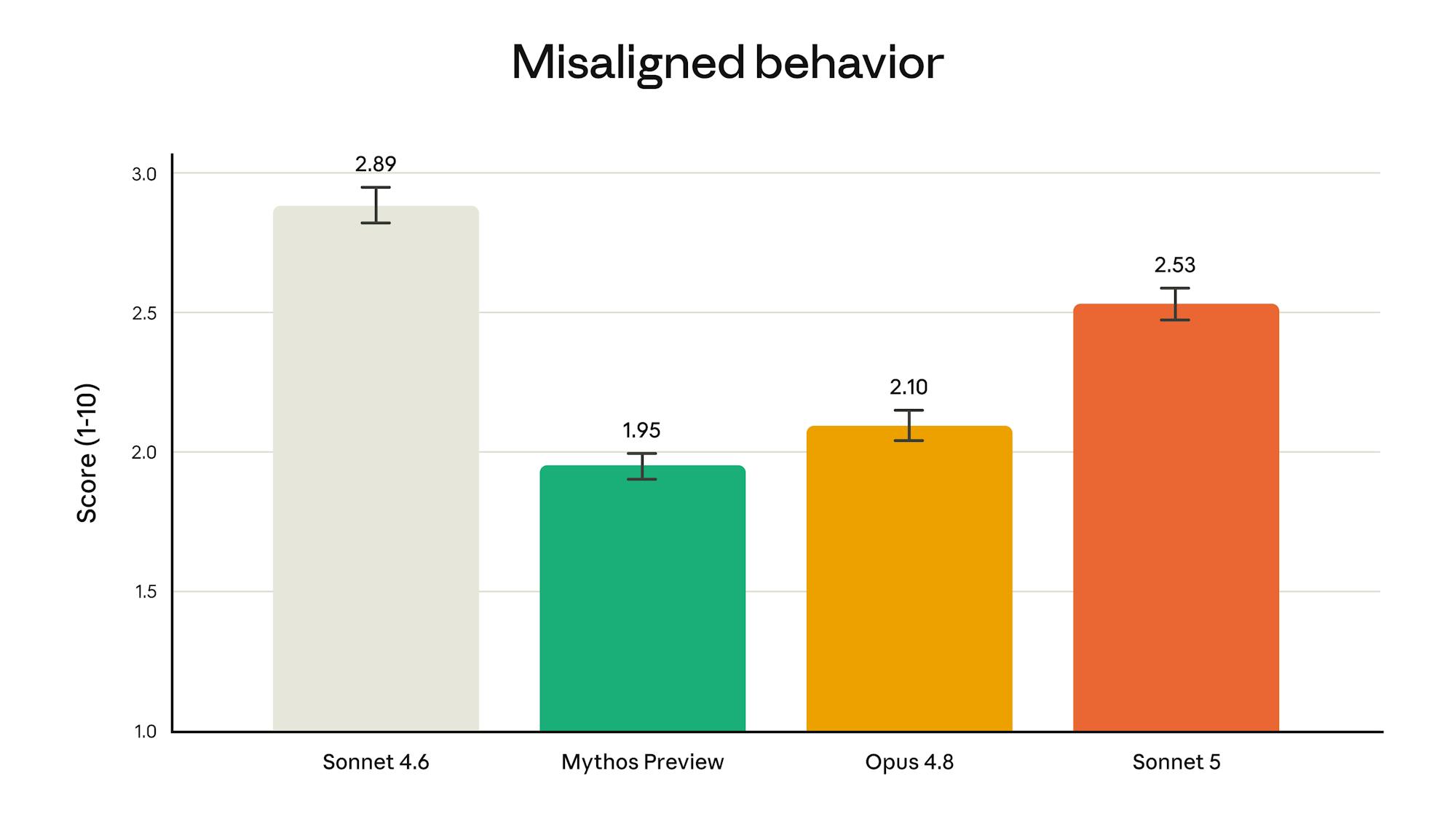
Anthropic reports lower hallucination and sycophancy rates vs Sonnet 4.6. Cyber safeguards are on by default. The misaligned behavior rate chart above shows Sonnet 5 performing meaningfully better than predecessors across multiple safety dimensions. These figures are from the June 30, 2026 announcement and were not re-verified in the August 20 or August 26 passes.
What This Means for Developers Building Agents
A more capable agent model raises the bar on everything downstream. When a model can reliably complete a 10-step task end to end, the quality, structure, and governance of the content it reads and writes become the constraint.
A lower misaligned-behavior rate is a probability, not a permission boundary. It tells you how often the agent goes wrong, not what it can reach on the runs where it does. Those are separate controls, and only one of them is yours to set.
A 1M-token context window makes this concrete. At that size you can hand an agent an entire content library in one call, which means the credential you attach to that call is doing more work than it used to.
That's where a structured content layer matters. With Cosmic, agents get:
- Typed, queryable Objects instead of raw blobs
- Draft-by-default writes as a team review convention before publish
- Separate read and write keys, so a read-only agent cannot write at all
- Full attribution tracking which agent wrote what, and when
The Cosmic MCP server is how you connect Claude Code, Cursor, or any MCP client to that content over scoped credentials. Giving an AI Agent Write Access to Your CMS walks through the four controls that are genuinely enforceable today, and is equally direct about the limits: a write key covers the whole bucket, and there is no per-object-type restriction. The Cosmic for AI teams overview covers how the pieces fit together.
Here's a minimal example of a Sonnet 5 agent reading and writing structured content:
import { createBucketClient } from '@cosmicjs/sdk';
import Anthropic from '@anthropic-ai/sdk';

const cosmic = createBucketClient({
  bucketSlug: 'your-bucket-slug',
  readKey: 'your-read-key',
  writeKey: 'your-write-key',
});

const anthropic = new Anthropic();

// Fetch structured content for the agent to act on
const { objects } = await cosmic.objects
  .find({ type: 'articles', 'metadata.status': 'needs-update' })
  .props('id,title,metadata.body,metadata.last_updated')
  .limit(5);

// Run Sonnet 5 on each article
for (const article of objects) {
  const message = await anthropic.messages.create({
    model: 'claude-sonnet-5',
    max_tokens: 1024,
    messages: [{
      role: 'user',
      content: `Update this article for accuracy and clarity:\n\n${article.metadata.body}`
    }]
  });

  // Write back as draft, human approves before publish
  await cosmic.objects.updateOne(article.id, {
    metadata: {
      body: message.content[0].text,
      last_updated: new Date().toISOString(),
      status: 'pending-review',
    },
    status: 'draft',
  });
}
The agent does the work. The content layer gives you a credential boundary you can test in about a minute: hand it the read key and watch every write tool come back refused.
Start free with Cosmic and connect the MCP server to your editor. The free plan covers 1 Bucket, 2 team members, and 1,000 Objects.
Should You Upgrade?
Yes, if:
- You run multi-step agentic workflows where reliability matters
- You want near-Opus quality at Sonnet pricing
- You need stronger coding/terminal performance than Sonnet 4.6
Watch first:
- Audit token budgets before switching. Up to 1.35x more tokens per prompt.
- Test your agent loops. More capable models can interpret prompts differently. Validate before hard-switching in production.
- Anthropic notes on its pricing page that prices and plans are subject to change at its discretion, so re-check current rates before committing to a long-term budget.
Where It Fits in the Claude Lineup
- Claude Haiku 4.5: fastest, cheapest, high-volume simple tasks, 200K context
- Claude Sonnet 5: best cost/performance for agentic and complex tasks (new default)
- Claude Opus 5: Anthropic's recommended starting point for complex agentic coding and enterprise work. See Claude Sonnet 5 vs Opus 5 for a side-by-side on cost, speed, and where each one earns its price.
- Claude Fable 5: the top of the current lineup, described by Anthropic as next-generation intelligence for long-running agents, at $10/$50 per million tokens
- Claude Opus 4.8 and Sonnet 4.6: now listed as legacy models on Anthropic's pricing page.
For a tier-level routing rule you can apply at any model version, read Claude Sonnet vs Opus: how to choose. To see which models are live in Cosmic today, read Claude Opus 5 is available in Cosmic. If you are comparing across vendors rather than across Claude tiers, see Claude vs GPT-5.2 vs Gemini 3 for real coding projects.
For most developers building content-aware agents, Sonnet 5 at $2/$10 is the obvious starting point. If you want to run either model against your own structured content, start free on Cosmic or book a walkthrough with our CEO.
Last verified: August 26, 2026. Model names, API pricing, context windows, and max output checked against Anthropic's models overview on that date. Legacy-model pricing checked against claude.com/pricing on August 20, 2026. Benchmark and safety figures are from Anthropic's June 30, 2026 announcement and were not independently re-verified.
Related Reading
- Claude Sonnet 5 vs Opus 5: A Real-World Comparison
- Claude Sonnet 4.6 vs Sonnet 4.5: A Real-World Comparison
- Claude vs GPT-5.2 vs Gemini 3 for Real Coding Projects
- Giving an AI Agent Write Access to Your CMS
- Cosmic MCP Server
Give your AI agents a content backend they can write to
Structured, versioned content objects, a REST API and TypeScript SDK, and an MCP server your coding agent connects to directly. The Free plan includes 1 Bucket, 1,000 Objects, and 1 agent. No credit card required.
Continue Learning
How We Won a Launch-Day Search Term in 48 Hours, and Why It Didn't Convert


Tony Spiro and Mia
September 29, 2026
Connect a Cosmic Agent to Google Sheets
Tony Spiro and Mia
September 25, 2026



Give your agent an inbox, then sign it up for Cosmic
Tony Spiro and Mia
September 23, 2026