Sanity vs Contentful: Which Headless CMS Should You Choose in 2026?

Tony Spiro
August 4, 2026
Sanity and Contentful get compared constantly because they solve the same problem from opposite directions. Sanity hands developers a Studio they configure in code and deploy themselves. Contentful sells a hosted content platform with governance features, an approval workflow, and an enterprise sales motion. Both keep your content in the cloud and serve it over APIs, so the interesting differences are elsewhere: who does the configuration work, how you query content, how much control editors get without filing a ticket, and what the invoice looks like in year two.
This is a working breakdown as of August 2026, with the verification method stated up front so you can check it yourself.
How this comparison was verified
- Sanity pricing was read directly from sanity.io/pricing on August 4, 2026. Plan names and per-seat pricing below come from that page.
- Contentful pricing renders its plan cards client side, so no dollar figures are quoted here. Contentful publishes a free tier, a self-serve paid tier, and a top plan that is quoted by sales. Confirm current numbers on contentful.com/pricing before you build a budget.
- Feature claims come from each vendor's own documentation.
- Cosmic pricing was read from cosmicjs.com/pricing the same day.
Where a number could not be verified, that is stated plainly instead of estimated.
Quick verdict
| Sanity | Contentful | |
|---|---|---|
| Best for | Product teams with front-end developers who want the editor itself under version control | Marketing organizations that need governance, roles, and a vendor with an enterprise contract motion |
| Editing interface | Sanity Studio, an open-source React app you configure in code and deploy | Hosted web app, configured through the UI |
| Content modeling | Schemas defined in code, reviewed in pull requests | Content types defined in the UI, with a migration CLI for repeatable changes |
| Querying | GROQ, Sanity's own query language, plus a GraphQL endpoint | REST delivery API plus a GraphQL endpoint |
| Real-time collaboration | Built into the Content Lake and Studio | Field-level locking and workflows rather than live co-editing |
| Pricing shape | Per seat, plus pay-as-you-go usage above plan limits | Tiered plans with quotas, top tier quoted by sales |
| Main adoption cost | Front-end skill required to shape the editor | UI-driven config that drifts between environments unless you script it |
Architecture: a queryable content lake vs a hosted content platform
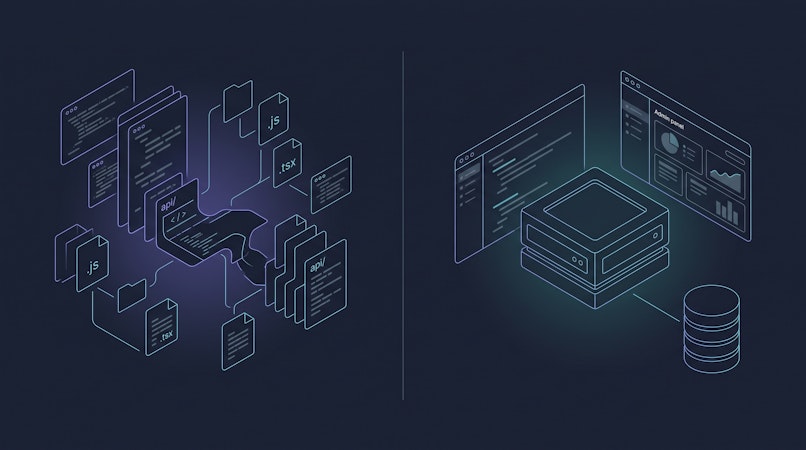
Sanity stores documents in what it calls the Content Lake, a hosted datastore you query with GROQ. The editing surface, Sanity Studio, is a separate React application that lives in your repository. You install it, define your schemas as TypeScript files, add custom input components where you need them, and deploy it either to Sanity's hosting or your own. The editor is part of your codebase, which is the single most important thing to understand about Sanity. If you want a custom preview pane, a bespoke field widget, or a dashboard that shows editors exactly what they need, you build it.
Contentful organizes work into spaces and environments. A space holds content types, entries, assets, and users. Environments give you a copy of the schema and content for staging changes. Configuration happens in the web app by default, and repeatable schema changes go through the Contentful CLI and migration scripts. The editing interface is Contentful's, extended through app framework extensions and custom fields rather than rebuilt.
The practical implication: Sanity moves editorial UX into engineering's backlog, and Contentful keeps it in the vendor's hands. Teams that have front-end capacity and strong opinions about editor experience tend to prefer the first. Teams whose developers would rather never touch the editing UI tend to prefer the second.
Content modeling and schema changes
Sanity schemas are code. A field rename is a diff, a code review, and a deploy. That gives you real history and makes environment parity straightforward, because the schema is whatever the deployed Studio says it is. Data already written under the old shape still needs a migration, and Sanity provides scripting tools for that, so plan for the same care you would give a database migration.
Contentful content types are created in the UI, which is faster for a marketer or a solo developer on day one. The cost arrives later, when staging and production drift apart and nobody can say exactly which change broke a build. The fix is to adopt the migration CLI early and treat UI edits as prototyping only. Teams that skip that discipline usually regret it around the second or third major model change.
Querying content
GROQ is genuinely powerful. You can project exactly the shape your component needs, join across references, and filter deeply in one request, which cuts down on over-fetching. It is also a language your team has to learn, and hiring for it is harder than hiring for REST. Sanity also exposes a GraphQL endpoint if you prefer that.
Contentful's delivery API is REST with query parameters, plus a GraphQL endpoint. Reference resolution through include levels is capped, so deeply nested models often require multiple requests or a restructured model. It is easy to start with and gets awkward at depth.
Both approaches work. The question is whether your team would rather learn a query language once or work around link-resolution limits repeatedly.
Editor experience
This is where the two products feel most different in daily use.
Sanity Studio is fast, and real-time collaboration means two editors can work in the same document without stepping on each other. Preview is excellent when a developer wires it up. Out of the box, before any customization, the Studio is fairly plain, and non-technical editors will ask for changes that require a developer and a deploy.
Contentful ships more editorial furniture by default: roles and permissions, scheduled publishing, workflows, and a content model that a marketing ops person can reason about. Customization is bounded. When an editor asks for a field arrangement Contentful does not support, the answer is often that the app framework can approximate it.
Localization
Sanity handles localization at the schema level. You choose the pattern, commonly locale-keyed object fields or separate documents per locale, and you own the consequences. That flexibility is useful for unusual requirements, and it means there is no single blessed path to copy.
Contentful has locales as a first-class concept in the space, with fallback chains and per-locale publishing. For a straightforward multi-market website, this is less work.
Pricing and seats
Here is the part that decides most evaluations.
Sanity, verified August 4, 2026:
- Free: $0, with public datasets, a published seat allowance, a document cap, and monthly API, CDN, asset, and bandwidth allowances.
- Growth: $15 per seat per month, adding private datasets, more roles, a higher document cap, and pay-as-you-go billing once you exceed plan allowances for API requests, CDN requests, asset storage, and bandwidth. Paid add-ons cover extra document capacity, additional datasets, and dedicated support.
- Enterprise: custom pricing, with SSO, custom roles, audit logging, and an SLA.
The per-seat rate is low, and the usage-based component is the part to model carefully. Check the current overage rates on Sanity's pricing page and multiply by your real traffic before you commit, because a high-traffic site with heavy asset delivery can add meaningful monthly variance.
Contentful publishes a free tier and a self-serve paid tier, then moves to sales-quoted pricing at the top end. Quotas on entries, locales, roles, API calls, and users are the levers that push teams up a tier. Since the figures are not readable without running their page's client-side code, get a written quote and confirm which quota you are closest to hitting.
Both vendors charge for people. That is normal in this market, and it is worth counting seats honestly during evaluation instead of at renewal.
Lock-in and exit cost
Sanity's exit cost lives in two places: GROQ queries scattered through your front end, and Portable Text, its structured rich-text format. Content exports cleanly as JSON, and rewriting queries and rich-text rendering is real work.
Contentful's exit cost is its rich-text JSON format and the entry-and-asset link structure. Its management API makes bulk export straightforward, and the same rendering rewrite applies.
Neither platform is a trap. Both are a few weeks of engineering if you decide to leave, which is a good reason to keep your content-fetching layer thin and isolated from day one.
Choosing between them
Pick Sanity if you have front-end developers with capacity, you want the editing experience under version control, real-time collaboration matters, and you are comfortable modeling variable usage costs.
Pick Contentful if governance, roles, scheduled publishing, and locale handling need to work on day one without engineering time, and your organization needs a vendor that fits an enterprise procurement process.
Pick neither if what you actually want is a hosted editor that non-technical people can use without customization, a plain REST API, transparent published pricing, and AI that does real work inside the CMS. That is the gap Cosmic was built for.
Where Cosmic fits
Cosmic is an AI-powered headless CMS (YC W19) that keeps the hosted, ready-to-use editing experience Contentful is chosen for, without requiring a front-end project just to shape the admin UI, and with pricing published on the page rather than quoted on a call.
Published pricing, verified today:
| Plan | Price | Buckets | Team members | Objects |
|---|---|---|---|---|
| Free | $0/mo | 1 | 2 | 1,000 |
| Builder | $99/mo | 2 | 3 | 5,000 |
| Team | $299/mo | 3 | 5 | 20,000 |
| Business | $499/mo | 5 | 10 | 50,000 |
| Enterprise | Custom | Custom | Custom | Custom |
Additional users are $29 per user per month. Current details are always on cosmicjs.com/pricing.
The developer surface is a REST API and a TypeScript SDK. No new query language to learn:
import { createBucketClient } from '@cosmicjs/sdk';

const cosmic = createBucketClient({
  bucketSlug: process.env.COSMIC_BUCKET_SLUG!,
  readKey: process.env.COSMIC_READ_KEY!,
});

// Fetch published blog posts with the fields you need
const { objects: posts } = await cosmic.objects
  .find({ type: 'blog-posts' })
  .props(['id', 'title', 'slug', 'metadata.teaser', 'thumbnail'])
  .depth(1)
  .limit(10);
That runs the same way in Next.js, Astro, Nuxt, SvelteKit, or a plain Node script.
Editors do not wait on developers. This is the outcome that matters most to the marketing side of an evaluation, and one of our customers put it better than we could:
"Cosmic is: us never having to ask a developer to change anything on the backend of our website."
Maximilian Wuhr, Co-Founder at FINN
Teams including FINN, Parque Explora, Vuetify, Tripwire Interactive, and Prairie Robotics build on Cosmic today.
AI agents do production work. Cosmic ships agents that generate, edit, and maintain content inside the CMS, along with AI image and video generation and web analytics through Cosmic Insights. We wrote up how that compares to what Sanity and Contentful currently offer in Cosmic vs Sanity: Which Headless CMS Actually Has AI Agents?
FAQ
Is Sanity cheaper than Contentful?
Sanity publishes a $15 per seat per month Growth plan. Contentful does not render its figures server side, so this comparison does not quote them, and a like-for-like answer needs a current quote from Contentful for the tier your quotas land you in. Sanity's usage-based overages can also narrow any seat-price gap on high-traffic sites, so compare total cost using your own request and bandwidth numbers rather than headline seat prices.
Do I need a developer to change the Sanity editing interface?
Yes. Sanity Studio is a React application in your repository, so field arrangements, custom inputs, and preview panes are code changes that ship through your normal deploy process.
Does Contentful support GraphQL?
Yes, Contentful exposes a GraphQL endpoint alongside its REST delivery API, and Sanity offers GraphQL in addition to GROQ. For clarity: Cosmic does not offer GraphQL. Cosmic provides a REST API and a TypeScript SDK, which covers the same use cases with less setup for most teams.
Can I move off either platform later?
Yes. Both provide full content export through their management APIs. The expensive part is rewriting queries and rich-text rendering, so keep your data-fetching layer isolated to make that cheaper.
Which one has better real-time collaboration?
Sanity. Live multiplayer editing is built into the Content Lake and Studio. Contentful approaches the same problem with workflows, field locking, and scheduled publishing instead.
Further reading
- Strapi vs Contentful: Which Headless CMS Should You Choose in 2026?
- Headless CMS Comparison 2026: Cosmic vs Contentful vs Strapi vs Sanity vs Prismic vs Hygraph
- Migrate from Sanity to Cosmic: A Complete Developer Guide
- Migrate from Contentful to Cosmic: A Complete Developer Guide
- Best Contentful Alternatives in 2026
Try the third option
If you are evaluating Sanity and Contentful, spend twenty minutes with Cosmic before you sign anything. The Free plan never asks for a credit card, and you can model your content and ship a working front end the same afternoon.
Start building on Cosmic for free or book 20 minutes with our CEO to talk through your migration.