Self-Hosted CMS vs Managed: The Real Ops Cost in 2026

Tony Spiro
June 29, 2026
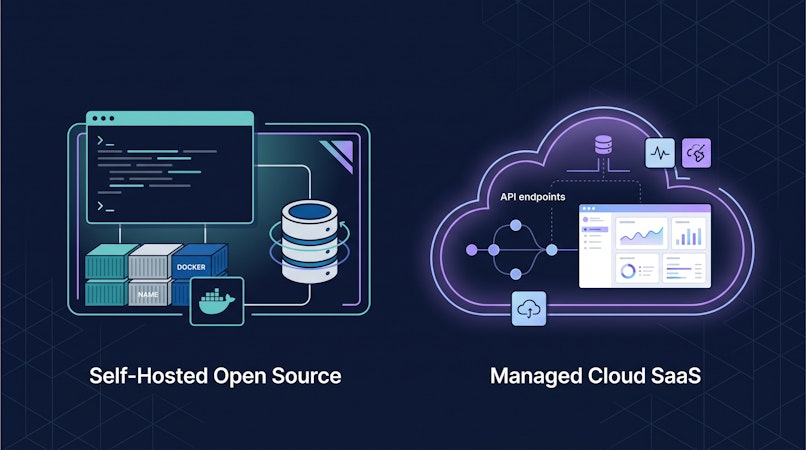
Twelve to eighteen months ago, self-hosting your CMS looked like the smart call. Full control, no vendor lock-in, deploy it your way. If you picked Strapi or another self-hosted option back then, you've had enough time to discover what that control actually costs to maintain.
This post walks through the real ops overhead of running a self-hosted CMS in 2026 and what teams are moving to when they decide the math no longer works.
Want to build AI-powered content workflows? Cosmic gives your agents a structured, versioned content store with a REST API, TypeScript SDK, and built-in analytics. See what your agents produce and whether it worked. Start for free, no credit card required. Or take the tour first: Cosmic for AI teams.
The Promises vs. The Reality
Self-hosted CMS platforms promise flexibility and ownership. Those promises are real. What the pitch decks leave out is everything that comes with them: patching cadence, hosting infrastructure, plugin supply chain risk, and the engineering time you spend keeping the system running instead of shipping product.
Let's put numbers to it.
The Hidden Cost Stack
1. Security Patching
Strapi releases security patches on a rolling basis. Each one requires you to read the CVE, assess impact, test the patch in staging, coordinate a deployment window, and verify nothing broke in production. For a team with a dedicated DevOps engineer, this might be a few hours per patch. For a small team where a developer owns the CMS infrastructure, it's frequently an entire day.
In 2025, major self-hosted CMS platforms averaged roughly one critical-to-high severity patch every 6-8 weeks. Miss one, and you're running a publicly exploitable system.
2. Plugin and Ecosystem Supply Chain Risk
Strapi's plugin ecosystem is community-maintained. That's a feature until a plugin you depend on gets abandoned, introduces a breaking change in a minor release, or becomes a vector for a supply chain attack. You own the dependency graph. When something breaks in a plugin you didn't write and don't control, debugging falls on you. (Two NPM supply-chain compromise stories hit Hacker News this week alone, a reminder that community-maintained ecosystems carry real exposure.)
3. Hosting and Infrastructure Overhead
You need a server (or container cluster), a database, a CDN configuration, backups, monitoring, and alerting. On AWS or GCP, a reasonably configured Strapi setup costs $80-$250/month in compute alone, depending on traffic and redundancy requirements. Add managed database costs, backup storage, and egress, and you're looking at $200-$400/month before developer time.
None of that includes the hours spent configuring and maintaining it.
4. No Uptime SLA
When your self-hosted CMS goes down, there's no support line to call and no SLA to hold anyone to. The incident is yours. At 2 AM on a Friday before a major campaign launch, that matters.
5. The Compounding Ops Tax
The real cost is the accumulation: patching time, infrastructure maintenance, unplanned downtime investigations, plugin debugging, database tuning, and security reviews. For most teams, this adds up to 15-30 hours per month of engineering time spent on infrastructure that delivers zero user-facing value.
At a blended engineering rate of $100-$150/hour, that's $1,500-$4,500/month in hidden labor cost, on top of hosting fees.
What Managed Looks Like
With a managed headless CMS like Cosmic, the ops stack disappears. Here's what you get:
- 99.9% uptime SLA backed by contract
- 50M+ API requests/month handled at the infrastructure layer
- 150+ country CDN with sub-100ms API response times globally
- 256-bit SSL provisioned and renewed automatically
- Zero patch management on your end
- Zero hosting configuration
- Zero database maintenance
Your engineering team's CMS-related work drops to: model your content, fetch it via the REST API or TypeScript SDK, ship your product.
import { createBucketClient } from '@cosmicjs/sdk';

const cosmic = createBucketClient({
  bucketSlug: 'your-bucket-slug',
  readKey: 'your-read-key',
});

// Infrastructure handled. Fetch your content.
const { objects } = await cosmic.objects
  .find({ type: 'articles' })
  .props('title,slug,metadata')
  .depth(1);
The Real-World Signal
Maximilian Wuhr, Co-Founder at FINN, put it plainly:
"Cosmic is: us never having to ask a developer to change anything on the backend of our website."
That's the outcome teams are buying when they move to a managed CMS: their developers work on product, not infrastructure.
The Migration Question
If you're already on Strapi or another self-hosted platform and the ops burden has become a recurring topic in sprint planning, the migration path to Cosmic is straightforward. Cosmic's REST API and TypeScript SDK mean your existing frontend code changes minimally. You model your content types in Cosmic's dashboard, migrate your data, update your environment variables, and you're done.
You keep the headless architecture. The ops overhead goes away.
For a detailed walkthrough, see: Migrate from Strapi to Cosmic: A Complete Developer Guide.
Pricing That Makes the Math Clear
Cosmic's plans are straightforward:
- Free: $0/month, 1,000 Objects, 2 team members
- Builder: $99/month, 5,000 Objects, 3 team members
- Team: $299/month, 20,000 Objects, 5 team members
- Business: $499/month, 50,000 Objects, 10 team members
- Enterprise: Custom pricing
- Additional users: $29/user/month
Compare that against $200-$400/month in hosting costs plus $1,500-$4,500/month in engineering labor for a self-hosted setup. For most teams, the managed option costs less in total even before accounting for the time saved.
For a deeper breakdown, see: Cosmic vs Strapi: Headless CMS Comparison and Headless CMS Comparison 2026.
Who Should Still Self-Host
Some teams have legitimate reasons to self-host. If your data residency requirements mandate on-premises infrastructure, if you have a dedicated platform team with the capacity to absorb ops work, or if your compliance environment prohibits SaaS vendors, self-hosted may be the right call.
For everyone else, the honest accounting of self-hosting costs makes managed the rational choice in 2026.
MCP and Agent Workloads
One consideration that didn't exist two years ago: if your team is building AI agents that read or write content, a managed CMS with a built-in MCP server and governed API access removes another class of infrastructure you'd otherwise need to build and secure yourself. For more on this, see: Cosmic MCP Server vs Strapi MCP: Why Cloud-Native Wins.
Give your AI agents a content backend they can write to
Structured, versioned content objects, a REST API and TypeScript SDK, and an MCP server your coding agent connects to directly. The Free plan includes 1 Bucket, 1,000 Objects, and 1 agent. No credit card required.